Offering a few glimpses into the abyss, Steely Dan’s Aja (1977) captured the late-70s mood swing between disillusion and dissolution by giving listeners an immersive experience in the blues, topped off with the latest innovations in sardonic pop songcraft. Steely Dan (namely the songwriting duo of Donald Fagen and Walter Becker) followed the massive success of Aja with Gaucho (1980). On this record, Fagen and Becker’s view of oblivion opens further, and their detachment from what they’re observing diminishes.
This perspective is already established on “Babylon Sisters,” Gaucho’s opener. In retrospect, the song can be regarded as the start of Fagen and Becker’s farewell, since Gaucho would be the last album that Steely Dan would release for two decades. Yet it perfects a formula that they had long worked on: chronicling the exploits of male losers so deluded that it becomes nearly impossible (or does it?) to identify with them. Thus Fagen and Becker comically turn a classic songwriting technique against listeners.
It’s not that the narrator views his journey to hook up with the two “sisters” (who/what they are is left to the listener’s imagination) as anything ecstatic; he fantasizes that, if he could pull off such a scandalous feat, he would rise in his peers’ esteem:
My friends say, ‘No, don’t go for that cotton candy
Son, you’re playing with fire’
The kid will live and learn, as he watches his bridges burn,
from the point of no return
Distant reggae guitar chords tick away, counting the miles left to go. Alex Pappademus, co-creator of the engaging study of the Dan, Quantum Criminals (2023), observes that “maybe it’s ‘Babylon’ in the Rasta sense, the ‘Rivers of Babylon’ sense.” At any rate, the narrator’s falling, but no one—not him, certainly—knows how far. The song’s serpentine hook is guided by Fagen and Becker’s obsessive desire, on Gaucho, to have the smoothness of the studio production contrast as sharply as possible with the wrecked, Los-Angeles states of minds of their characters.
[“Babylon Sisters”]’s serpentine hook is guided by Fagen and Becker’s obsessive desire, on Gaucho, to have the smoothness of the studio production contrast as sharply as possible with the wrecked, Los-Angeles states of minds of their characters.
The parade of losers continues in the smash-hit, “Hey Nineteen.” Fagen and Becker don’t have to spell out this guy’s problem; as Pappademas puts it, “He’s just that guy who stayed at the party too long.” When the chorus shifts into a minor tonality, a chill enters into the room. The women with whom maybe he could’ve made it are long gone, and nothing, listed during the bridge, not any “Cuervo gold,” not any “fine Columbian,” can bring back what now he imagines that he had.
In “Glamour Profession,” the viewpoint of a drug dealer, who uses his connections to curry favor with his LA social betters, becomes the irony inherent in the song’s title. My favorite moment, which I find screamingly funny, is:
On the town
We dress for action
Celluloid bikers is Friday’s theme
I drove the Chrysler, watched from the darkness while they danced
The ending solo, by Steve Khan, accentuates blues-sounding notes, up and down his guitar neck, telegraphing the dealer’s inevitable comedown.
Opening the second side, the title track, “Gaucho,” scripts what could be called (though not stated in the lyrics) a “tacky scene.” The details of an unplanned threesome going off the rails are easy to grasp; what puts it over the top is Fagen’s singing, “What do you think I’m yelling for?” like a drowsy Bob Dylan. During the bridge, Becker breaks in with a guitar solo of ruthless precision, every note a direct hit. The musical mainline of “Gaucho,” however, is a ticking time bomb, stolen from a composition by Keith Jarrett. Jarrett successfully sued for a co-write credit on “Gaucho.”
And Becker doesn’t play that much, overall; as Pappademus points out, he’s on three of the seven songs on the record. His absence is, to a large part, due to his heroin addiction, referenced in the next track, “Time Out of Mind.”
Now, if you were a Rolling Stones fan, artistic thievery and drugs would seem like business as usual, as you delved into Mick and the lads’ underwhelming Emotional Rescue (1980). Conversely, Gaucho shows that Fagen and Becker, despite their ordeals, were ever ascendent, surpassing bands that were aging out of their league. “Time Out of Mind” transforms the early-70s mythic decadence of the Stones’ Exile on Main Street (1972) into a narcotic Tupperware party. Here, the narrator, turning his suburban marks on to smoking heroin (the drug slang of “chase the dragon”), speaks with religious fervor, “The water may change to cherry wine.”
Then, wherever it was sequenced on Gaucho, ”The Second Arrangement” would have gone a long way towards completing the album, already close to thirty minutes of flawless songs. Portraying an unfaithful man’s private hell, “The Second Arrangement” depicted his ping-ponging between two relationships.
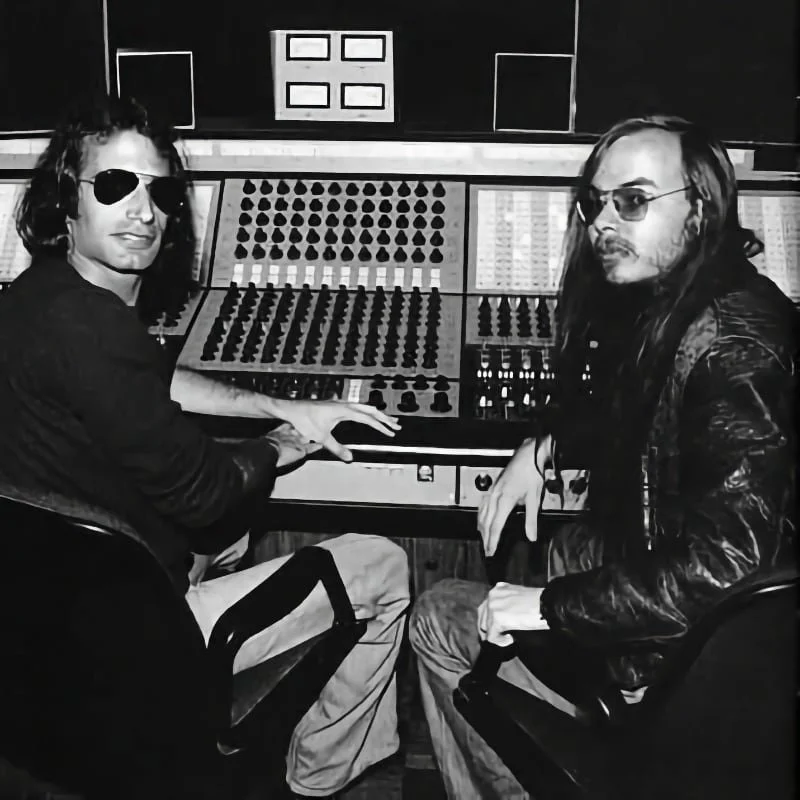
Yet, although Gaucho ushered in our current digital era by using a homemade sampling device (called WENDEL), then, as now, a crucial part of a song can be accidentally erased—which, unfortunately, happened to “The Second Arrangement.” Fagen and Becker ended up spending a lot of money (“reportedly tens of thousands of dollars,” as Pappademus says) to salvage it, to no avail.
Thus, on the final version of Gaucho, two more songs remain. The first, “My Rival,” is a carnivalesque blues song, with weird ripples of organ/synthesizer. A guy’s been cuckolded, and he threatens, “Sure he’s a jolly roger/Until he answers for his crime.” Khan’s abrasive, string-bending guitar solos strike through the mask of this guy’s rage, coloring the search for his “rival” with existential despair.
For the closer, Fagen and Becker resorted to going back to the past, taking a demo from an earlier recording session (most likely for Aja). In demo form, “Were You Blind That Day” is a protest song, which they rarely wrote. Yet, thematically, the song implies that there’s a time when people can see the world around them, which none of the characters, on Gaucho, can ever, really, do.
Retitled “Third World Man,” the song changes into a surreal depiction of a man who’s melting down in the suburbs, waging his own war, blowing up shit. The larger implications of this apocalypse emerge through the sound bites of an American political speech: “When the sidewalks are safe/For the little guy.”
“Third World Man” ends Gaucho on a discordant note, appropriate for such a fascinating, yet uncomfortable album. And, out of its many intrinsic contradictions, the one that I think about the most is that this record, so focused on eviscerating LA culture, was made in NYC.
Okay, everybody, time for some Gaucho-related trivia:
What jazz standard, recorded originally by Count Basie’s Kansas City Seven in 1939, is being alluded to during the description of the guitar solo in the song, “Gaucho”?
What quote from a famous literary seafaring captain is being alluded to during the description of the guitar solos in the song, “My Rival”?
What composition by Keith Jarrett was stolen for the song, “Gaucho”?