I have a couple other ideas for columns, including seasonal wrap-ups and reviews of a couple of shows, but I needed something brief this week. I’m sure you all enjoyed Dave Shutton‘s, oh, let’s say particular take on the best TV of the 21st century1 and the New York Times list (now with bonus reader list!). For a critique that doesn’t more or less reject the entire premise of the list, I have a few points to address.
Methodology is the first one. The NYT put out a ranked list of 100, but their methodology was to poll people for their top 10 shows, unranked. This Rotten Tomatoes way of doing things will get you a list of what shows appeal to the most people, but it might not get you a list of the best the way a ranked poll would. Even the world of college football understands that the best way to build a consensus top 25 each week is to poll people for their top 25 teams in ranked order, not, say, the five teams they really like the most.
“Show that cracks the most people’s top ten” might not be the best show, even if you asked the voters— a ranked list could produce entirely different outcomes, if enough people love a show that just falls outside the top ten for many others (but would still be on a longer ballot). To take this to the extreme, what’s a better show: One 50% of the voters rate #1 and 50% rate #11, or one 100% of the voters rate #10? (Or if you really want to get silly, one that 51% of the voters rate #10 and 49% of the voters don’t rate at all.) The latter gets a higher place on the NYT list, but it’s hard to argue the general opinion isn’t that the first show is more broadly regarded as better2.
Another weird thing in the methodology was splitting seasons of anthologies as individual shows. It feels like this was done mostly to get True Detective season 1 on the list. Beef season 1 also makes it, and while I haven’t seen it and hear it is very good, I wonder if that is a case of…
Recency bias: There are a handful of shows that have maintained universal critical acclaim and popularity among people in the industry: Breaking Bad / Mad Men / The Wire in drama; 30 Rock / Arrested Development / Veep in comedy; Fleabag3 for some reason4. Once you get beyond those mainstays, though, it seems like being fresh in viewer’s minds means as much as anything. The White Lotus ranked #21 on the list, which has to be a case of recency bias.5 And if not, then it’s a case of another troubling trend in what’s valued by tastemakers:
Style over substance. That is to say, The White Lotus an obviously expensive show where you get to watch a luxurious lifestyle and fantasize about living it while feeling superior to the characters in it, that attracts big-time actors because they basically get a paid vacation at a luxury resort for four months and get to do some showy monologues that might win Emmys, but… beyond that, there’s no there there. It’s an expensive show where you can see every dollar on screen, but that’s about all it is. It has all the gloss that signifies Prestige TV without the substance that truly made the best shows great. (The latest season in particular received lots of criticism for bad and inconsistent writing.)
Or, to put it another way, how the fuck did this rank higher than Deadwood (#24)?
(I mean, putting The Shield and It’s Always Sunny in Philadelphia in the 70s are even more egregious examples of “prestige aesthetic > quality,” but I’ve stopped expecting those shows to be properly respected. Actually, I did think Sunny would be higher. And The Shield ranked #141 on the reader list, so maybe TV critics and and industry pros are still, at least, more intelligent than the general public6.)
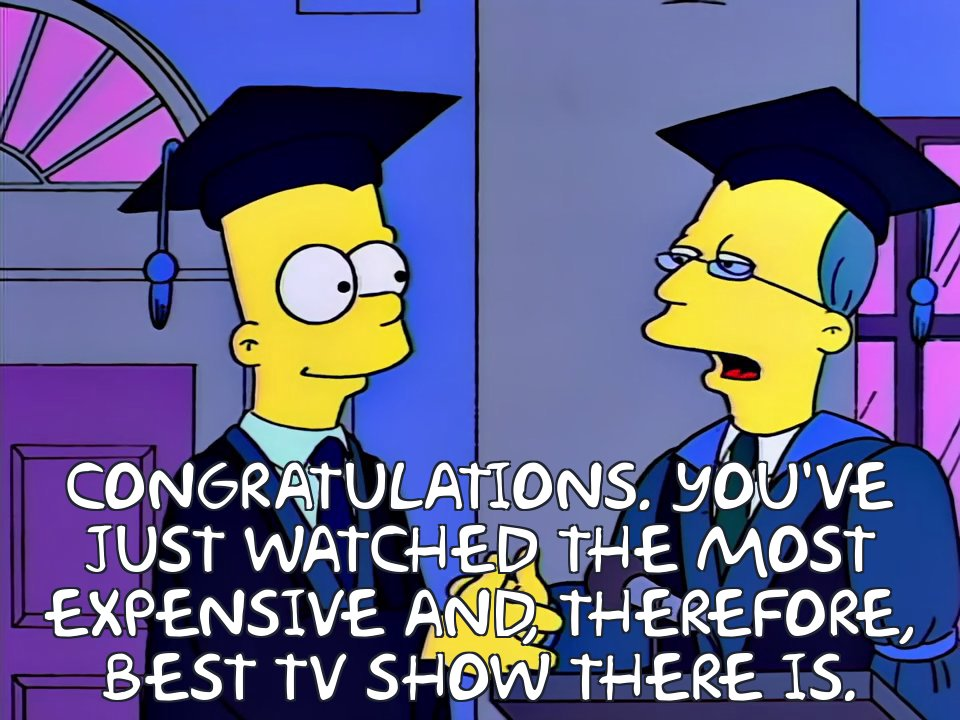
Anyway, the lesson from this, as always, is that consensus lists about art are often silly. Personalized lists from a critic you vibe with are much better. And that critic probably should be me.
Other stuff
I decided to give the first episode of Funboys a shot because I’d heard good things about season two (and each season is only four episodes). It’s a show about three young lads in Northern Ireland and their friendship. The first episode started out in a way that rubbed me the wrong way; the friends were too immature, dysfunctional, and codependent to be fun. But it got better over the second half of the episode, with some legit funny jokes and payoffs of earlier setups. That said, I do have to say that it suffers by comparison for me having seen Adults so recently, because Adults is a laugh riot, and Funboys is probably a fine show.
What’s new and upcoming
Nobody told me that Animal Control and Grimsburg both returned to air September 27. I still enjoy Grimsburg quite a bit. I want to like Animal Control more than I do, because I quite like the cast, but it’s really suffering from how it’s calibrated its antagonists. Gerry Dee is funny, but Templeton has been written as not only weird, obnoxious, and crude, but an actual workplace creep and a plagiarist, who keeps getting away with it somehow instead of getting fired, and who every time we get a moment or story that suggests there’s more to him, turns out to be him faking it, and who never gets his comeuppance for any of this. And the writers’ solution this season was… reintroduce Ken Jeong’s Roman as an even more obnoxious antagonist that Frank and Templeton will have to team up to take down. (At least neither Roman nor Templeton were in the second episode, which was pretty funny.)
Abbott Elementary returned last night. I probably won’t have watched it by the time this column publishes. And even if I do, I’m probably not gonna edit this to insert a writeup of one episode specifically.
Elsbeth returns for season four tonight. As Matlock is being held over until the spring, Cupertino will be its CBS fall partner. That’s another show created by Robert and Michelle King, best known for The Good Wife and its spinoffs, though Cupertino is not one of them. The early reviews have been pretty positive for a CBS procedural, and it’s apparently about law talking people and how much big tech sucks, so those seem like pretty good reasons to give it a shot.
Next Wednesday brings back The Lowdown with season two! Season 1 was one of the best shows on TV last year. I’ve deliberately avoided more details information about what season 2 will be like, since I know I’m going to watch it anyway. So I can’t tell you more than that.
Future columns
I intend to have a writeup about The Paper season 2 at one point and another about Ted Lasso season 4, which just finished this week. I’ll pad them enough to sustain a full column if I have to. I’m not sure what else I’ll have up after that. Hopefully those buy me enough time to have new ideas by the time I’m next up.
What did we watch?
- I’ll give him the 2004 ALCS, though. Absolute cinema. ↩︎
- Related, Metacritic > Rotten Tomatoes. ↩︎
- I think it’s a good show, but I do not think it is the fifth-best show of the last twenty-seven years. (I didn’t even think it was the fifth-best TV show of 2019.) Breaking the fourth wall isn’t that novel or amazing by now (or even by seven years ago), is it? ↩︎
- The real show whose placement I don’t get at all is Girls (#13), but I’ve made my points on that so many times before and I’m tired of talking about it. ↩︎
- Not recency bias: the placements of Andor and Shōgun. They really are that good. ↩︎
- Or at least the segment of the general public that votes in New York Times lists. Ted Lasso was the #10 show on the reader list and Parks and Recreation was #11. Enough said. By the way, here’s my ballot. ↩︎
What did we watch?
M*A*S*H, Season Four, Episode Twenty-Five, “The Interview”
“I brought a book over.”
“Which book?”
“The dictionary. I figure it’s got all the other books in it, I like to read the dictionary.”
“Doesn’t patriotism have to come from the heart?”
“I don’t have that problem.”
“What do I do when I’m bored? I do the same thing I do when I’m not bored, only I do it slower.”
“Can you say latrine on television?”
“Let’s find out.”
This is the one where the crew are interviewed by a TV journalist – definitely the Vietnam influence coming in, even if it’s realistic to that specific time. We get to see the characters ‘performing’ for people; no surprise that Hawkeye is the most willing to air outrage, or that Radar is shy and enthusiastic. Potter is the most fun, I think; he’s allowed to be thoughtful and composed, and gets asked interesting questions the characters wouldn’t normally pitch to him.
“When the doctors cut into a patient, and it’s cold, you know, like it is today… steam rises from the body. And the doctor will… will warm himself over the open wound. Could anyone look on that and not feel changed?”
This is my all-time favourite M*A*S*H line. Obviously I think about it when it comes to things like, you know, starving Palestinian kids, but it’s also a thing I think about a really good piece of art or a movie.
This is such a great one, and yeah, the imagery and the dramatic punch of that last quoted line–including outside of the scene, as you point out–are phenomenal. And the halting delivery is so starkly beautiful.
This is a great episode that does not feel like the tone of the show drastically needed to be altered. It is hurt, however, by Loretta Swit being unavailable for a lot of the season (she was “Same Time Next Year” on Broadway). Would have been great to have had Margaret here.
Immaculate – solidly grisly nun-horror, and a punchy 80 minutes long! I thought that was a lost art. Some good creepy images here and it knows how to make the viewer wince with some well-deployed nastiness. I liked how the convent-friendly soundtrack occasionally blasts into the Italian horror sphere too. Not an exceptional film perhaps, but I thought it a good job as a short, sharp shock.
I sincerely didn’t think Sidney Sweeney had that final scene in her, but she did, and my jaw was dropped pretty much the whole scene.
This was actually my first exposure to her in a leading role, so I’m a little off the culture there. She definitely gave a very committed scream-queen-type performance!
Elementary, “The Art of Sleights and Deception”/”Fly Into a Rage, Make a Bad Landing” – Essentially a two parter as events in the first – though not the mystery – continue to the second. The events involve Marcus’s girlfriend’s ex-husband, who has resumed harassing her. Bell seems to think he’s dealt with the problem only for the girffriend to be badly beaten up. It looks like the ex is to blame, but when he is found dead from a seeming suicide, it turns out the beating was part of a plan that had nothing at all to do with the ex being bad to Marcus and girlfriend. The mystery is okay, but we have both a stunning coincidence and a woman beaten within an inch of her life both to frame a man and to cause Marcus manpain. It’s a wonder she wasn’t just murdered. The mystery in the first involves a magician killed because he’s discovered the heretofore anonymous author of a famous book about card tricks was actually a Mengele type. This was a bit of fun mainly because we learn how much of a magic fan Sherlock is. (Maybe a small tip of the hat to the unlikely and sometimes contentious friendship between Conan Doyle and Houdini.) The latter guest stars Danny Burstein as the killer, and while Broadway fans would say “the famous actor is of course the murderer,” I suspect most people are not aware of Burstein’s multiple awards and nominations for his stage work.
Always Sunny, “Frank’s Little League” – Extremely funny with the Gang all adopting various warped versions of baseball tics they’ve cobbled together from media and culture, including Frank’s “the spoils”, Dennis having to get in on the announcer action, and Charlie’s seed voice getting so hoarse he needs subtitles. Only natural that the Gang gets a violent lunatic as their second “special needs kid.”
Hacks, S4E9 – Nearly Sorkinesque for good or bad except Sorkin wouldn’t have the chutzpah for the scene where Bob Lipka, much as he’s an asshole, is more disappointed and irritated than defeated, and outlines why Deborah has utterly fucked herself.* There’s dramatic power too in Deborah having changed enough to do the right thing by Ava and not make the selfish choice, and Jimmy remaining loyal but going “gorilla mode.”
*Hacks continues to feature rich jerks ala Succession while refusing to make them purely self-interested or JUST awful. Bob is not stupid, and he has real, and from a capitalist perspective perfectly legitimate (if shitty), reasons to cover for a sex pest.
I missed that there was a reader list. I like that it’s basically the same, except for they added Big Bang Theory.
It’s probably for the best that I didn’t submit a ballot (I have only seen three television shows) but much as I did thoroughly enjoy Fleabag when I belatedly got around to it, the UK comedy stuff I’d have high up my list would be Detectorists, Darkplace and Look Around You. Plus Joe Pera Talks With You and Flight of the Conchords for a little US / NZ representation. I guess I’d have to include The Wire, Twin Peaks and Deadwood as the three critical favourite dramas I’ve actually really enjoyed, and Over The Garden Wall would also make my list because I have watched it so many times and now that the weather is turning colder I may have to do so again. I genuinely can’t think of a 10th without some major disclaimers, so many shows I’ve loved have lost their way or outstayed their welcome.
I really need to watch Detectorists. From what I’ve heard, it feels like I would like it.
It’s the perfect blend of comedy and melancholy for me. I’m still not sure how I feel about the final one-off episode they did a few years later but the rest of it is perfect.
Obviously I am a big Beef season 1 defender, so I would be in favor of that staying. Have never seen any White Lotus, though I’m tempted to at some point at least watch the season with Walton Goggins and Carrie Coon because, hey, two of my favorite people, but it’s true that I don’t anticipate enjoying it much beyond just watching very talented actors give very good performances.
Strongly agree that individual lists are always more interesting than these consensus picks (and great as ways to explore someone’s tastes and figure out if they’re a good source of recommendations for you). I like a bit of canon formation, but things like Sight & Sound feel like they do better and more interesting work on this front in the movie world than the NYT did here.
And the literary world at least has more practice doing it and has spent more time thinking about it, so it’s maybe a bit better at avoiding some of the most obvious pitfalls by now. I thought the recent Guardian list was reasonable, even if you still have to think about it as not expressing universal truths–or necessary congruence with one’s own tastes–but just some assembled picks by some particular people. Like, the book lists will always tend towards literary realism, but I know that going in, so they’re a good way to get recommendations for that.
If nothing else, that Guardian list has given me a fun challenge (that I will probably never fully complete).
Year of the Month updates:
Here’s all the movies, albums, books from 1998 you can sign up for this October!
Oct. 9th: Gillian Nelson: Mighty Joe Young
Oct. 13th: John Bruni: High Art
Oct. 18th: Tristan J. Nankervis: Who Moved My Cheese?
Oct. 30th: Gillian Nelson: Halloweentown
And coming in November, get ready to write about anything from 1968! Here’s some lists of movies, albums, books, and TV to get you started.
Nov. 8th: Tristan Nankervis: Night of the Living Dead
Nov. 22nd: Tristan Nankervis: Slouching Towards Bethlehem