In the closing scene of The Man Who Fell to Earth (1976), an ageless alien (David Bowie), seated outside at a restaurant, gets wasted. Viewers are in a similar state of wooziness, having been subjected to over two hours of time-challenging film edits that merge spaces and places. The passing of time feels liquid; it spills over/into multiple impressions of past, present, and future like the water the alien had intended to bring back to his destroyed planet. Alcohol has, however, replaced water in the alien’s life, lubricating his descent.
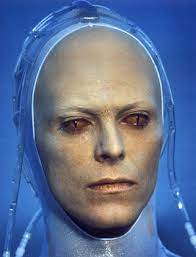
Something, obviously, has gone wrong. In their adaptation of Walter Tevis’s 1963 novel of the same name, director Nicolas Roeg and screenwriter Paul Mayersberg insert scenes on the alien’s home planet, and these scenes of his left-behind family in a post-apocalyptic nuclear devastation of a landscape are more distracting than informative. The reason for the alien’s fall, rather, is to be found on Earth—specifically, as the film proposes, in the United States.
While it is tempting to focus on the outer/otherworldly elements of the plot, we should keep in mind what director Roeg said, that “the plot is a shell,” which shifts our attention to the fundamental strangeness of the American experience, seen from an outside(r’s) perspective. The alien arrives in New Mexico, and strikes it immensely rich, thanks to the futuristic technology that he brings with him. To some degree, The Man Who Fell to Earth is a quasi-immigrant story with the alien masquerading as an “alien” with a British passport, bearing the name of Thomas Jerome Newton. Played by Bowie, in the throes of a cocaine-induced psychosis, Newton partly resembles “the Thin White Duke,” whom Bowie sang about on the title track of his album Station to Station (1976), released in the same year as the film. Bowie inhabits, by his warped projection, the role of Newton. In the film, the space vessel transforms into a black limo cruising through the Southwestern desert region, offering, to a British citizen, like Bowie, a boundless landscape in which to get lost.
Newton absorbs the sights and sounds around him, mostly conveyed through a wall of TV sets that he constantly watches with a detached fascination. But he can’t get these images out of his mind. Throughout the film, Newton is overly sensitive to his environment; cars and elevators nauseate him. Bowie, who admits that he “was stoned out of his mind from beginning to end” of the film shoot, does a persuasive job of depicting Newton’s adverse reaction to American cultural overload.
As a musical artist, Bowie dominated the 1970s, absorbing every trend that was happening, or about to happen. Thus, it made sense for Bowie, despite his wrecked state, to make the film’s soundtrack. The spacey, predominantly instrumental, pieces that he submitted, however, were rejected.
In an early scene in a Japanese restaurant, Bowie, an aficionado of Japanese culture, is out of/in character while alarmed by a kabuki performance—Newton perceives the staged violence as real. The film crosscuts between Bowie/Newton at the restaurant and Dr. Nathan Bryce (Rip Torn), a chemistry professor, in a rough-and-rowdy sexual bout with a young woman student. As Bryce, Torn serves as Bowie’s American double. Not only did Torn play a self-destructive country singer in the highly underrated Payday (1973), he, like Bowie’s character, is far from home, separated from his wife. Disillusioned, Bryce quits his job and travels to New Mexico to work for Newton.
Also working for Newton is Oliver Farnsworth (Buck Henry), a patent lawyer in New York City; the editing bridges geographical distance. Farnsworth, mirroring Newton’s naivete, thinks he can benefit from Newton’s largesse, without having to face any serious consequences for helping Newton to move around massive sums of money. In a similarly codependent relationship with Newton, Mary-Lou (Candy Clark) introduces him to drinking, to predictably deleterious effect, topped off with religion.
Bowie’s theatricality, honed as a rock star on stage performing various personas, like his best-known alien alter ego, Ziggy Stardust, amps up the surrealism of many of the scenes with Mary-Lou. Watching Newton and her attend a church service, Bowie doing his best to sing a hymn amateurishly, is a gas. More unsettling is the wild gun/sex play when she drops by his terrarium-like prison (Bryce has a key role in setting Newton up; scientists proceed to conduct painful experiments on him).
After Falling, Low
As a musical artist, Bowie dominated the 1970s, absorbing every trend that was happening, or about to happen. Thus, it made sense for Bowie, despite his wrecked state, to make the film’s soundtrack. The spacey, predominantly instrumental, pieces that he submitted, however, were rejected. Instead, the soundtrack was assembled by John Phillips, formerly of The Mamas & the Papas. Phillips’s cosmic-country tunes navigate their way through the media saturation, while we hear traces of pop, jazz, and classical fade in and out, random encounters between Steely Dan and Louis Armstrong. There are also, notably, Stomu Yamashta’s globe-spanning compositions and Desmond Briscoe’s drawing upon the BBC’s Radiophonic Workshop (of which Briscoe was a co-founder) to create electronic backgrounds mixed with whale songs.
The soundtrack fills in the narrative gaps, and counterpoints the film’s poetic breaks, in particular when we see gymnastic displays of bodies in fluidic zero gravity. Bowie’s proposed music would be, perhaps, too complimentary; The Man Who Fell to Earth highlights the dissonance between worlds, each alien in its own way. Yet the film pays homage to Bowie, as a musical artist, by having Newton put out his own album in a last-ditch attempt to communicate with his wife, who may already be dead. In fact the homage is doubled by also including Bowie’s Young Americans (1975) as one of the albums in the racks, as well.
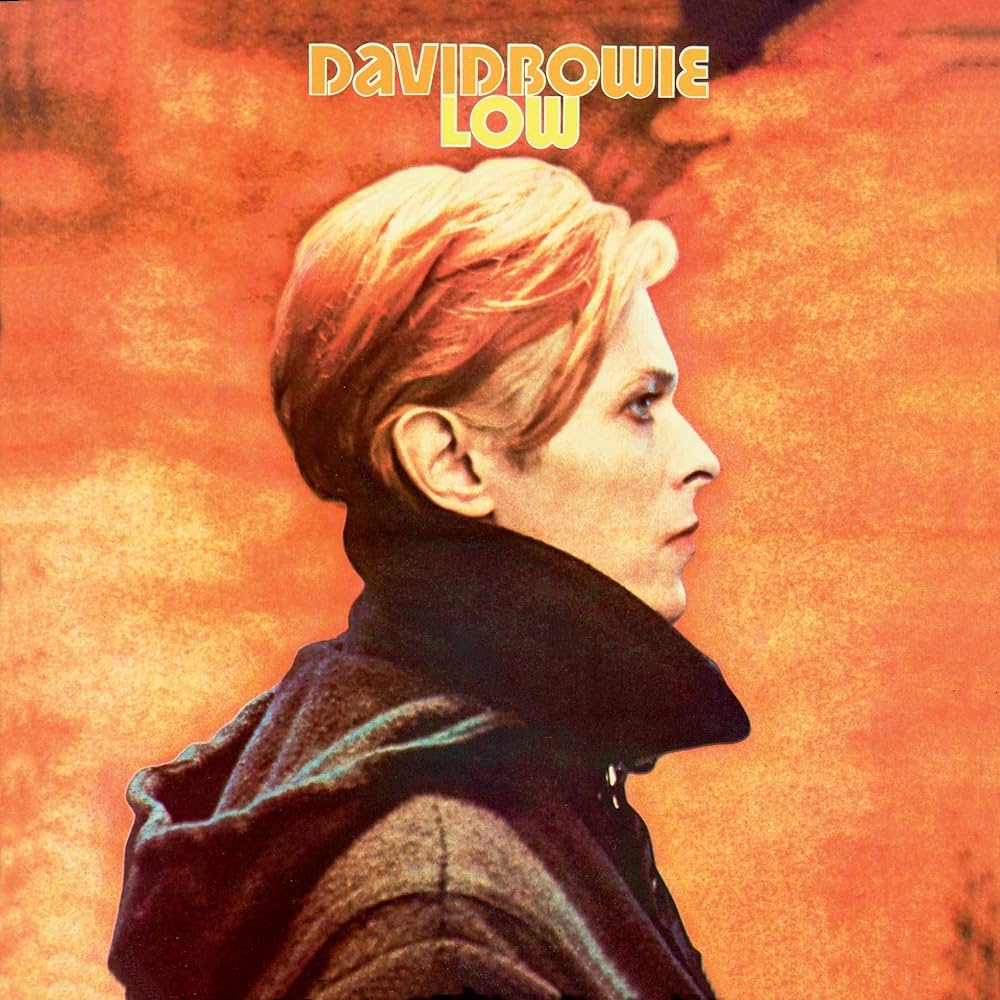
Released a year later, Bowie’s Low (1977) features, on the album cover, a distinctive still of Newton’s profile. Made while Bowie was in a self-imposed exile in West Berlin to kick his cocaine addiction, this is no confessional, kicking-an-addiction record; instead, Bowie is at his most innovative, sublimating his alien experiences into sound. The instrumental layers are submerged under the electronically-treated drums which resonate with splashes of color. The second side of Low eliminates the vocals and rhythmic propulsion. Including the album’s closing track, “Subterraneans” (one of the songs written for the film), these tracks perhaps suggest what Bowie’s film soundtrack could have been; but Bowie’s rejected work on the film’s soundtrack is lost to time and editing room floors. In hindsight, it seems like the record Bowie would create in the wake of the post-filming letdown—but the only direct reference to the making of the film is on the album’s cover.
From this perspective, The Man Who Fell to Earth is a crash that doesn’t feel like it hits fully. But, if Low is the aftermath, then we never see/hear the actual crash. Maybe Bowie, who did feel it (possibly in West Berlin), is trying to communicate to us that moment of terrible sublimity – but only if we both watch the film and listen to the record: the “low” as double/split image.
Sources:
Doyle, Sean. “The Sonic Landscapes of The Man Who Fell to Earth.” Criterion. Sept. 24. 2015. https://www.criterion.com/current/posts/3716-the-sonic-landscapes-of-the-man-who-fell-to-earth
Duncan, Paul. David Bowie. The Man Who Fell to Earth. Taschen, 2024.
Just checking in to see how this site works. Anyway, nice article. Offhad I can’t think of any films starring rock and roll performers in the 70s that connects the material to the persona as well as this one, with the possible exception of CISCO PIKE, which is more of a downer Kristofferson alter ego than a reflection of the performer’s persona. That said, in the pre-rock era you did get occasional autobiographical musical dramas like PAL JOEY and A MAN CALLED ADAM, the latter which is worth an in depth analysis of narcissism as self flagellation.
The soundtrack assembled by John Phillips gives the film a more direct musical line to CISCO PIKE than if David Bowie had composed it.