In a pivotal scene in Out of the Past (1947), Jeff Bailey, played with peak attitude by Robert Mitchum, arrives at gangster Whit Sterling’s Lake Tahoe hideaway. Taking in the scenery, Jeff wisecracks, “Nice view. Am I here to admire it?” Here, a natural vista is just another thing for Whit to own, like the underlings who do his dirty work for cheap.
Played with an evil toothpaste grin by Kirk Douglas, Whit is one of those people from whom Jeff makes it a priority to keep his distance. Unfortunately, when he was a detective, Jeff attempted to run off with Kathie Moffatt, Whit’s mistress. And now, Jeff sees that Kathie is back with Whit. The look on Jeff’s face says it all: he knows that he’s lost.
If a film such as The Big Sleep (1946) shows us that heroes may lose until they win, Out of the Past reminds us that losers keep losing. Even what looks like a lucky break only prolongs the day of reckoning. That’s why Jeff is in Tahoe.
After his dalliance with Kathie, Jeff was able to lay low for three years, until one of Whit’s henchmen found him. Whit orders Jeff to travel to San Francisco to get incriminating tax records from an attorney who’s blackmailing Whit. Jeff, however, sees through Whit’s convoluted plan to make him the fall guy rather easily. He not only seems to have a stoner’s intuition about the trouble coming for him (Mitchum was busted for cannabis possession, no small legal matter at the time, after the film’s release); he is aided by the borderline incompetence of the thugs that work for Whit.
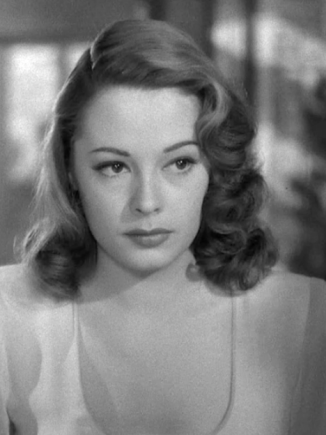
The problem, which Jeff can’t see until it’s too late, is that Kathie is a more formidable adversary than Whit. Three years ago, Whit hired Jeff to track her down; she fled after having stolen 40,000 dollars from Whit and attempted, unsuccessfully, to kill him. Jeff falls for her, ignoring any number of obvious red flags (for starters, it is unwise to get involved with a woman who tried to steal from and kill the guy who hired you). Kathie is a classic femme fatale, her cool indifference hiding the coldly manipulative way that she pits Whit and Jeff against one another.
The chemistry between Jane Greer, who plays Kathie, and Mitchum heats up the screen; at the same time, it reveals that Jeff is a proto-loser on a downward trajectory that anticipates the fate of his 1970s neo-noir counterparts. When Jeff tells Kathie, “There’s a way to lose more slowly,” while she recklessly gambles at a casino, there is an uncanny resonance with the worldview of private eye Harry Moseby in the essential Night Moves (a 1975 film soon out in a Criterion edition). When asked who’s winning a football game, Harry replies, “Nobody. One side is just losing slower than the other.”
“There’s a way to lose more slowly”
Jeff Bailey
The ups and downs — well, mostly downs — of Jeff’s dalliance with Kathie is conveyed through a lengthy flashback, which takes up close to 1/3 of the film’s running time. In a bleaker twist, Jeff recounts what happens via voiceover, to Ann Miller, the stereotypical good girl who loves Jeff, despite his flaws. But the small town in which Ann is stuck and Jeff hid out, where everyone assumes the worst about Jeff, especially Ann’s milquetoast childhood sweetheart, is no less rotten than Kathie’s world. As Jeff tells his story to Ann, you can see the self-loathing for what he’s done really come out; he tries to get it across to her that he has to leave, so he doesn’t take her down with him, even if it means that she will be subjected to a dull, grey life.
Jeff has no choice but to lose as slowly as he can. In San Francisco, Kathie is making the crucial moves that frame Jeff for the attorney’s murder. Her logic is coldly efficient; she wants Jeff to owe her, which will keep him in her clutches, as well as maintain her plausible deniability with Whit.
At this point, it is worth noting that Mitchum’s mesmerizing performance makes us forget the cliches about hindsight being 20/20, the thin line between love and hate, and all of that. He sells us on how losers can have dignity too, even if it’s (only) in how they lose. It’s a departure from the archetypal noirs, such as The Maltese Falcon (1941), where the detective is a couple of steps ahead of everyone else, and a preview of neo-noirs, like Chinatown (1974), where the detective is a couple of steps behind.
Out of the Past shies away, for the most part, from the shadowy lighting of noirs, until the ending where Jeff and Kathie are silhouetted against darkness on the way to their memorable final ride together. Jeff may share his last name with George in It’s a Wonderful Life (1946), but Jeff is already living out his second chance — and as Out of the Past shows us, he won’t get a third one.
“As Jeff tells his story to Ann, you can see the self-loathing for what he’s done really come out; he tries to get it across to her that he has to leave, so he doesn’t take her down with him, even if it means that she will be subjected to a dull, grey life.”
This is what gets me about the ending — Jeff has to lose everything, including Ann’s love and respect, in order to keep her not even winning but just plugging away in a boring life. Sacrifice with no one to see it (literally!), not that that’s why you make the sacrifice but Jeff goes down so hard here.
It’s possible that Jeff knows that he’s gonna go down hard from the start of the film. Maybe, though, he thinks that he will be able to eventually outsmart Whit. But there’s no way that he can escape Kathie.
“One side is just losing slower than the other” has long been one of my favorite noir lines, nice to see its origins (in noir attitude if not literal text) called out here. There’s glass half-empty and then there’s glass half-full-and-just-waiting-to-be-emptied.
That noir line (from Night Moves) is shaped by how Out of the Past critically looks at the kind of fantasy world projected by a film such as The Big Sleep — that is, it seems rather unlikely that, in real life, one would get so many lucky breaks. Neo noirs committed to depicting harder, more realistic portrayals of life.