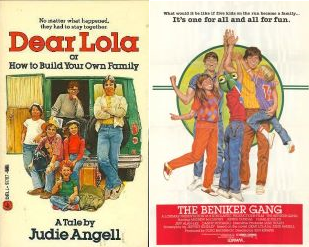
We are going deeply obscure here, folks. So obscure the book doesn’t have a Wikipedia page and the movie’s is a stub. I think I saw the movie on the Fabled Disney Channel Of My Childhood, long ago, or else it was one of my mother’s summer rentals—my mother likes watching silly movies in the summer, ones that don’t require much in the way of thinking. I think I got my copy of the book at a library book sale, though I’ve had it for so long that I don’t actually remember. It’s about time for me to introduce it to my son, who’s the same age as Our Narrator.
Her name is Annie. She’s ten, and she’s an orphan. She and her twin, Al-Willie, live at St. Theresa’s Home and School. They’d like to have a family, but no one wants a pair of kids their age. So they’ve made their own. There’s five-year-old Ben, who has an oral fixation and eats everything small he gets his hands on. There’s nine-year-old Edmund, who has just never liked any family they’ve put him in with. There’s thirteen-year-old James the agoraphobic, who just wants to hide in a room and stay there. And there’s eighteen-year-old Arthur. He could in theory go anywhere and do anything, because he is after all eighteen, but he wants to keep the family together.
So the children go off with Arthur. They don’t have to worry about money, because Arthur has a happy job as “Dear Lola,” an advice columnist. However, they know that no one will let him adopt the kids, so they run off. They end up in a small town in the middle of nowhere, where they take over a derelict house. The kids go to school, except James, whom no one knows exists, and they settle in to a happy, quiet life together. However, they’re strange and don’t seem to have parents, and the town is immediately suspicious.
The movie spends a lot of time before it gets to that point. They’re in a secular facility now, and Al-Willie’s nowhere in sight. Annie is now Cassie (Jennifer Dundas) and thirteen—they’ve actually aged up the remaining boys, too. Lola (Andrew McCarthy), as the kids call him in both book and movie, smuggles them out disguised as laundry as opposed to just, you know, sneaking out with them in the middle of the night. We see a lot more of their driving before finally reaching the house Cassie has long dreamed of.
There’s still the same problem with the younger ones. No one wants Lola to be their guardian. Molly Stamwick (Martha Byrne) is still an enormous snob. The kids still feel out of place and unhappy. If anything, it’s worse for Cassie than for Annie, because at least Annie has Al-Willie; Cassie is the only girl in a family of boys and feels lonely because of it. Lola feels overwhelmed in dealing with the kids, who have their issues—at least here, Ben only eats paper? Worse, they’ve made Lola do all the cooking and cleaning; in the book, each child takes on a responsibility, and there’s not so much pressure on Lola.
If they were blood relatives, it’s possible Lola could have gotten custody of the others.
This is the story of a blended family. If they were blood relatives, it’s possible Lola could have gotten custody of the others. A Nani and Lilo situation, albeit with more kids. But because Lola is eighteen, there’s no way he could just go and adopt kids not that much younger than he is himself. Now, the children are happy together, happy with Lola. He’s taking care of them. They’re taking care of each other. And maybe it would be nice if there were an adult of some sort Lola could consult with when he needed it, but I’m 46 and I have friends who I think of as the adults I consult with when I need it. And after all a family has to be better than being in the facility we see them in at the beginning.
We learn that Lola’s column came to prominence rather quickly—in the world of the movie, at least, it goes from a small local column to nationally syndicated in the three years since Lola himself took over. (He uses male pronouns regardless of the name.) He grew up in circumstances much worse than the one he’s making for the kids. It’s made him compassionate and considerate; he is gentle and affectionate toward the kids. In the world of the book, he keeps twins together who the system is trying to separate. He’s probably the only one who can make James feel safe. Who is in the courtroom scenes in the movie despite no one even knowing he exists yet in the book.
My feelings about this family are not different as an adult. They deserve to be a family. With each other. And maybe they deserve to have a social support network, but then don’t we all. The endings of the book and movie are different; the movie ending is sillier and less realistic, but it’s also happier. There’s something to be said for even Arthur’s getting the chance to be who he really is, after all.
Next month, we’ll be taking a look at a movie I discovered because of the Lux Radio Theatre broadcast of it, Phantom Lady. So greetings from Hollywood! And if you want to keep me in fine Lux Toilet Soap (or Caress body wash, its modern day version), consider supporting my Patreon or Ko-fi!