with Rachel S. Anderson
The final shot of L’eclisse (1962) is the visual analogue of the title, “Eclipse”: light floods the screen. It’s not that we can’t see anything; it’s that we can’t see anything else except the light. Of all the ways to interpret the ending, I am drawn to the ironic possibility catalyzed by the film’s being set in a modern suburb of Rome, heralding the so-called social progress of bland suburban living. Thus the ending is the artistic equivalent of saying, “fuck you,” in response to the question that seems to hang in the air throughout the film: “Do you feel modern? Well, do you?”
At this point, I’d like to introduce another Eclipse, our bunny. Recently, the vet told us that Eclipse has no vision in either eye. He has adapted by fine-tuning his navigation skills of the first floor of our house. In the same way, I’m not sure that most people in the film realize just how modern living has reduced their vision, through obsessing about the stock market or, even, anxieties about the nuclear arms race (conveyed by the headline in a discarded newspaper). Like my Eclipse, they have adapted to what they cannot see.
One person, Vittoria, (a luminous Monica Vitti) stands out from the lonely crowds in Rome. She works as a translator (although we rarely see her at work), and she is what she does. She translates, finding connections with people sealed off in their own little worlds, such as her neighbor, who is subsumed by colonialist fantasies of Kenya. Vittoria even acts somewhat amused when her mother loses her shit after a big loss on the stock market.
Although we watch Vittoria put up with a great deal, she is not passive, nor does she equate mindless activity with living, like, surely, her mother does. And Vittoria acts with an almost radical openness. As Jonathan Rosenbaum puts it, the film’s director, Michelangelo Antonioni, “clearly empathizes; her refrain, ‘I don’t know,’ is virtually his own watchword.”
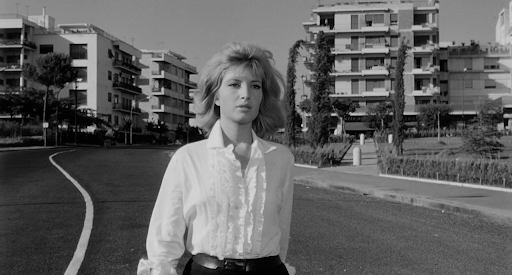
In the opening scene, Vittoria is in the midst of leaving her boyfriend because she understands everything about him. She will be attracted to Piero (Alain Delon, at the peak of his good looks), her mother’s broker, because it is the process of understanding him that excites her. Vittoria doesn’t understand the stock market, while Piero does – she is interested in trying to translate all the frenetic activity, which, in striking contrast to her high-strung mother, Piero processes with coolness under pressure.
You could say that opposites attract, as in numerous Hollywood films, but to translate differences on a personal level, Vittoria and Piero both realize, feels like being in a strange country. And Vittoria is, as always, okay with saying that she isn’t sure how she feels about the feeling. Maybe it’s too much. Or not enough.
Some U.S. exhibitors were in fact so troubled by this ending that they lopped off the entire seven minutes of it — perhaps the most powerful sequence in Antonioni’s work.
Jonathan Rosenbaum
It will be a similar feeling that we have when Vittoria and Piero disappear in the (in)famous closing scene. As Rosenbaum states, “Some U.S. exhibitors were in fact so troubled by this ending that they lopped off the entire seven minutes of it—perhaps the most powerful sequence in Antonioni’s work.” Another irony, of course, emerges in such a bizarre move: to make the ending impossible to see.
Dino Risi’s Il Sorpasso came out the same year as Antonioni’s L’eclisse, and in a brief scene about a third of the way through the film, manages to include a quick discussion of it between the two main characters – Bruno, a wandering libertine with a fast car, and Roberto, a buttoned-up law student whom Bruno hijacks during the Roman summer when all good Romans leave Rome. In this scene, Bruno puts on a record in the car (side note – if you’re interested in the history of in-car vinyl turntables, here’s a link…) and remarks:
Ah, music. I really like Modugno. This song really drives me crazy. It seems so simple, but it’s got everything — loneliness, inability to communicate, and that stuff that’s all the rage now — alienation, like in Antonioni’s films. Did you see L’eclisse?
When Roberto eagerly answers “yes,” perhaps thinking that now he’ll get a serious conversation about art, Bruno continues, “I fell asleep. Had a nice nap. Great director, Antonioni. I saw him in his Flaminia Zagato once. I couldn’t stop gawking.”
Bruno, and by extrapolation, Il Sorpasso, speeds right past all things serious – there’s no interest in Etruscan tombs or picturesque mountains here. Instead, we have Bruno’s driving need to overtake (the title, Il Sorpasso, means just that) every other car on the road and to move from one party to another with frenetic energy.
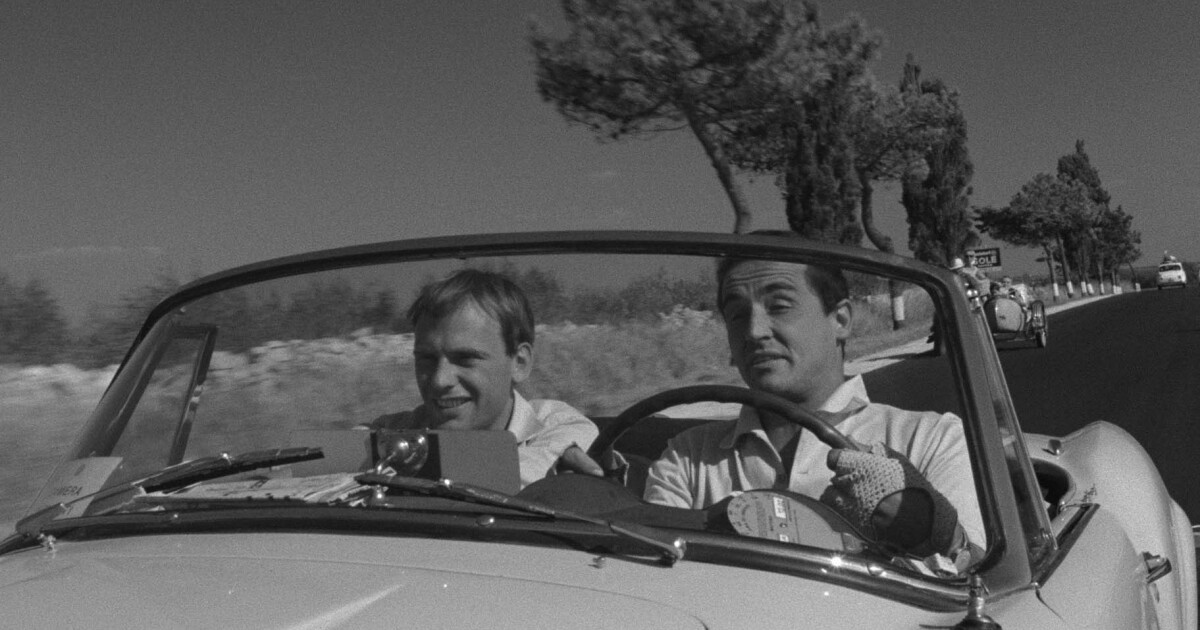
In this way, this film almost seems to contrast L’eclisse wholly – but does it? The “loneliness, inability to communicate, and …alienation” are fully on display in Il Sorpasso as well, just through the lens of a road-movie comedy. Central Rome is deserted; when Bruno convinces Roberto to leave his studies for the afternoon they speed past famous landmarks like the Spanish Steps and the Parthenon with streets populated only by an impotently shouting traffic cop. So they venture into the country, where Roberto slowly loosens up and realizes what a lonely, shitty life he’s led. And we, as viewers, realize that Bruno’s life, despite his outsized bonhomie, is just as alienated – he’s so interested in moving that he seemingly can’t form relationships that last longer than a few hours. It’s telling that what he appreciated about Antonioni was not his film but his car.
Risi, like Antonioni, provides a cutting commentary on the “modern” post-war Rome, a society that is both deeply suspicious of the futurism promised by fascism and yet wants to be part of the technological and social revolution that the 60s would usher in. Is this future one of fast cars constantly (and ultimately fatally) overtaking others, in a mad rush to get …somewhere? Or is it one where the technology brings two lonely people, like Bruno and Roberto, together for an often joyous romp through the Italian countryside?
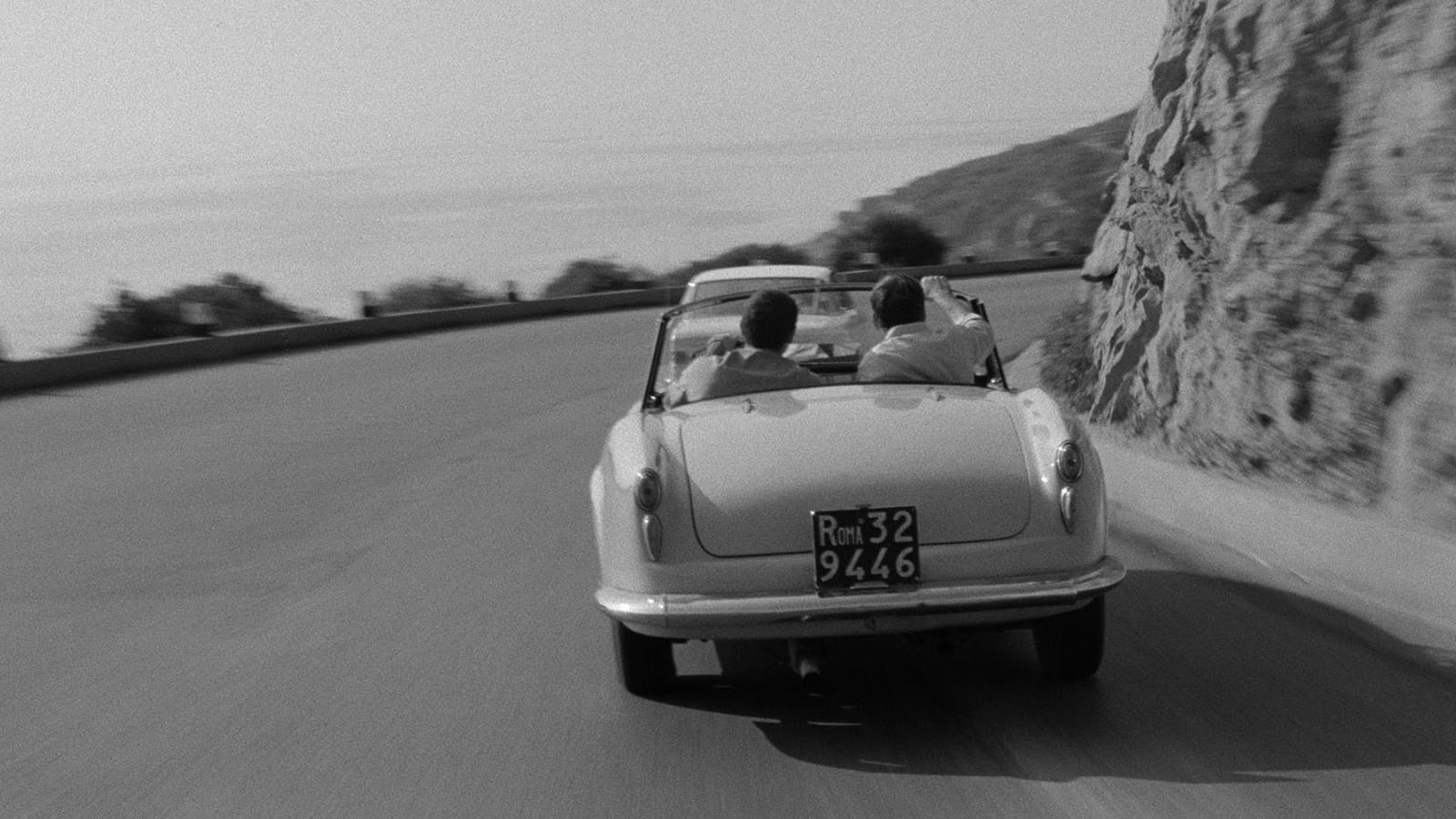
Once you watch Il Sorpasso, you’ll get that the ending is just as heavy as the one in L’eclisse. And just as philosophical, although Bruno – like our Eclipse, won’t, or can’t, tell you directly. Bruno, however, may not see what he’s missing, until it may be too late. Where he ends up will remind us of what Ennio Flaiano, a screenwriter who worked with Federico Fellini, says, “In Italy, the situation is always tragic, but never serious.”
If, conversely, L’eclisse is perhaps too serious to be tragic, must it be seen as a flaw? It really does feel as if the two films are in a conversation, and it’s an interesting one.