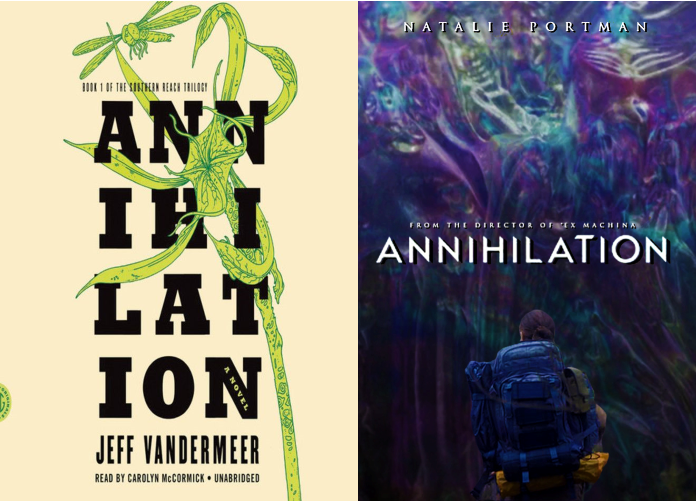
One of the things we have lost in the streaming wars is an opportunity for spectacle. Oh, it still happens now and again, but mostly, if it’s not a blockbuster, it’s not going to have the opportunity to be seen on the big screen. Especially, sigh, if the movie is led by women. Now, part of why this movie got shuffled mostly onto streaming is that it’s long and dense and talky and so forth. But I can’t help thinking that the assumption was that Natalie Portman wasn’t enough to get butts in seats.
At the time the movie was optioned, the book was still unpublished. Annihilation is told in first person, and no character in it ever gets a name. The main character is referred to only as the biologist. She is a member of a four-person team going into a place only known as Area X. The other three are a psychologist, a surveyor, and an anthropologist. A linguist was supposed to be part of the group but chose not to go at the last minute. The four, all women, have spent months training, including essentially leaving behind their entire personalities. They are supposed to be investigating exactly what is happening there; twelve expeditions have gone before them and all have failed. Most never came back; the few who have are also now dead.
In the movie, she is Lena (Portman), a biologist at Johns Hopkins. Her husband, Kane (Oscar Isaac), has been gone for a year and is generally presumed dead. Then, he returns. Only he starts hemorrhaging. As they are on their way to the hospital, a military strike force stops the ambulance and they are taken into a kind of custody. They are brought to a complex near something called the Shimmer, which the movie says is outside Area X but which is not referred to as such by most of the characters. Lena meets Dr. Ventress (Jennifer Jason Leigh), a psychologist. She also finds out that Anya Thorensen (Gina Rodriguez), Cass Shepherd (Tuva Novotny), and Josie Radek (Tessa Thompson), along with Ventress, will be going in. She agrees to join them in the hopes of saving Kane’s life.
What Area X is like varies pretty seriously between book and movie, but in both cases, it is both familiar and alien. It is never fully clarified in the book; in the movie, it is apparently explicitly St. Marks Wildlife Refuge, the inspiration of the ecosystems of the book. In the book, the biologist gives us great detail, noting details that would catch the eye of someone whose expertise is in ecology. However, Lena is an expert in cell development and is initially seen teaching about what are not named as HeLa cells but are HeLa cells. It is she who explains to the others that what they are seeing is mutation.
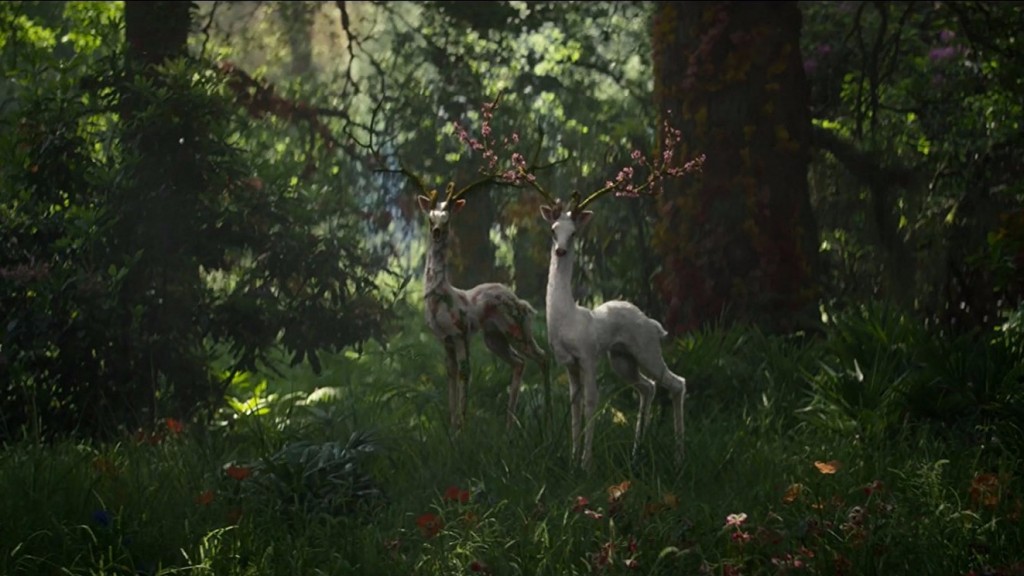
Alex Garland explicitly did not reread the book before making the movie. He wanted it to be a dream of the book, and it does have that feel. Plot details feel half-remembered. In the movie, we initially have five women; in addition to the biologist and the psychologist, we have a paramedic (the husband’s job in the book), a geomorphologist, and a physicist, respectively. Since the characters are seldom seen actually doing their jobs, it wouldn’t be difficult to imagine simply having forgotten what jobs anyone had and, say, knowing there’s a paramedic in there somewhere.
Mostly I do not vibe with Alex Garland movies. I found Ex Machina disturbingly sexist, and most of the others have no particular interest for me. I found this one unsettling, but of course it’s supposed to be. The filming is impressive, and it’s strangely beautiful. There are images from it that linger. After it ended, Peacock tried to throw me into a different movie, and I had to tell it to let the credits play so that I could absorb what I had seen and listen to the score, by Geoff Barrow and Ben Salisbury, to process. Even if it’s a dream of Jeff VanderMeer’s book, it’s enough of a reflection of it to be worth the experience.
As for the book, well, I’ll have to read the other two now. It’s apparently later revealed that the ethnicities of the biologist and the psychologist are not what they are in the film, but the characters get no physical description and almost no personal information in the first book, the only one that had been written at that point. There is more world to explore, and the book left me wanting to explore it.
Next month, we’ll be exploring not just strange worlds but sexuality with Desert Hearts.
Love this movie, warts and all, but especially the open question of the ending. Garland seems to thrive when he’s not in metaphor-land and has to exist in the ambiguity of a premise, like 28 Days Later’s virus that’s less zombification and more the body getting taken over by overwhelming anger and bestiality.
I haven’t seen it, but I’m willing to give him another chance based on how much I liked this one.
His collaborations with Boyle are his best work aside from Annihilation, especially Sunshine.
His current War phase isn’t doing a whole lot for me, but he’s a consistently interesting filmmaker and I’ll happily seek out his stuff against the usual early spring releases.
This is one of the few times I’ve been glad to have seen the movie before reading the book. My wife did it the other way around and was ready to file a suit against Garland for misappropriating a book she greatly enjoyed. I was fortunate to catch it in the theater in those halycon early days of the Great MoviePass Debacle, and I loved its blend of dreamy sci-fi and monster movie. Then when I read the book I enjoyed its uncanniness and all the glimpsed details that would be unadaptable in the conventional sense. Garland making the movie based on a remembrance of a reading makes complete sense and was the right choice, letting the movie be its own thing instead of trying to flatten the book’s strengths onto the screen.
The other two books are worthwhile. The second one is quite a bit different and took me a while to get into, but I think the payoff of the third makes the journey worth it. Nothing quite like that first trip, though.
Yeah, I get why book purists wouldn’t like it – especially since it contradicts some things in the later books even further – but I always appreciate it when a creator recognizes that something has to be radically transformed to work onscreen.
Frankly I was in such a hurry to finish that I was reading the book and watching the movie at the same time. I really need to pay more attention to my deadlines.
Tessa Thompson’s last scene absolutely haunts me.
It’s so good. So good.