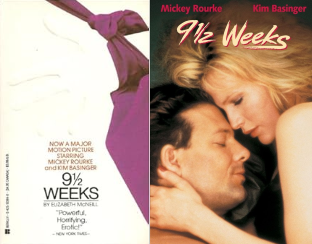
I’m genuinely amazed sometimes what shows up as mainstream erotica. It’s not that I don’t understand erotica per se. It’s that things will sometimes make it big as the new big sexy thing and I don’t understand why more people don’t seem to see the horrifying bits. I am just old enough to remember when 9 ½ Weeks came out in theatres, and I’ve even seen a parody of it in a movie I quite like, but of course I was wildly too young to ever see it and somehow never did as an adult and it gradually faded from public consciousness until it was fodder for this column. I think I was better off.
Ingeborg Day, writing under the pseudonym Elizabeth McNeill, released the book with the subtitle A Memoir of a Love Affair. In it, she details the life of a woman who lives a perfectly ordinary life by day, but by night she goes to the apartment of her lover and completely gives way to him. He handcuffs her the moment she walks in the door. He bathes her, feeds her, brushes her hair and teeth. She does nothing. He also beats her, leaves her hanging from a hook for hours at a time, and summons a taxi to take her and all her belongings away when she dares to say no to him.
In the movie, she is Elizabeth (Kim Basinger) and he is John (Mickey Rourke). They meet, and he immediately takes charge. There is, quite early on, a scene wherein he takes Elizabeth without her consent that I’m not sure the movie is aware is actually rape. Still, she stays with him, and as in the book their actions escalate, eventually ending with a moment in the Chelsea Hotel that is similar to the book but different, and this time Elizabeth is able to get away after saying no. Though she still goes back to him.
I mean, I’m not here to kink-shame. BDSM between two consenting adults, or three, or whatever, is fine. If you have an entire arena full of consenting adults doing kinky stuff to one another, you do—well, whoever. The issue is consent. The book knows this; I’m not sure the movie does. The woman in the book—presumably Elizabeth, or Ingeborg, given its title as a memoir—knows that there’s something wrong with what she’s involved in. By the end, she’s beginning to wonder if the nameless lover will kill her and decides he won’t because it would be too difficult to find another woman willing to do what she does with him. Maybe it’s because we can’t get into movie-Elizabeth’s head the same way, but she’s much more a cipher, going along because that’s what the plot says to do.
Book-Elizabeth’s job is never defined. She has meetings and clients and things, but who they are and what they’re doing is never established. Movie-Elizabeth works in an art gallery doing poorly defined things. We see her trying to make a sale, deciding where paintings will hang, and visiting an artist whose show is upcoming, but we also see a lot of her just kind of sitting at a desk. What is she doing there? Your guess is as good as mine. Waiting for John to call and for the plot to happen to her, mostly.
She’s also, I suppose in an effort to flesh her out as a character, been given an ex-husband about whom we know nothing except that her mother likes him. I’m uncertain as to the cause of the divorce, and she ends up suggesting that her best friend/roommate go out with him instead, which she does, and the pair begin dating. It adds nothing except I guess to let us understand a bit as to why Elizabeth is so mopey. But she’s not mopey until she meets John; she and Molly (Margaret Whitton) get along beautifully and joke and tease and laugh. She seems more of a person with Molly, and a young Christine Baranski as Thea, than with John.
Frankly, Kim Basinger was abused on the set by director Adrian Lyne. He deliberately kept her and Rourke apart and would lie to Basinger about how Rourke felt about her. He showed Rourke more respect. Apparently this was deliberate, because he was filming the movie in sequence and wanted Basinger to break down the way Elizabeth should have been. Which is appalling. In the book, she ends up literally hospitalized at the end. Because, you know, there’s a huge power imbalance, like the one between a well-known director and an unknown actress?
If you want to watch a version of the scene where a man erotically feeds a woman, watch Hot Shots. Not the movie where, even while trying to arouse a woman, he can’t resist giving her a spoonful of cough syrup and a whole chili. When Charlie Sheen is the less abusive option, that’s something to worry about. Frankly, I also felt it was bad roommate etiquette to fool around in front of an open refrigerator door in a shared kitchen. That wastes electricity, is bad for the fridge, and leads to the possibility of the roommate having to walk in on your boyfriend feeding you erotic Jell-O, and no one should have to suffer through that.
Next month, we’ll be celebrating the spookiness of Conjure Wife!