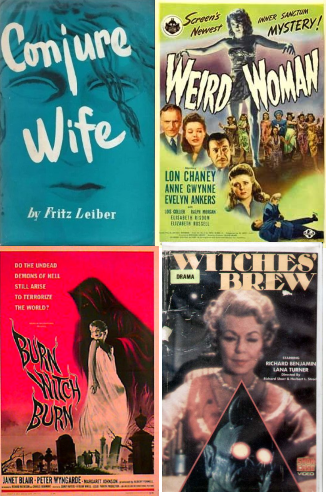
Adaptations fascinate me. All three of today’s variations of the original story have obvious aspects to it, but what they’ve chosen to cast aside varies. The 1980 version is the most sexist, and boy is that a whole conversation, and the 1944 version decides it needs to go the rational, sensible way. I don’t think that stems from the Code, but I don’t know. It could be that having the magic be real could be seen as an insult of religion, because of course Native Hawaiian practices aren’t really religion, as everyone knows. Either way, I definitely have my preferred of the three.
In Conjure Wife, Norman Saylor is a professor of sociology at an extremely conservative college. His wife, Tansy, turns out to be using protective charms to help his career along. Unfortunately, Norman has made his career writing about the triumph of reason over superstition, and finding out that his wife is deep into superstition—as he sees it—is disappointing to him. He makes her destroy all her charms. The problem is that Tansy really was doing magic, and now that the charms are destroyed, a trio of other faculty wives believe that she’s dropped her protections preparatory to a major strike on them.
In Weird Woman, Norman Reed (Lon Chaney, Jr.) is a professor of sociology at an extremely conservative college. While vacationing in the South Seas, he encounters Paula Clayton (Anne Gwynne), the daughter of a professor he used to know. He marries her and brings her back with him, to the ire of Ilona Carr (Evelyn Ankers), the school secretary and sister of the dean, who believed he was in love with her. Norman discovers Paula doing a ritual of protection and makes her burn all her charms, including an amulet given to her by the nursemaid who raised her (Hanna Kaapa). The magic is almost certainly not real . . . or is it?
In Burn, Witch, Burn (also called Night of the Eagle), Norman Taylor (Peter Wyngarde) is a professor of psychology at an extremely conservative college, this time in England. His wife, Tansy, turns out to be using protective charms to help his career along. Unfortunately, Norman has made his career writing about the triumph of reason over superstition, and finding out that his wife is deep into superstition—as he sees it—is disappointing to him. He makes her destroy all her charms. The problem is that Tansy was really doing magic, and now that the charms are destroyed, a trio of other faculty wives believe that she’s dropped her protections preparatory to a major strike on them.
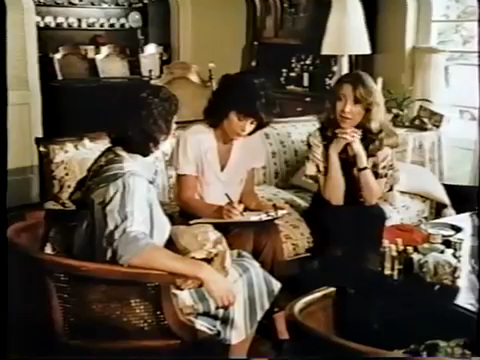
In Witches’ Brew (according to Wikipedia also Which Witch Is Which?), Joshua Lightman (Richard Benjamin) is a professor of something, I guess, at an extremely conservative college. His wife, Margaret (Teri Garr), is one of a trio of faculty wives who use witchcraft to benefit their husbands. Joshua knows this, but they bicker over the idea that her work does any good and he makes her destroy her charms, which she agrees to do out of spite. This leaves him open to the influences of the other two, Susan Carey (Kathryn Leigh Scott) and Linda Reynolds (Kelly Jean Peters), who are afraid that Margaret’s spells will make Joshua do better than their husbands. Also Vivian Cross (Lana Turner) has plans for Margaret.
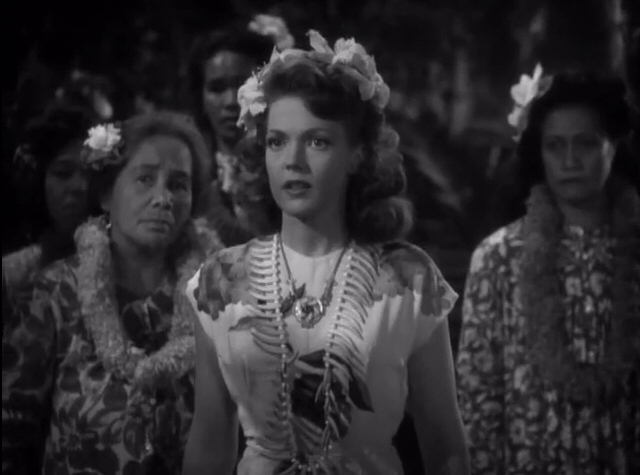
So okay, it’s not difficult to tell which is the most faithful adaptation of the three. Honestly, only the second one understands the import to the name “Tansy.” Tansy is an herb, used both as an abortifacient and a fertility drug, but more importantly in magic. Specifically to ward against evil, including witches. It is used in mourning wreaths, and in Victorian flower language, it’s a declaration of war. So okay, I don’t have proof that any of the people making the movie knew all that, but I wouldn’t be surprised if Fritz Leiber didn’t know at least some of it. It’s a significant name. “Paula,” meanwhile, means “humble” or “small,” and “Margaret” means “pearl.” These are not bad names, but . . . .
More to the point, only Burn, Witch, Burn (which I think is a better title) takes the magic at all seriously. It’s real. And while so is the magic in Witches’ Brew, it’s also something to be scoffed at. Now, it’s extremely helpful as well, inasmuch as Joshua doesn’t seem capable of tying his shoes unaided, but the three ingredients the movie feels the need to dwell on are cat urine, bat guano, and lamb’s blood. We’re clearly supposed to think it’s silly.
The other two movies, at least in their American releases, start with warnings about the real nature of such things. The American release of Burn, Witch, Burn starts with a somber Paul Frees—as if there’s any other kind—actually intoning a full-on incantation of protection for the audience. Using, I’d note, real names of real deities from non-Christian faiths. Even most practicing Pagans will think it’s silly, less silly than many Evangelical Christians likely would, honestly. But in the world of the movie, magic is real—or at least its practitioners believe it is—so why wouldn’t you take it seriously?
In a way, all four versions of the story are about the conflict between spirituality and rationality. Between the old ways of understanding the world and the new ones. Now, in our world, rationality obviously wins. But in the world of the book, and at least two of the movies, magic is just a different way of manipulating the world. Leiber suggests that, in the world he has created, the rules of magic simply change more quickly than the rules of things like physics and therefore are harder to study and seem more arbitrary. If the equations we use for physics were accurate until suddenly they weren’t, would we have come so far in science?
There is, obviously, a lot to be said about how women are treated in the versions. Witches’ Brew comes closest to making Margaret our perspective character, but even there we veer for extended periods into Joshua’s perspective. Now, in part this is because the story involves in all other cases Norman slowly coming to terms with the fact that everything he’s based his academic career on is wrong. The reality of magic has to develop for him. Joshua knows it’s real and just doesn’t believe.
However, in all four versions there is at best a distrust of women and a distancing between men and women—while we may have a female dean of women, the professors are men, and that’s just a start. Leiber explicitly emphasizes the feminine nature of magic, particularly in the modern world. Men work in science and women work in witchcraft and that’s just the way of things, and when a scientific view of witchcraft is needed, well, that’s what men are for.
Further, the women only do magic to benefit their men—or to retain youth and beauty. Sure, Paula’s governess protected her with magic, but it that might as well be protecting her child, and none of the other women we see have children—except Vivian, whose child is an adult and who she barely interacts with. And who is male. Ilona of Weird Woman uses petty gossip to benefit herself, or anyway punish Norman, but then it’s far from clear that magic is anything more than psychology in that world.
There are female friendships, but if the men are for any reason in conflict, there goes the friendship. Susan must decide whether to side with Linda or Vivian and decides she’s more scared of Vivian. Paula had her nursemaid but makes no friends on the mainland; neither Tansy has friends. Margaret had Linda and Susan, but as soon as Joshua’s career threatened to eclipse that of their husbands, they turned on her immediately. The women have no children, though Margaret and Joshua are trying for one at the end of the movie, and the only family that really comes up is Paula’s dead father. Their existence is based on their husbands.
Who frankly aren’t ever shown to be worth it. Okay, Joshua’s manifestly the worst, mocking magic even though you’d assume he’d seen it work at least a little by then and proving to be utterly incompetent on his own. But Norman of Weird Woman makes me deeply angry by forcing Paula to burn an amulet with emotional significance beyond any possible protective power. It was a gift from someone she loved; making her burn it is an act of cruelty. Also he knew her when she was a child and he wasn’t, so there’s that, too.
One hopes that in at least a few of these stories, Norman/Joshua came away with a better understanding of and appreciation for Tansy/Paula/Tansy/Margaret. And maybe she saw the importance of the occasional outside interest. Of making friends. The evil forces are dealt with; there are lots of other people to befriend. Honestly I think Paula would befriend Evelyn Sawtelle (Elizabeth Russel) at the end of the picture, and maybe Grace Gunnison (Elisabeth Risdon). But Book-Tansy doesn’t even have that option, because they’re members of Book-Ilona’s coven, and all three are out to get her. Because the only nice thing women can have is men.
Next month is on my calendar as All of Me, which turns out to be based on a still-unpublished novel called Me Two. We will have things to say!