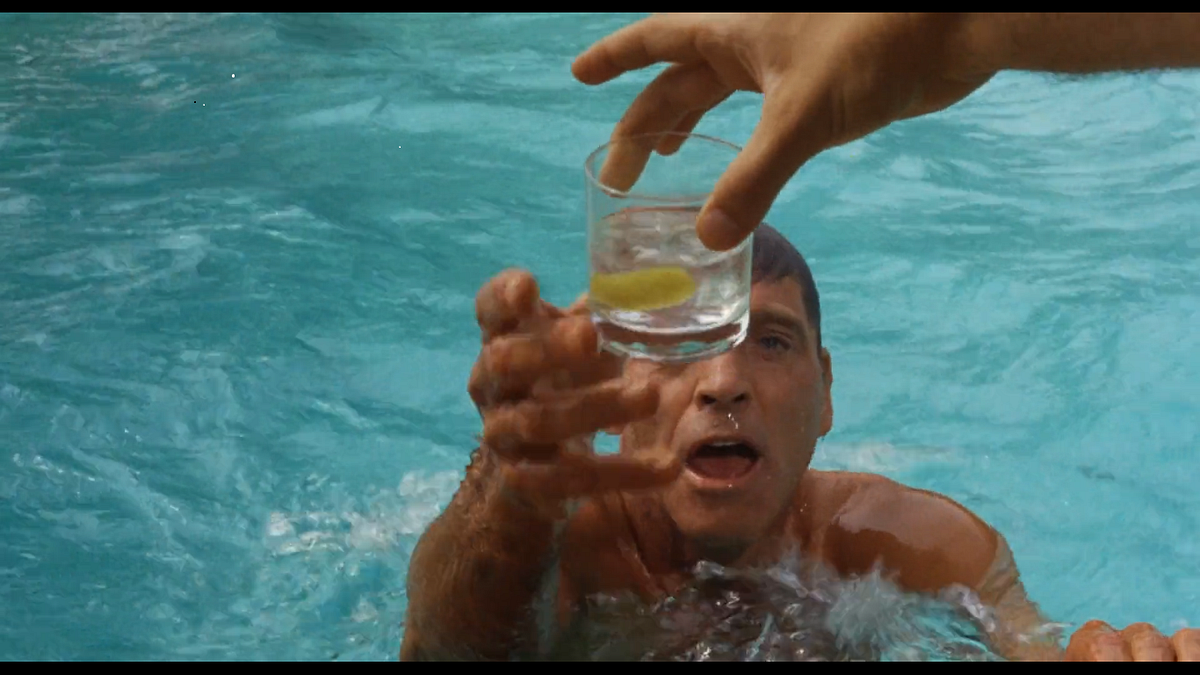
Looking back at 1968, it’d be hard to argue that “the Sixties,” that peak time of dreams of peace and love, weren’t, by then, already over. The pivotal events from this year alone — the assassinations of MLK and RFK, followed by Richard Nixon’s election — signify a cultural sea change. From the perspective of the older generation, it thus becomes difficult to tell which social norms remain relevant, and which are now obsolete.
Forecasting this problem, John Cheever’s “The Swimmer,” a short story published in The New Yorker on July 16, 1964, addresses the impending conflict as the ground starts to shift under North-Eastern suburbia. Cheever takes a rather visible class signifier of success, the swimming pool, and, in the trajectory of Ned Merrill, a declining blueblood who impulsively pool-hops home only to arrive at an empty house, shows with pinpoint accuracy the fissures among who the aspiring social elite thought they were, who they wanted to be, and who they really were.
Eleanor Perry read “The Swimmer,” and immediately wanted, with director Frank Perry (although their marital relationship was already fracturing, they continued to work together, professionally) to make the story into a film. Her screenplay draws upon the episodic structure of Cheever’s story, and weaves together views of suburban mores at various pool-side festivities. The film, as they envision it, keeps an insular feel without diving overly into pop-psych exposition.
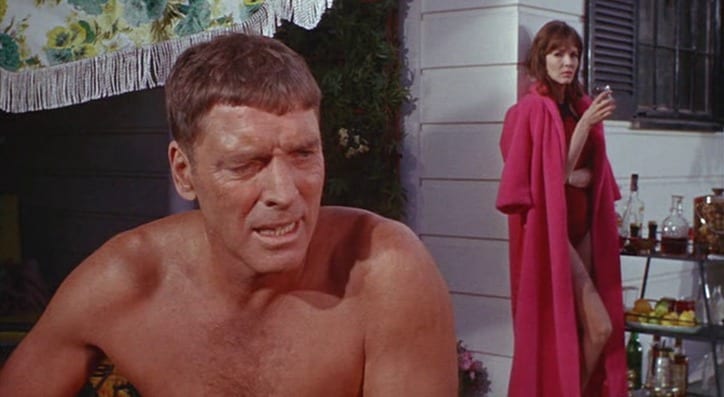
The fear of losing one’s class identity that Frank and Eleanor Perry incisively detail in The Swimmer plays like a moodier, East-Coast version of Faces, the 1968 film written and directed by John Cassavetes that depicts the collapse of a middle-class marriage in Hollywood. Whereas Cassavetes, however, shows little interest in putting literary symbols on screen, Eleanor Perry intends to make Ned’s failure hit harder by giving him a last chance at redemption that he’s unable to see — in her unpublished memoir (included on the Grindhouse Releasing Blu-Ray DVD of The Swimmer), she writes of the “metaphysical” dimension of Ned’s downfall.
This chance comes in the climactic scene when Janice Rule, as Shirley Abbott, Ned’s former mistress, adds a longing inflection to her words to Ned (played by Burt Lancaster):
l thought we were
going to make it.l really thought
we were going to make it.
But Ned looks right past Shirley’s implying that, just maybe, they could get back together, signaling the tragic end to an allegory of the road — or, rather, the swimming pool — not taken. Thus Ned’s self-absorption points to the social crisis lurking at the periphery of the film.
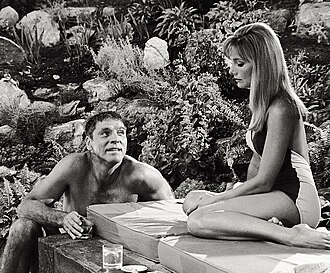
Burt Lancaster & Barbara Loden on the set of The Swimmer
Yet by the time this scene was filmed, Frank Perry had already been fired by the film’s producer, Sam Spiegel, and Eleanor Perry had unsuccessfully pleaded to keep an earlier version of the scene, with Barbara Loden as Shirley, in the film. Like any younger artist in touch with the zeitgeist of the times, Eleanor Perry had picked this scene to move into stormier waters than the more mainstream modernism of Cheever’s story could fully envision. In the story, the encounter between Ned and Shirley rates a single paragraph, barely standing out from any of the other pools he traverses. As written in the third revision of the screenplay (February 18, 1966), their encounter is far more explosive, amping up the abusiveness in the remnants of Ned’s class privilege. In a blatant attempt to seduce Shirley in her own pool, he rips her bathing suit while she just manages to escape (the extant film stills show their intensely physical struggle). The breaking point is thus reached: Shirley responds with a vengeful mockery of Ned’s sexual prowess, delivering a crucial blow that shatters his world. In keeping with Cheever’s concise narrative, the scene’s relative brevity, akin to real time, adds to its emotional power.
Eleanor Perry’s post-mortem detective work, recounted in her memoir, posits that Elia Kazan sabotaged the career of Loden, his then wife, by demanding that her scene be cut. But not only could Spiegel be suspected of doing Kazan’s dirty work; his ordering of reshoots, directed by Sydney Pollack, changes the film. While Peter Avellino observes, “The episodic nature means that the tonal shifts possibly caused by the reshoots aren’t as noticeable,” what emerges is a dreamier mood imparted through a sensation of slowed-down time. For instance, in the scene with Ned and Shirley, the thematic message (they almost could’ve made it) is gradually intimated, rather than shown concisely.
In retrospect, Cassavetes’s at-the-time unprecedented decision to independently finance Faces sets up a barrier against the multiple instances of studio interference that Frank and Eleanor Perry had to endure in the making of The Swimmer. Of course, the interactions of the sublime and the ridiculous — such as a clumsily symbolic scene, shot by Pollack, of Ned’s racing a horse — place The Swimmer into a different artistic orbit than Faces. While Faces relentlessly changes in tone, The Swimmer, in the sum total of its directing/editing, tries to hold us in the midst of Ned’s disintegrating identity. As Avellino suggests, we can see, in the final cut of The Swimmer, the fascinating ripples of Frank and Eleanor Perry’s influence, especially in the film’s guiding “interest in capturing that cockeyed local Connecticut vibe searching for the idiosyncratic, oddball touches of those parties and their guests.” The surrealist superstructure of The Swimmer, moreover, intensifies our realization that Ned is out of time, before that thought ever seems to cross his mind: a critical staging of the disorientation of 1968.