Created and acted by Jacques Tati, M. Hulot, a whimsical figure in a worn raincoat and hat, looks the model of imperfection. Yet Hulot is perfect in his own way, despite the concerns of others who don’t get how he marches to the beat of his own drummer, and especially worry about how he gets others to join in. Throughout Mon Oncle (1958), Hulot, like director Tati, expresses, as Penelope Gilliatt points out, “a hatred of fuss.” The Arpels, Hulot’s sister and brother in law, embody such fussiness; caught in the middle is Gerard, their son, who adores Hulot. Contrastingly, his parents look down on Hulot, because he is jobless and also unmarried.
What I want to focus on is an important site for this conflict: the Arpels’s hi-tech house, which reflects their fussiness in a way that looks very much like current infatuations with AI. Mon Oncle advocates jouissance (translated as joyful pleasure/play) as a means of resistance – which would work especially well against tech-bros, who always come across, in their hectoring about AI, as humorless scolds.
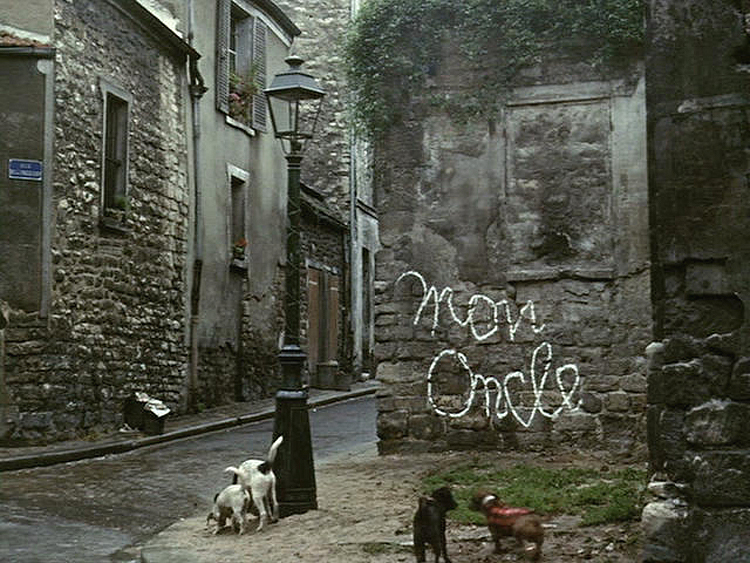
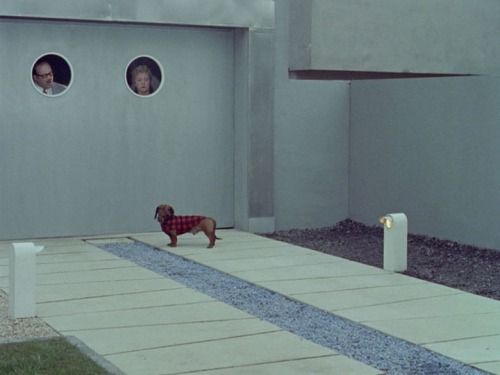
While the film initially appears as a traditional narrative about technological progress, this narrative is undermined in every hilarious and creative way that Tati can devise. We start with credits presented as signs at a construction site, then the scene shifts to an older part of the city, where we see the film title, Mon Oncle, scrawled in cursive on a wall. The difference couldn’t be more obvious, but we are about to see the importance of this difference, as we track a dog and his canine friends to the Arpels’s house, where the dog returns home, leaving his buddies behind at the gate.
With abstracted lines and shapes, the house – before the era of AI slop – is more of an idea of a house. Lacking any sense of jouissance, the house is liable to make a French viewer cry out, “Quel horror!” The dog, once let through the gate, speedily traverses a wildly convoluted stone walkway to get to the house, a path, which, as we will see repeatedly in the film, humans have the utmost difficulty navigating. In technical terms, the house reflects a critical lack of ergonomic planning. Put more bluntly, from any human-design perspective, this house sucks.
That the pathway to the house seems unnecessarily complicated will immediately register, as intense frustration, to anyone now trying to use an AI search engine. In other uncanny ways, the house symbolizes a very big problem with AI: it simply does not seem very well designed for human use; AI’s sycophancy is all the more indicative of this problem.
Mon Oncle depicts what happens to humans living in an unfriendly hi-tech environment. When Hulot, used to the friendlier low-tech environment of the older part of the city, arrives at his in-laws’ house, any question of his adapting to it is comically mocked. Hulot takes a glass from the kitchen cabinet and accidentally drops it. The glass, made of a synthetic material, bounces upon hitting the ground. Amused, Hulot drops another glass, only to have it shatter on impact. The point of the joke is, certainly, that machines can make a world which seems, to us, real. But a more subtle, unsettling idea is that we start to assume that we can technologically remake the foundations of our daily lived reality, such as the crucial distinction between what is breakable and what is not. Which is to say that we should’ve shut down the tech-bro mantra of “move fast and break things,” before it could metastasize.
A clever move, on Tati’s part, is to make the Arpels seem, at first glimpse, anyway, as not morally bad people. They are, however, completely unaware of how the world that they have made is perceived – painfully, obviously, so – by other people. It doesn’t require, for example, a licensed chiropractor to observe that the furniture in the house is extremely uncomfortable. It also doesn’t take someone with highly-acute hearing to recoil from the clacking of feet on the hard polished floors, a sound that, as the film goes on, becomes all the more distracting. And no trained chef is necessary to regard the amount of kitchen gadgetry, used to prepare and serve a boiled egg, with borderline disgust.
At this point, Tati is tempting the viewer to turn contrarian and ask if the discomfort of visitors to this house is, really, all that big of a deal. Well, he has a powerful response ready to go, articulated by the shift, in location, to the plastics factory where Hulot is hired, through an arrangement made by his in laws. There are more complicated machines, additional clacking of feet – but the suspense is ramped up, as we realize that the smallest mishap could lead to workplace disaster. Even if Hulot looks to be on the more sensitive side, it’s hard to imagine anyone who wouldn’t be knocked out by a severe gas leak. Which happens to Hulot. Although the crisis gets resolved before any major damage occurs, mountains of plastic waste remain.
In the late 1950s, this outcome has a jovial feeling. But in our current time of escalating climate-change crisis, plastics polluting our oceans is far more serious. We must, perforce, reconsider the Arpels, Hulot’s seemingly innocuous in laws. All of the energy that, for instance, it takes to boil an egg in their kitchen is wasteful, a scaled-down version of AI’s trashing our ecosystem for the most questionable benefit of convenience. The Arpels moreover, do not just discomfort others; they are a potential threat to themselves. As a wedding-anniversary gift for her husband, Hulot’s sister buys an automatic door opener synched to a photo-electric eye in front of the garage. After taking the car out for a celebratory drive, they open the door and park in the garage. But the dog inadvertently gets in the way of the eye, trapping the two people inside. In doubly-good fortune for them, the car engine has already been turned off, and the dog has the intelligence, when called, to retrace his steps, opening the door.
At the end of the film, Hulot, predictably blamed for the debacle at the plastics fantasy, is, in a follow-up arrangement made by his in laws, hired for another job in the provinces. But, no matter, because Hulot will bring jouissance wherever he goes. And back in the city, Gerald takes the initiative to change his father, Hulot’s brother in law, into a less uptight person, which gets off to a promising start. Not only does Hulot change with the times and not get left behind, in an anticipatory riposte to the AI cheerleaders’ threats; Mon Oncle remains self-aware of the challenges of hi-tech. By putting his own credit on a construction sign, Tati signals his own responsibility for continuing to make art against the dictum of progress, which too often forces artists into conformist dead ends. That damn house, moreover, amplifies Gilliatt’s observation, that people such as the Arpels “have no grasp of their scale in the universe,” a misrecognition that has built the shoddy towers of AI, ready to fall in the slightest breeze.
This is great. The Arpels’ house–and the AI it prefigures–really does have all the waste and inefficiency of a Rube Goldberg device without even any of the charm and sense of a guiding, eccentric human intelligence (jouissane, really, as you said). Even fully human missteps and fuck-ups are better than where this road gets you, in short.
Also, I’d forgotten how adorable that dog is.