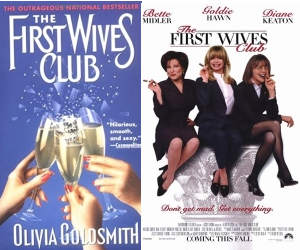
Olivia Goldsmith died relatively young. She had a heart attack as a complication from elective cosmetic surgery. It’s quite clear that Goldsmith was aware of the value society places on looks, given that most of the eleven books she published (two posthumously) were about women dealing with the expectations of society. Women whose lives were valued because of their looks. Women who needed to look a certain way in order to succeed. But also, of course, women who, in the natural course of aging, became “not pretty enough” and were forced to fight for a partner who was more interested in going for someone younger instead.
Such is the story of Cynthia Swann Griffin. The day after her ex-husband married his second wife, she jumped off the terrace of her upscale Manhattan penthouse. At her funeral, her three best friends from college are reunited. Elise Elliot is an actress, pursuing youth rather than end up playing the kinds of roles Hollywood allows for middle aged women. Brenda Cushman is struggling after her husband Morty left her, insisting that, despite the successful chain of electronics stores he owns, he is too poor to pay living expenses for her and their son. Annie MacDuggan is something of a doormat, whose husband Aaron is leaving her for their therapist. The women decide that the men, including Cynthia’s husband, should pay.
The movie is roughly the same, with Stockard Channing as the late Cynthia. Elise is Goldie Hawn, Brenda is Bette Midler, and Annie is Diane Keaton. Together, the trio form the First Wives Club, with the intention of making men treat the women who helped bring them to prominence and success. Gil Griffin (James Naughton) used Cynthia’s money to build his career. Bill Atchison (Victor Garber), Elise’s husband, was taught by Elise how to produce and is now demanding half their assets plus alimony—though his career is still going. Morton Cushman (Dan Hedaya) started his business with stolen property given to him by Brenda’s shady relatives. Aaron MacDuggan (admitted pedophile Stephen Collins) similarly built his career on Annie’s support.
One of the things the story recognizes is that the women need to work together. Okay, I do place a certain amount of blame on Dr. Leslie Rosen (Marcia Gay Harden), because what kind of sleazy therapist sleeps with a patient—while treating the patient’s wife as well? And, sure, Shelly Stewart (Sarah Jessica Parker) is something of a gold-digger, not to mention an uncultured social climber. But the problem with Bill is not caused by Phoebe LaVelle (Elizabeth Berkley), Struggling Actress; it’s caused by the fact that Bill is a creep who insists that things like gifts are in fact community property.
It’s also true that happiness for all three women looks different. Elise, rather than playing the mother in a film directed by a very young Timothy Olyphant, got sober and went on the stage. Brenda really does want Morty back, Gods help her. Annie needs to find the strength that Cynthia believed she had. However, the unifying happiness is their friendship with one another and their support of other women. There’s an early scene in a gay bar, where they’ve gone to talk to Annie’s daughter Chris (Jennifer Dundas), wherein Brenda is able to sympathize with a woman other than her friends who has also been dumped, because being left after a very long time together is a painful experience no matter what.
What’s deeply frustrating about this whole thing is that the movie was wildly successful despite the studio’s predictions. Everyone involved was told that it would fail at the box office, especially since it was released the same weekend as a Bruce Willis action film. (Last Man Standing, yet another Yojimbo remake.) Which The First Wives Club skunked; it was on about six hundred fewer screens and made well over twice as much. A Jean-Claude Van Damme movie, Maximum Risk, was in its second weekend of release, and The First Wives Club made more than the two put together. And of course, it was seen as a fluke. It didn’t change any minds about the possible success of a movie aimed at middle-aged women—the three are all about the same age and all turned fifty during production.