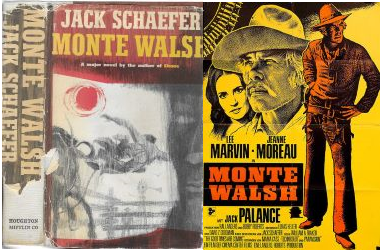
The Western is generally set in the 1880s. This is actually near the end of the Old West era. One of the issues is the invention of barbed wire, which led to the closing of the range. I don’t pretend to understand all the issues at hand, but in short, when barbed wire spread to the West and people began fencing things in, that was an ending time. The problem, of course, is that every ending means change for the people who lived there before. Not everyone is capable of that change.
Monte Walsh, by Jack Schaefer, is the story of one such person. At the age of sixteen, Monte Walsh got tired of being beaten by the men his mother brought home to replace his dead father. He refuses to take it anymore. He takes a horse just far enough to be far away, then he sets out on foot. As years go by, he is able to ride any horse and do any job. He meets up with Chet Rollins, and they move from ranch to ranch, working and fighting and drinking. They do a lot of cattle drives and roam from the Mexico border to the Canada border, eventually joining up at the Slash-Y, a ranch run by Cal Brennan but owned by an eastern consortium.
This is roughly where the movie starts. Monte is Lee Marvin and Chet is Jack Palance, and they are hired on by Jim Davis as Cal Brennan. There are not a lot of jobs left for men of their sort. Even Cal cannot take on as many men as need jobs. The men are doing what they’re accustomed to—but there’s a sense of finality to it. Fightin’ Joe Hooker (John McLiam), a former Union soldier who took his commanding officer’s name, is fencing in the land. Chet is casting an eye at Mary Eagle (Allyn Ann McLerie), the “hardware widow.” And Martine Bernard (Jeanne Moreau) is casting an eye at Monte.
You can’t keep progress from happening. People have learned that the hard way for a long, long time. Presumably there were once flint-knappers who lost their jobs to bronze workers. Possibly even people who had kill with one kind of flint tool who lost out when others were developed. And there has always been the question of what those people will do next. This isn’t helped by the fact that Monte and Chet have lived a life that is by definition outside most of society. They have been alone in the company of other rough men. What place is left for them?
The book starts by showing us each year in Monte’s early life, in which he grows into who he is. We don’t get the same for Chet, but we know he lived on a farm in Illinois, and we know he’s determined never to go behind a plow again. There are younger men who are living the same sort of life, and what now? Late in the movie, the point is raised that there were, ten or fifteen years earlier, who knows how many cowboys in the country. And there are many fewer now. In the book, when Cal is trying to hire his men, some of the men he seeks are married and others are dead, and that’s the way of it.
The movie came at the end of the era for Hollywood Westerns, in a way. Oh, they still make them, but they don’t make anywhere near as many as they used to. Lee Marvin and Jack Palance both made a lot of Westerns; I don’t even want to count how many they made between them. And they both won Oscars for them—both for comedic Westerns. That is how they ended the era. It’s still more dignified than how things ended for men who couldn’t grow with the times. Frankly it’s more dignified than a lot of the not-Westerns Jack Palance made.
Next month, we’ll be getting into early Whoopi Goldberg. Stay tuned for Burglar, which promises to be deeply weird.