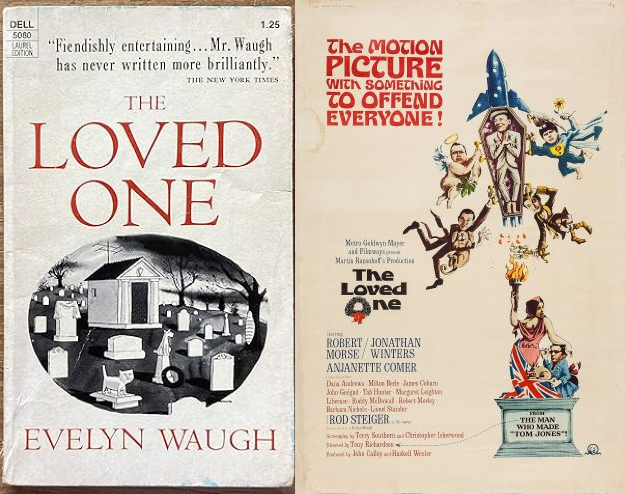
I am unusually steeped in death for a woman of my era. Sure, we could all tell you about Mr. Hooper, and we know where we were when we found out about Challenger and Kurt Cobain, but there were few prominent deaths in our era other than those until 9/11. I have friends my age who have only ever been to one or two funerals, friends not much younger who have never been to any. One of my earliest memories is my older sister’s godfather’s funeral, and of course there’s a lot to be said about my dad’s and how that shaped me. But I actually attended a funeral in 1994 at Forest Lawn Glendale, the Totally Not Subject of today’s piece. It was one of four important deaths in my life that school year.
In Eveyln Waugh’s The Loved One: An Anglo-American Tragedy, young Dennis Barlow, formerly a poet of some note, is living in Beverly Hills with an elderly relative, Sir Francis Hinsley, the first of the English brotherhood of film employees. He is fired, and he hangs himself. Barlow is an employee at the Happier Hunting Ground, a pet cemetery, to the horror of Sir Ambrose Abercrombie, head of the club of expatriates in Hollywood. The club raises the funds for a “proper” funeral, which sends Barlow to Whispering Glades, where he meets Aimée Thanatogenos, a cosmetologist there.
Aimée is a woman of no particular religion, named after Aimée Semple McPherson, who believes passionately in what she’s doing but seems possessed of few other interests. She writes to “the Guru Brahmin,” a columnist, for advice, not knowing that he is in fact invented by the paper. She is pursued by both the frankly odious Barlow and by Mr. Joyboy, one of the embalmers. Who is, honestly, not a ton better. She’s clearly adrift, because she was never really given anything to believe in but death.
In the 1965 movie The Loved One, Dennis Barlow (Robert Morse), who’s written a few poems, comes to Beverly Hills in a completely random way—he’s won a free trip anywhere in the world from British Airways—and goes to visit an elderly relative, Sir Francis Hinsley (John Gielgud), the first of the English brotherhood of film employees. He is fired, and he hangs himself. Barlow doesn’t really have a job, but Sir Ambrose Abercrombie (Robert Morley), head of the British club in Hollywood, raises the funds for a “proper” funeral, which sends Barlow to Whispering Glades, where he meets Aimée Thanatogenos, a cosmetologist there.
Aimée appears to be a member of a cult that worships Reverend Wilbur Glenworthy (Jonathan Winters). She writes to “the Guru Brahmin,” a columnist, for advice, not knowing that he is in fact invented by the paper. She is pursued by both the frankly odious Barlow and by Mr. Joyboy (Rod Steiger), one of the embalmers. Who is somewhat better but boy we’ll get to how he’s been changed. Being around Barlow sets her adrift despite her being passionately dedicated to the Blessed Reverend.
It’s hard to say which version was more appalling. Both treat Aimée quite badly. Half the male cast of the movie at least tries to sexually assault her, and in neither version do the two men pursuing her most openly seem to bother getting to know her as a person. The only other female character of any note is Mrs. Joyboy, Mr. Joyboy’s mother. In the book, she’s domineering and crude. In the movie, she’s jovial—but fat and crude instead. It’s adding yet another layer of bigotry, and boy that’s worth watching, isn’t it!
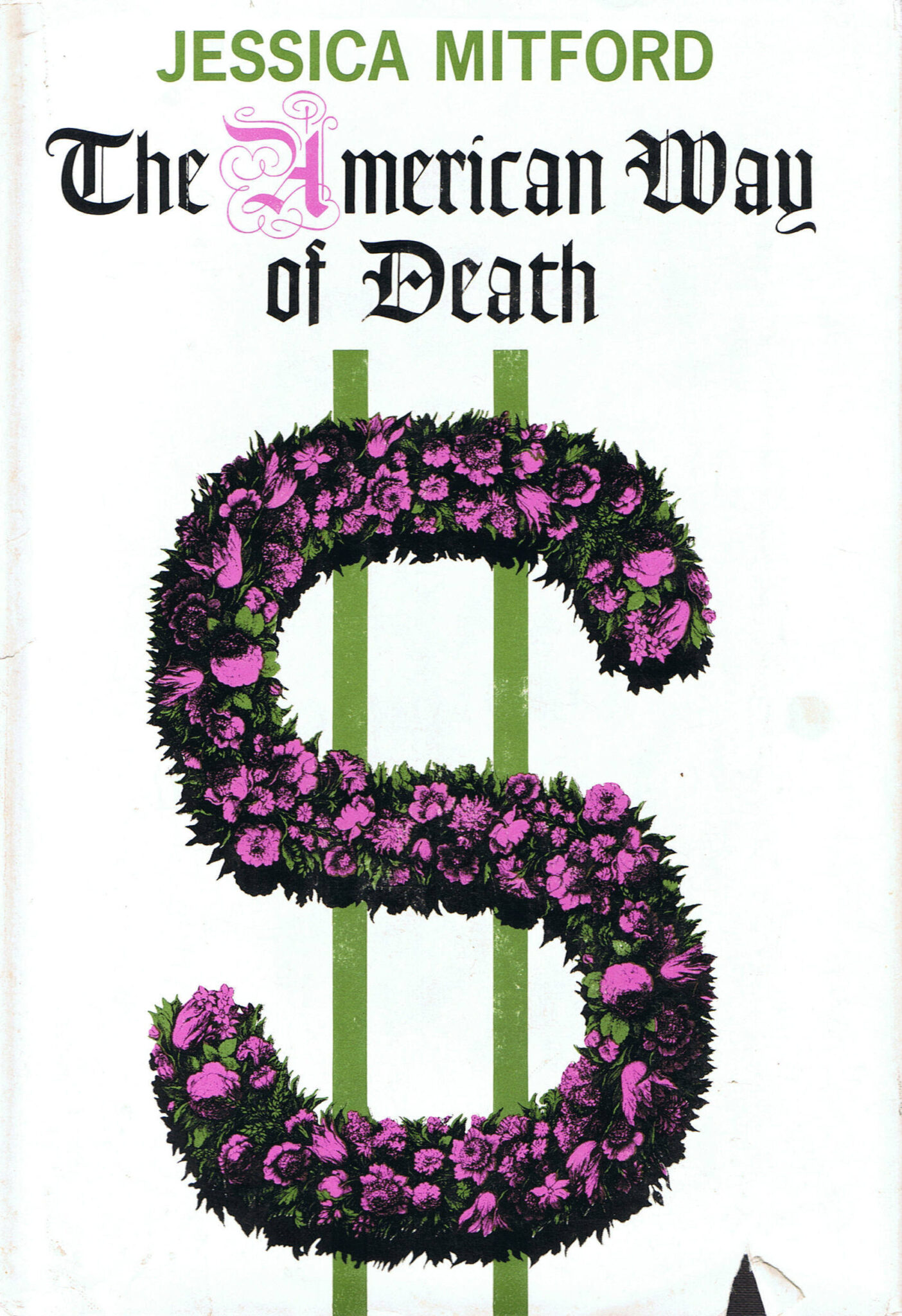
I think the problem is that the story refuses to pick an issue. There’s a lot to say about the American funeral industry, and it hasn’t gotten better in the decades since then. I remember back in the ‘80s my mom talking about owing the funeral home for my dad’s funeral, and he was a veteran. I read the 1963 classic The American Way of Death for this, and in those days, the average American funeral was well over a thousand dollars before we adjust for inflation. Caitlin Doughty talked a lot about it in her video about Kennedy’s funeral, and that’s a much more thoughtful explanation of the problem.
Waugh said he was driven to write about the American funeral system. Jessica Mitford said that British people in the US refused to go to a second funeral there because it was so creepy. And I mean neither were wrong, in my opinion. I have no interest in viewing the body—I remember my sister getting one of my dad’s pallbearers to put a valentine in the casket so neither of us would have to do it and look at my dad’s body—and in fact have been very clear that I want to be composted. Mitford was doing work that would be carried on by Doughty, talking about how you do not in fact need the enormous casket and the embalming and the hundreds to thousands of dollars in flowers and so forth.
But Waugh rather loses the plot, and he’s closer on it than the movie is. While the movie does give us the cult-like following among the lovely young women of Whispering Glades, not to mention Liberace as a smarmy coffin salesman, it also turns Glenworthy into a cold businessman who’s one of the people to attack Aimée and lead to her ultimate fate. Barlow works for Harry Glenworthy, the reverend’s cousin, who is fired from the studio himself and sent to work at the pet cemetery. They meet young Gunther Fry (baby Paul Williams), which brings us to a subplot about shooting bodies into space because the funeral industry is no longer profitable. Which, uh, the site I found for an average price for a funeral says it costs $8300 (or $9995 with a vault) even before adding on things like “paying for a plot.”
Oh, but it does say that embalming is an expense that’s universal regardless of whether you want to be buried or cremated. Which it isn’t and doesn’t have to be and don’t let anyone tell you different. Some states have specific laws about embalming, though many of them are “or refrigeration” or regard something to do with specific communicable diseases. A lot of the laws are changing, in part due to the advocacy of people who may or may not have read their Mitford but have definitely watched their Doughty. Know your rights—and pester your government more than the funeral directors do.
It took me a couple of rewatches, but my interpretation is that the land in which people have been buried is too valuable to let it just sit there. So they get rid of the bodies by shooting them into space. It’s a morbidly funny riff on the notion, paraphrasing Mike Davis, that people in LA love their families, but they love the value of real estate more.
That’s explicitly said, but Mitford explains the finances of why that simply isn’t true.
I need to re-read Mitford (Waugh dedicated THE LOVED ONE to her before her book was published, and his travelogue through the process of the funeral process mirrors what I remember of it). The popularity of THE AMERICAN WAY OF DEATH clearly inspired Hollywood to revive interest in Waugh’s book.
Many of those who contribute and read this site know that I am obsessed with THE LOVED ONE film, and that the only reason I’ve failed to produce any meaningful writing on it here or at THE SOLUTE is because, like the movie, the many rabbit holes I’ve gone down with it (along with another contributor here) fail to cohere into a singular line of thought worthy of a concise essay. In that light, I’d like to offer a few random abservations.
1. The film is both a chronicle of the end of a particular era of Hollywood storytelling, and symptomatic of that collapse, embracing many of the factors that challenged the morality of taste embodied in the ancient regime (namely, the subversive deployment of camp aethetics, dosed in “sick” humor, in substitution of Waugh’s dry wit) while succumbing to disciplinary laxness of traditional narrative world (and character) building in lieu of stringing together comedic sketches, undoubtedly reflecting television’s influence over the medium. Few films have been so obviously poisoned by the cake it was both having and eating.
2. The novel’s main idea was to satirize the spiritual demise of European classicism under the control of American capitalism and Protestantism. Waugh was very much a tourist who shared, along with other emigre artists (many of whom returned to Europe when the fortunes improved) the view that the rationalization of mass production drained art of its transcendental and spritual qualities. Aimee’s suicide, in the book, is prompted by a brief glimpse into the sublime in the form of sun and landscape, and how empty, outside of that ephemeral revelation, her values and culture. By leaving that out, I think her actions are merely the result of her disappointment of men and the patriarchal utopian visions they manipulate.
3. Whereas Waugh’s view is a conservatives take on the decline of Occidental culture, The film offers a broader satire of California’s political economy, and how Hollywood, Forest Lawn, and the militarization of the industrial rim define it’s cultural exceptionalism. Namely, the troika of real estate, mass culture, and self regulated corporate growth sans political oversite, are put together in this version that presents a powerful vision of the modern Los Angeles dystopia that informs its late 20th century cyberpunk, neo-noir, and magic realist representations.
Feel free to respond to these ideas. I’d love to include you in my journey through this provacative, if maddiningly dysfunctional, work.
Even, despite John Cassavetes’s legendary refusal, starting with SHADOWS, to ever get to the point in the films that he’s written and directed, these films all have, at least, a momentary sense of a center. Which makes it all the weirder that THE LOVED ONE simply doesn’t have one.
That’s a good point. I think the problem starts with Barlow, whose knavery is introduced well into the movie after being introduced as a naive dolt. Parts of Waugh’s version of the character were inspired by British gay exile poets and writers who abandoned England, took up residence in Los Angeles and embraced pacifism. Ironically One of those fugures, Christopher Isherwood, worked on the film’s screenplay. I doubt that he was a fan.
From what I read he and Isherwood hated each other and he was furious that Isherwood was hired.
Waugh was conflicted about his sexuality, and turned to Roman Catholicism as a way of establishing what he felt was a moral path towards accepting it as sin and setting a moral path from that concept onward. Isherwood learned to accept his sexuality and turned towards Hinduism and Buddhism as a path towards inner peace with it. Isherwood, and W.H. Auden, who were often conflated by certain critics as part of a confederacy of gay poets, who were also pacifists who sat out WWII as conscientious objectors, finding refuge in America where their sexual orintation would have excluded them from military service.
Isherwood would have been an odd duck when it came to adapting the book, as, unlike Waugh, and like many other English intellectuals who came to Los Angeles (like Aldous Huxley), he was inspired by a tendency in the region (again, outlined by Mike Davis) to find a holistic connection between science and spirituality. Waugh couldn’t tolerate this reconciliation of the sublime with modernism, and the sublimination of spiritual awakening (through the sublime) to simulation. Both would have found Forest Lawn as abominable kitsch, but their attitudes would have been different, Waugh was like the Eagles, appalled at the profane performativeness of piety in the cultural wasteland. Isherwood probably was like Steely Dan, more amused by the display but not dismissive of the impulse for spiritual reflection such simulations were designed for.
From the look of it, the version of the film we see seems to have been shaped by Terry Southern, whose dark comic influences seem heavily influenced by Lenny Bruce and the emergent sexual revolution pervading circles of power in Los Angeles. This constitutes part of a “dark legend” pervading L.A. and misogynistic violence that has been a source of urban legend (aka John Whiteside Parsons, George Horell and the Black Dahlia) and an increasingly important part of its paranoid literary and cinematic landscape.