While MASH was often cheerfully disconnected from its theoretical time, one of the stranger moments to viewers who didn’t actually remember the Korean War was when BJ was peeking over the edge of a dusty bus window and Hawkeye wrote “Kilroy” underneath him. I don’t know if that’s where I first learned about the idea of “Kilroy was here,” but I’ve since learned that the graffiti popped up all over the place for years, dating to possibly 1937 but at least 1939. It may have been predated by twenty years by the Australian “Foo was here.” Kilroy allegedly confused Stalin at Potsdam and was speculated to be an American code by German intelligence.
I was afraid I was going to have to read Richard Dawkins for this, but while he named the meme, he said the idea of one was older, so his specific phrasing isn’t important. The thought of a meme was based on the concept that ideas spread in ways not dissimilar to genes, and they are self-replicating units that go from person to person. They were intended to be to culture what a gene is to biology. Obviously, this isn’t quite what the term is used to mean today—from what I can tell, Dawkins wishes we’d call internet memes something else, but I’m not inclined to care what he thinks.
Probably the first memes kids used to learn were nursery rhymes, jump-roping rhymes, and hand-clapping rhymes. I’m fairly sure that the ones I learned in Southern California in the ‘80s were the same as ones learned decades earlier and thousands of miles away. I’ve seen some in books—more so the nursery rhymes, obviously—but that’s not where we learned about a majority of them. You’d learn them from either an older kid or a kid your age who’d learned them from an older kid. It’s impossible to say for sure how far back some of the rhymes go because of how seldom they were written down.
There were the perpetual parodies, too—new ones cropped up, especially when Weird Al’s career took off, but how many generations of kids sang, “Jingle bells, Batman smells”? Mark Hamill sang it as the Joker on an episode, at which point I myself had already known that version for at least a decade. Probably the Barney ones haven’t lingered, but my goodness those spread quickly, passed from kid to kid with variations either from how easy bits of it were or by the general process of how things like that spread.
Even outside the childhood sphere, though, there were versions. Kilroy, of course. The Xeroxlore discussed by Jan Harold Brunvald, possibly the only person to have discussed urban legends in both an academic and popular nonfiction medium. One person deliberately poisoned his son’s Halloween candy—and another kid’s, to throw off suspicion—and generations of us had our candy checked because Everyone Knows weirdos poison Halloween candy. Stories passed from hand to hand and office to office about organ theft and blue star acid.
Like urban legends, jokes were often collected only after having been spread orally for goodness knows how long. I know musician jokes that I learned from my high school band teacher—he was a drummer and I played viola and we told jokes at one another’s expense for most of my high school career. You can find pages of them now, but obviously that’s not where we learned them. They were told to us by other musicians, and we told them to one another, even after one or two of the drummer ones became kind of pointed given his personal situation.
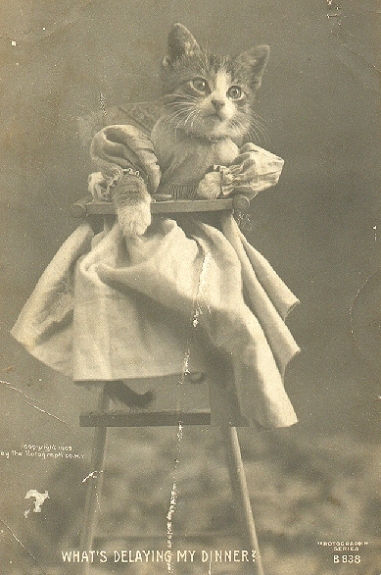
Even some phenomena that are thought of as being part of the internet age are far older. The original Lolcats were Victorian and were printed as postcards. I grant you that Rickrolling relied on the creation not just of “Never Gonna Give You Up” and then YouTube to provide a link to the video, but jokes about slipping something into someone’s speech or slideshow or similar well predates that, to the point that there’s a comedy sketch about that involving a quiz show most of which I cannot now remember to look up.
In The Science of Discworld, Ian Stewart and Jack Cohen reject the title of Homo sapiens for our species, saying that calling ourselves thinking or wise misses quite a lot. I’ve since learned enough primatology to know that they’re overstating how close we are and what genus we should be, but they declare us instead Pan narrans, the storytelling ape. This is how I’m talking to you, how we talk to one another. The Star Trek: The Next Generation episode “Darmok” has some issues from a linguistic perspective, but the idea of expressing ourselves through stories is also something humans do.
Memes spread before the internet. I don’t know if there will be a time after the internet, or if it’s akin to writing and a version of it will shape our species for the foreseeable future, but even the kinds of memes that I knew as a child continue to spread in the same way. I could probably ask my kids about some of the rhymes I learned when I was younger than they are now and have them recite them back to me, never having seen them on the internet. Word spreads. We add new ways, but we seldom remove old ones.