This article is co-written with John Anderson (aka Son of Griff)
“Counterfeit” is most commonly used to describe money – more specifically, “funny money” — but it can describe any combination of imitative objects, persons, or places with larcenous intent. On the DVD commentary track for To Live and Die in L.A., director William Friedkin stated that he intended counterfeit currency to serve as a metaphor for Los Angeles, comprising a sort of a covert roman à clef about Hollywood, whose film industry has long been accused of cultural falsification. Depression-era writers from Raymond Chandler to Nathanael West preceded Friedkin in connecting the city’s noir identity to its most high-profile business, but he is among the few to use counterfeit money to symbolically represent the movies and the metropolis that produces them.
1947’s T-Men and 1985’s To Live and Die in L.A. not only connect Los Angeles’ and Hollywood’s presumed inauthenticity to counterfeit bills; they also show the changes in how that connection was represented over the course of nearly four decades. Both films trace the U.S. Secret Service’s policing of the Southern Californian marketplace via undercover surveillance and false identities, valorizing the professionalism of its agents even as they pose, and act, like criminals. This “dark double” trope, in which law enforcement mimics criminal behavior, documents shifts in public tastes and cinematic norms.
T-Men sets the template that To Live and Die in L.A. looks to revise. The 1947 film incorporates numerous stylistic trends associated with post-WWII cinema, most notably the newsreel documentaries that ran before feature presentations during Hollywood’s so-called Golden Age. After the credits, for example, a printed scroll thanks the U.S. Treasury Department for their cooperation in allowing real money to be used in the making of the film. It is followed by a stentorian voiceover describing the Secret Service’s purpose transposed over a splendorous neoclassical image of the Treasury Building. T-Men then cuts into another introduction by the head of the department’s currency investigation division, who explains how the story that we are about to see, the “Shanghai Paper Case,” exemplifies the process by which the Bureau arrests counterfeiters. The voiceover occasionally returns to provide expository shorthand throughout the film.
A crucial perception is that T-Men attempts to shift romanticism from watching heroes and villains engage in cat-and-mouse chases to observing men acting as professionals, as they conceal their individual identities.
This use of documentary techniques sets a pedagogical tone that T-Men returns to throughout its melodramatic narrative. It announces a sense of urgency, and even necessity, in communicating its need to didactically depict certain moments. By today’s standards, this imposition of legalistic authority over a romanticized film-noir suspense caper feels gratuitous, even clumsy, in how it displaces the viewer’s engagement with the story’s momentum.
Other techniques T-Men utilizes to convey documentary authenticity are less obtrusive. Italian neorealism, for one example, is referenced through the film’s on-location shoots of L.A. landmarks like Chinatown (memorably in one shot showing the neighborhood adjacent to Union Station, which bisected the community in a 1936 urban redevelopment plan) and the Farmers’ Market. This sense of authenticity supports the newsreel-esque viewpoint established at the film’s beginning and sustained through its narrator’s interventions. However, T-Men heavily employs the film-noir aesthetics of postwar crime cinema in its use of chiaroscuro lighting, high and low camera angles, and stock chronotopes (a term which will be explored further below) such as dingy rooming houses, seedy pool halls, Turkish baths, and Tiki-themed nightclubs. These are sites that portray social interactions within a (very generalized) geographical specificity; namely, they depict the inner city, as opposed to the suburbs. This distinction is a crucial component in understanding how T-Men reconciles its stylistic fragments into narrative and ideological coherence.
Film noir’s aesthetics arouse feelings of pleasure with male performativity and the simulated exoticism of the inner city’s cosmopolitan diversity. These tropes of performativity and exoticism – operating outside the parameters of verbal exposition conveyed by the quasi-newsreel footage – allow viewers to process the film’s emotional tone through imagery and associations with imagined spaces conveyed through other film noirs. T-Men seeks to integrate the pedagogical aspects of the documentary and the sensational designs of urban “high” tourism; what Thom Anderson, in Los Angeles Plays Itself, refers to as the unsanctioned proletarian spaces outside of the more celebrated, manufactured tourist locations promoted by civic boosters and the travel industry (Anderson, 2003).
Does T-Men maintain a documentary-style realism while guiding viewers to a “legally sanctioned” interpretation? Taking up this question foregrounds systems theory, more popularly known as cybernetics (see Bruni, 2014). As Cary Wolfe, an observed communication of any message – especially a clearly didactic one, in this case using newspaper headlines, and direct addresses by government officials to the camera – might feel as if it slows and destabilizes our “processing” of the film. Perhaps counterintuitively, the most recognizably cinematic moments appear to give us an “immediacy” that helps to lock in the interpretation endorsed by the legal system. In other words, because perception has, technically, a faster processing speed than communication, our perception of T-Men doesn’t seem to pressure our overall observations of its formal strategies as much as our awareness of its ventures into didacticism does. Such a critical question sheds light on how a systems-theoretical interpretation of any artwork hinges on its “re-entry” of the difference between perception and communication (which, in an analysis of T-Men, would look at how film, as part of the system of art, differentiates itself from the messaging of the legal system) (Wolfe, 2010).
Crucially, T-Men attempts to shift romanticism from watching heroes and villains engage in cat-and-mouse chases to observing men acting as professionals as they conceal their individual identities. On the surface, T-Men’s voiceovers underscore the Secret Service’s efforts to uphold the integrity of American currency from the wiles of organized crime. It educates the public as to how the government conducts its war on counterfeiting. The plot centers on two agents, O’ Brien and Genaro, who become partners as they perfect the art of impersonating underworld hoods by extensively researching the history and transnational interconnections of criminal “families,” as well as their sartorial tastes and vocabulary. Counterfeit gangsters, in short, pursue counterfeit money, and they have already lost any anchorages with more stable forms of identity.
The criminal families, in particular, are depicted as complex systems that are not reducible to human elements; they are constituted by and through transnational capital flows and material resources for the production and distribution of counterfeit money. For the legal system, operationally, there are no problems with forays into illegal realms to dismantle such systems. But for any observers, including, of course, film viewers, there might be problems, because, as Wolfe explains, any observation of the legal system discloses that it can only make decisions based on what’s legal, as opposed to what’s illegal; in T-Men, the crucial determination is what is real currency, so as to exclude any counterfeit money from federal protection. This is to say that the film dramatizes the tension produced by the clash of legal and illegal systems.
The film’s depiction of the legal system details how the two agents are supported by various Treasury sub-branches (or subsystems) of chemists and analysts in Washington, DC, who interpret the agents’ collected data and information and relay it back down to the street. Conversely, the observations of illegal systems map onto the Santucci gang that runs the counterfeiting ring, mirroring the process by which the government prints money and distinguishes real from counterfeit currency. The gang’s transnational operation obtains paper from China, uses its own ships to import the “raw” counterfeit money, and “pushes” its wares through American cities controlled via a network of cooperating capos.
When Genaro’s identity comes under suspicion, for example, it’s clear that this ring has inserted “moles” in the Secret Service in order to gather intelligence; it also has an array of experts (some of them private contractors) utilizing insider knowledge of the production and identification of false bills. The criminal underworld, in short, constitutes a systemic illegal operation, creating a strategic counteroffensive imitating their opponent’s bureaucratic infrastructure, technical expertise, and scope of operations.
The film, furthermore, defines the operational breaching of system boundaries as an essential part of the legal strategy of containment, where it becomes necessary to break the letter of the law in order to uphold it. As these actions are legally sanctioned by the institutions valorized in the film’s “documentary” aspects, the dramaturgical narrative style merges with its legalistic messaging, papering over, to a degree, the communicative discrepancy in (and what a systems-theoretical analysis would call the “deferral” of) its genre integration.
T-Men’s depiction of the government’s attempts to suppress organized crime is highly instrumentalist, stressing the technocratic equivalency of the methods by which the government brings counterfeiters to justice and the counterfeiters’ attempts to thwart government surveillance. Only the underworld’s use of murder to protect its interests, as demonstrated in the violent demises of informants and even a treasury agent, marks the ethical boundaries of the combatants, and even those acts occur out of the operational necessity of keeping the ring under the proverbial wraps. The distillation of Los Angeles’ culturally specific sites into a noirscape of alienation and masculine performance is a strategy T-Men uses to delineate this distinction.
The film-noir diegesis of the 1940s is more than just a style; it is a chronotope, “a premise that, in existing both concretely and visibly in both the films and the culture, materially ground both the internal logic of the films and the external logic of the culture and allow each to be intelligible in terms of each other” (Sobchack, 1998). The onscreen drama that the characters experience is determined by the range of actions allowed by the constraints of place and time as facilitated through other media the viewer consumes or directly experiences. As in Crossfire (and other L.A. noirs of the late 1940s), T-Men’s settings comprise a male demimonde of alienated labor and mass consumerism, where identity is largely performative. Warehouses and the L.A. harbor spatially represent sites of industrial production where counterfeit cash intersects with the “real” economy backed by the value of money established by international commerce.
Rooming houses, tiki bars, and pool halls constitute modes of illicit consumption where male competition, such as drinking and gambling, foster a facade of camaraderie masking imminent betrayal. These are also spaces where illicit desires flourish under the cover of backlit smoke and steam. For example, the camera lingers on O’Brien’s mirthful smirks when he withstands torture and beatings, suggesting he derives some masochistic pleasure beyond professional necessity. Likewise, the camera’s voyeuristic gaze as O’Brien searches for a queer-coded pusher in Turkish steam baths is eroticized with a glistening sensuality in John Alton’s cinematography.
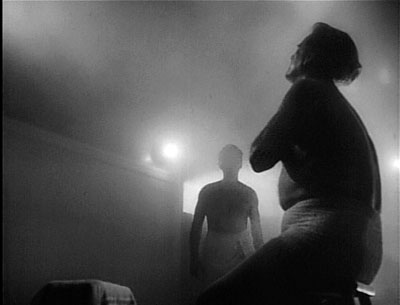
The processing of T-Men as a film-noir narrative catalyzes a darkly romantic manifestation of male desire heightened through scenes, such as O’Brien’s search, that do not only appear intensely immediate; they seem to oscillate between charged feelings of loathing and desire for intimacy. The “legal” sanctification staged by the film must contain male desire by differentiating it from a sanctioned space of domestic sublimation. Thus the film’s representation of the inner city enters a larger public discourse differentiating cities from the suburbs. The manufacture of counterfeit money becomes a metonym for an illicit array of transactions relegated to Robert Park’s inner circle of urbanism, the site of manufacturing and working-class housing. As historian Eric Avila argues, the inner city symbolized white, middle-class anxieties about the postwar economy and its dodgy moral landscape, giving the state the rationale to police and contain these zones of performance and imitation (Avila, 2004).
T-Men illustrates that, in such zones, the gendered demarcation of consumer behavior, as a containment strategy, has profound limits. In a scene set at the L.A. Farmers’ Market, Genaro’s wife and her friend spot him. The friend naïvely blows the agent’s cover in front of a potential bureau informant, and although the spouse tries to cover for her husband’s identity, her lie is not enough to defer suspicion once the informant is compelled to spill his information to the counterfeit ring. T-Men insists on a further separation between the public and private sphere as necessary for the greater good of public safety and operational security.
But here, the problem of identity – which will be reinforced through O’Brien’s reaction to Genaro’s fate – and its conflict with the legal system reemerges. As Wolfe points out, the legal system must maintain its own identity by preserving the crucial distinction between itself and the largely criminal environment in which it operates. And this distinction must come before and beyond any other distinctions — for example, the separation between spheres of influence (Wolfe 2010).
The film uses the need for this distinction as an opportunity to punish O’Brien for the pleasures he experiences in pursuit of the illegal paper. When Genaro is gunned down, he protects O’Brien by falsely claiming that he was the only T-Man in the operation. In contrast to earlier scenes, which linger on O-Brien’s delayed reactions of pleasure to the physical rigors of the job, he tilts his head downward, covering his eyes with his hat brim, so as to hide his sorrow in a genuinely emotional act that, under the scene’s dramatic context, cannot be expressed by an onscreen change in the actor’s visage. In this critical juncture, the noirish gesture of casting a shadow for the purpose of concealing an emotional reaction facilitates the legalistic formality of “showing” how officers operate in these circumstances. What they do must be regarded, operationally, as legal; otherwise, you might say, they wouldn’t be part of the legal system (which, granted, will have various iterations of complexity, ethical and otherwise, that need not be observed all at the same time).
This scene reconciles the communicative “messaging” of the legality of the film’s impersonations to its formal processing as a film noir. It legitimizes to the viewer these expansive new parameters, both spatially and operationally, for law enforcement actions and behaviors. By using the style of film noir to uphold an imaginary distinction between the forces of government and organized crime, the former can operate against the latter with a more malleable moral latitude. To quote The Big Lebowski’s tautologies of the “other” Lebowski, “strong men,” meaning those who resist the pressures of the system, “also cry.” Recognition of this fact establishes the domain in which the performance of strength triumphs over the weakness of need.
Put slightly differently, there is a recurring imperative in T-Men to limit critical observations of a murky ethical terrain. In systems-theoretical parlance, the film’s problematic ethical position reflects how the economic system exerts influence over, or “interpenetrates,” the domains of legal and illegal systems. From our viewpoint, the economic system then obscures the distinctions between what is legal and illegal, and, because its own functionality must be prioritized, can only regard anxieties about the “weak” boundaries of the domains of legal and illegal systems as, at best, a secondary concern) (Wolfe, 1998, 2010). As we will see in our next installment, analyzing To Live and Die in L.A., these distinctions seem even less discernible as the film industry’s relationship to the state frays under different postwar environments and circumstances.
Works Cited
Anderson, Thom. Los Angeles Plays Itself, Cinema Guild, 2003.
Avila, Eric. Popular Culture in the Age of White Flight: Fear and Fantasy in Suburban Los Angeles. University of California Press, 2004.
Bruni, John. “Expanding the Self-Referential Paradox: The Macy Conferences and the Second Wave of Cybernetic Thinking” in Traditions of Systems Theory: Major Figures and Contemporary Developments. Ed. Darrell P. Arnold, Routledge, 2014.
Friedkin, William. To Live and Die in L.A. MGM Home Video, 1985.
Mann, Anthony. T-Men, Eagle Lion Films, 1947. Accessed on TUBI 12-15-2024.
Sobchack, Vivian. “Lounge Time: Postwar Crisis and the Chronotope of Film Noir,” in Refiguring American Film Genres: Theory and History. Ed. Nick Browne, University of California Press, 1998.
Wolfe, Cary, Critical Environments: Postmodern Theory and the Pragmatics of the “Outside”. University of Minnesota Press, 1998.
Wolfe, Cary, What Is Posthumanism? University of Minnesota Press, 2010.
John Anderson (aka Son of Griff) is a San Diego-based researcher who has taught film history at several California universities and hosted the Movies and American Society telecourse on the Los Angeles public access channel. He has also assisted with programming efforts for the San Diego International Jewish Film Festival and the North County Film Club. Anderson co-hosted the Ellroycast podcast with Grant Nebel. He is currently working on a manuscript chronicling depictions of Los Angeles in American cinema.
T-Men is available on Tubi. Guess what I am watching tonight?
To Live and Die in LA is not available in streaming form legally. (Friedkin is a tough nut to crack. Sorceror has never been on any service I have access to.)
I’ll check in tomorrow to see what you think about it. I was fortunate to hang on to my 2003 DVD of TO LIVE AND DIE IN L.A. through various moves and purges or I would otherwise not complete this project. While it was given a high profile release in 1985 (I’m pretty sure I saw it in 70mm at the Mann National in Westwood opening weekend), I don’t think it was through a a major studio, which means that the video and streaming rights are probably in the hands of currently non-existent entities. SORCEROR ran on the Criterion Channel for a couple of months last year and is well worth checking out if it pops up somewhere again. The french movie its based on–THE WAGES OF FEAR, is also pretty good
Friedkin, like Robert Evans, was a fantastic ranconteur and completely full of himself. I had the pleasure of hearing him introduce a number of his films at the American Cinematheque, and the displeasure of watching him try to moderate discussions with other directors (namely, Seijin Suzuki) who didn’t speak English. The last time I saw TO LIVE AND DIE was in a director’s class at Chapman University around the mid 2000s where Friedkin talked about the shoot after the screening. It was a bit awkward because It was clear that for the most part the audience didn’t like the film that much.
I put my comments in the daily thread.
I saw Wages of Fear a long time ago, at the Walter Reade Theater at Lincoln Center. Marvelous if heavy work of cinema. Though Friedkin didn’t like anyone saying Sorceror was a remake.
Oh wow, this is fantastic, heady stuff. And more to come with TLADILA! One of the things that struck me toward the end of this is how the informant is rejected by both systems — the crooks hate him of course but the cops, who need him, seem pretty fine with him getting got immediately after he is useful. This is something that I’ve seen in other flicks from this time (thinking of Force of Evil) and the implications regarding squealing in Hollywood seem clear. As you get at, the mix of procedural and noir works really well here — there’s one point midway through(?) where the straight-up lecture that if I’m not mistaken is directed point-blank at the audience is pretty dopey, but otherwise the mix of modes makes the straight stuff murkier than it would otherwise be, as opposed to providing a clear contrast.
Good point concerning the Schemer. That character, the person whose slight betrayals are, for a good amount of time are tolerated because of a certain moderation in their snitching, is a favorite of mine. Thelma Ritter’s role as Mo in PICKUP ON SOUTH STREET is probably my favorite, and the saddest, of these characters. I simply love that her quirky ethical code allows her to sell info on Widmark to the cops but not to the “commies”, a hill that she literally dies on rather than bend to.
I just watched The Crimson Kimono last night (finally) and Anna Lee’s great Mac put me in mind of Ritter’s Mo, not in terms of scheming but in knocked-around independence and guts. Pickup is a great movie and part of its greatness is how it lets Ritter make that choice and puts her in the situation of snitching through the ecosystem you describe in T-Men — she is worked to the bone and ready to die, selling info* keeps her alive until it doesn’t, but she has nothing but contempt for the commies who are theoretically trying to upend that ecosystem (but are a just a third prong of the law/lawless dynamic where the sides take on each other’s aspects). All of this is portrayed, not spelled out. And yes, Ritter is just incredible in the movie.
*this feels slightly but crucially different than informing — Crimson Kimono has Charlie getting info from one of his snitches and it’s played straight as exchange, not the selling out that informing connotes.
I envy you watching the Crimson Kimono for the first time. It’s the film that I’ve probably turned more people onto than any other. One of the best books I’ve read on Hollywood’s blacklist era was Victor Navasky’s NAMING NAMES, which is centered on the decision not to inform as a value system that defines working class ideology and contempt for government infiltration into its affairs. I think it explains why McCarthyism failed and, rather unfortunately, why Trumpism has triumphed despite its obvious corruption.
Why does TLADILA! sound like something you’d shout at Carnaval?
Carnaval? William Friedkin? It’s time to watch the car chase in Jade again!
This is almost impressively unreadable! Love that you added “Works Cited” at the end.
Glad you liked it. And I’m especially happy that you noted our careful research. It’s people like you who really make what we’re doing seem worthwhile.