Sleeping Beauty is the most beautiful animated film ever created.
In 1937, Walt Disney Productions released Snow White and the Seven Dwarfs, the (give or take) first animated feature. The studio revisited the fairy-tale genre with 1950’s Cinderella. At about that time, Walt conceived the idea for a third in the series, this time with the French/German folktale “Sleeping Beauty,” the story of a beautiful princess cursed into a hundred-year slumber by an evil witch. But Walt feared another retread of Cinderella, which, while a critical and commercial success, was an artistic retrenchment after the more daring — and less successful — experiments of the 1940s like Bambi and Fantasia.
Enter painter Eyvind Earle, who joined Disney in 1951. Although Earle is not credited on the film, he took the lion’s share of responsibility for developing its look in personally creating the “background” paintings against which the action of the film is set (although they were hardly background — we’ll get to that in a sec). Earle leaned heavily on Medieval European art as his inspiration. In art history class they teach you that Western art came into its own during the Renaissance, with its greater emphasis on the personalization of human figures and realistic perspective. And they’re not wrong. But for this film, Earle returned to the earlier works, achieving a style less grounded in realism. Ironically, in this way the film’s look, with its sharp planes and angles, almost invokes the thoroughly modern art deco movement.
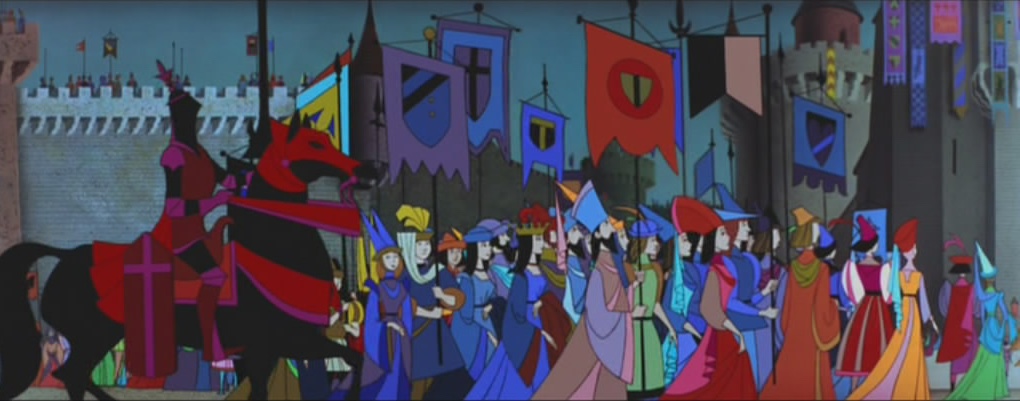
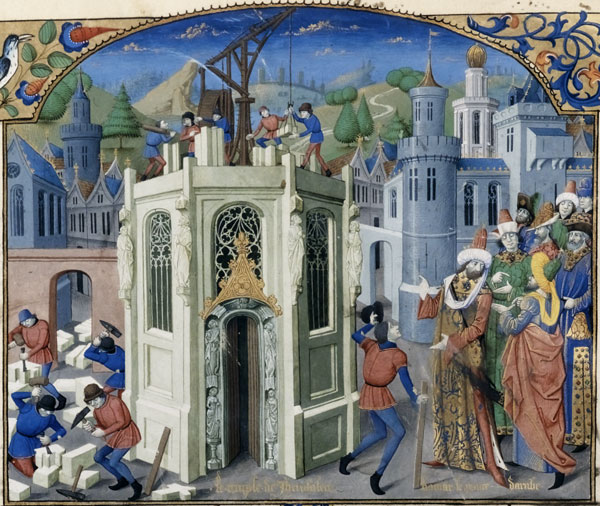
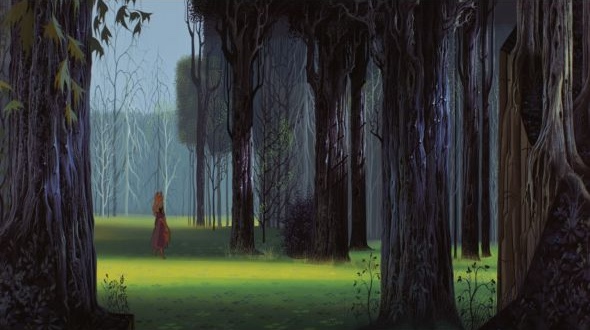
Even beyond his inspirations, Earle’s paintings are the showcase of the film. The level of detail is astounding. And rather than merely creating background setting, he places design elements in the front of the frame. For instance, the film’s middle section largely takes place in the forest where the good fairies have hidden Princess Aurora and raised her in anonymity. In many of these arboreal scenes, Earle foregrounds massive, gnarled oaks that demand attention as Aurora and Prince Philip flitter around them, while flat, rectangular, almost Impressionist trees dot the true background. There’s no doubt that Earle’s paintings are the real star of this picture.
Disney (the company and the man) fully supported Sleeping Beauty’s lofty artistic goals. They shot and exhibited the film in Super Technirama 70, a deluxe 70mm format developed by Technicolor Inc., which provided a 2.20:1 aspect ratio and four-channel stereo sound. The studio had designed its previous animated fare to be projected in mono, and no wider than Academy ratio. And Disney maximized the value of those four channels with a George Bruns score based largely on Tchaikovsky’s ballet adaption of the story. (Sleeping Beauty was the beginning of a fifteen-year collaboration between Bruns and the Mouse, during which the composer would be nominated for four Oscars and three Grammys.) All of these efforts cost the studio a whopping nine million dollars and almost eight years of production time.
If there is any quibble one could make with this film it is, unfortunately, the story. Disney jettisoned traditional elements of the fairy tale, such as the hundred years of slumber and the wall of thorns. It is hard to decry this choice, as it allows Aurora and Prince Philip to meet, fall in love, and choose each other. In the original, Aurora is wakened by just some guy who happened by and heard of the legend. But even in the ’50s, audiences would give the side-eye to a complete stranger macking on a sleeping teenager. However, granting Aurora this sliver of agency chops away at the movie’s dramatic heft, reducing a century of sleep to about ten minutes. (The rest of the castle’s inhabitants are also ensorcelled, not as part of the curse as in traditional versions, but by Aurora’s benevolent fairy guardians because they don’t want the king to yell at them.) At least the visual presentation of the climactic battle is constructed with the same verve as the rest of the film.
Sadly, audiences were less than impressed, and Sleeping Beauty was a big flop on initial release, making back less than half its costs. Disney audiences were more interested in The Shaggy Dog, a live-action romp where Tommy Kirk gets turned into a — well, you know. The loss of millions on the picture led to layoffs in the animation department and a philosophical turn to less expensive projects and techniques that would last decades. And while the creativity and talent left in the studio led to some strong successes in that time (such as One Hundred and One Dalmatians or The Jungle Book), the financial and stylistic conservatism in Disney Animation engendered by these losses persisted until the Disney Renaissance thirty years later. But forget all that and lose yourself again in Earle’s arresting imagery, and you will agree that Sleeping Beauty is the most beautiful animated film ever created.