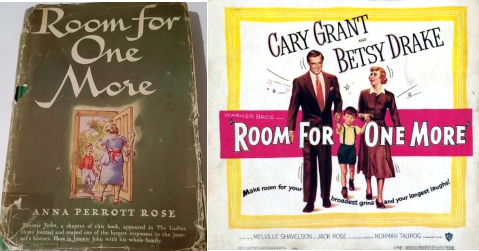
The foster care system is broken. However, it is definitely true that one of the problems is that there are not enough people, good people, who are willing and able to take in the older children who so desperately need loving homes. Everyone wants babies. Everyone finds excuses for not being willing to take in older children instead. I, in fact, am a birth mother; I was young, white, and in decent health in those days, and it was easy to find a home for my firstborn. If he’d been even a year older, it would’ve been substantially harder for him.
Anna Rose Wright was a writer of children’s fiction and nonfiction about children, and her husband, Arthur Wright, was a civil engineer; his book on the subject is still on Amazon. In 1950, she wrote a book of autobiography about her life as a foster mother. She and her husband had two biological daughters and one biological son— by age order, Trot, Tim, and Teensie—and would over the years take in a daughter and two sons. First would be Jane, older and troubled. Joe would come next, between Jane and Trot in age and determined to be important. The youngest would be Jimmy John, limbs withered and twisted by polio. They would adopt none of them, mostly so as to keep getting the money provided for their care, but they would spend far more than the state provided on them.
Jane’s father was rich. Her parents had divorced, and she went into the care of a grandmother—but the grandmother died, and Jane went into boarding schools, because her father’s new wife didn’t want Jane. Jane ran away, and it turned out her mother had remarried, lived in poverty, and had five more children with her new husband. Jane tried twice to kill herself and ended up in the Wright household. Joey’s father was a widowed coal miner. At age nine, Joey and a group of other boys piled rocks on a train track and derailed a freight; he was deemed to young to go to reform school and was sent to the Wrights’. Jimmy John was a two-year-old orphan who caught polio. He was mistreated, and Wright asked to take him in.
In the movie, Anna Perrott Rose (Betsy Drake) is touring an orphanage with a group of women. Miss Kenyon (Lurene Tuttle) lectures them firmly about how no one will take in the older children, so Rose agrees to. Before she can talk to “Poppy” (Cary Grant), as he’s called in book and movie, Jane is brought to their house. She has a hard time at first and eventually joins the family with Tim (Malcolm Cassell), Trot (Gay Gordon), and Teenie (George Winslow). Later, they take in Jimmy John (Clifford Tatum Jr.). Jimmy John becomes a Boy Scout, and Jane has problems after being asked to a dance.
Now, if you paid attention to our book summary, you will have a couple of questions, and well you might. First, where’s Joe? Not Appearing In This Film. A few of his details are given to Jimmy John, and mostly he’s not part of what’s going on. Second, Teenie is played by George Winslow? Yes. She was a girl; in the movie, she’s a boy. What’s more, a practically throwaway bit about Jimmy’s going to a dance and needing a suit becomes a huge drama for Jane about how a mother doesn’t think she’s good enough because she’s a foster child.
And if all that weren’t enough, while the book is, obviously, from Anna Wright’s perspective, in the movie, Arthur Rose is the narrator. He even gets some of Anna’s lines; when the teacher describes Jimmy John to her in horrifying terms and mentions that he once bit her ankle, it’s Poppy who declares he would’ve bitten both of them—and he says it out loud instead of merely thinking it, too. While I concede that Cary Grant is a considerably bigger name than Betsy Drake—at the time his wife, and that’s mostly what she’s known for—it’s still hard not to diagnose the problem as sexism.
The book’s biggest problem, meanwhile, is its era. She doesn’t question the idea that college-educated women make worse foster mothers because they have interested beyond their family and children and instead wonders what causes it and if they can maybe fix it in college somehow. She refers to Jimmy John as being under the care of the State Commission for Cripples. There are a lot of moments like that. It’s awkward.
The movie is . . . fine. One of those family melodramas they liked putting Cary Grant in for some reason. There’s a bizarre underlying Thing about how he really wants to have sex with his wife and it never ends up happening that makes me wonder what was going on under the surface of the Grant-Drake marriage. But the book is substantially better and actually worth seeking out. At some point, I’ll even probably read more of Anna’s books. Even if Arthur’s isn’t at all my sort of thing.
Next month, we’ll celebrate Pride with a gender-bending historical classic—we’ll be wandering through Europe with Orlando!