Punko’s webcomic Cinderella Boy completed its first season on Tuesday (or the previous Tuesday, for impatient fast passers1), finishing a delightful story at a satisfying stopping point.
Cinderella Boy focuses on sweet-natured Chase, a somewhat flighty young man with dreams of pop stardom. While spending the summer at his grandfather’s house, he finds an enchanted key that allows him to enter and live out the storyline of any book he chooses, earning Narratonin, a magical substance capable of granting wishes.2 Chase’s key puts him (quite literally) in the dainty shoes of the heroine,3 and directly in the path of a young man with a similar key: his, though, is the villainess key. A shadowy organization called Ex Libris created the keys and seems to want them back, adding a little intrigue and danger to spice things up.
Chase begins by bumbling his way through the books, both hindered and reluctantly helped by his new adversary. “Buddy,” as Chase dubs him, is invested in Narratonin for his own reasons, and they fight and flirt for the remainder of the season. (Chase’s queerness is obvious almost from the jump, and anyone who’s seen a good slap-slap-kiss romance will see where his relationship with Buddy is headed pretty quickly.)
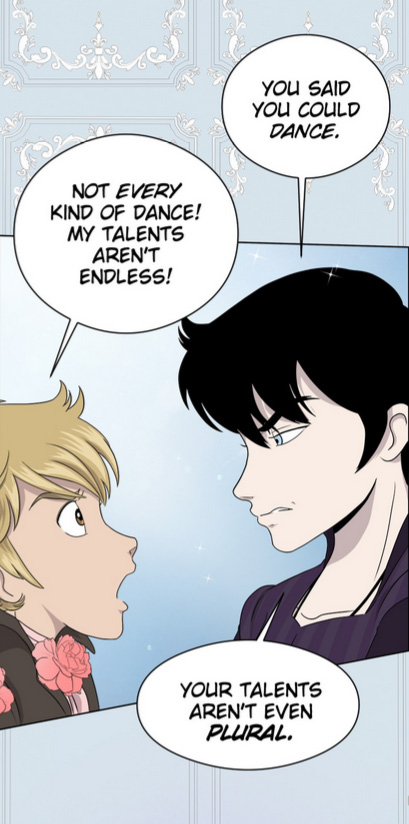
Other figures from Chase’s everyday life become part of the narrative, new keys are found, and the last arc in the season has our leads facing genuine peril. As time passes, Chase gains confidence, and begins treating the stories themselves with more respect. It’s a good thing, too; he’s going to need every advantage he can get.
Fate pushes hard on the cast, and they push back.
Cinderella Boy is, by a lot of measures, a pretty straightforward narrative. Not everything is as it seems, but that’s telegraphed early on, and I called one of the major twists about a quarter of the way through the season. But it’s also a story with a lot of little surprises and pleasures. The art is consistent and bright — Punko is clearly a veteran comic artist at this point — and it’s great fun every time we see the ’mirror image’ contrasting what the leads really look like and the way the book sees them (there are some great gags when characters look into mirrors). The side cast is a lot of fun, including the keys themselves, who appear as toy-sized humans with their own personalities and goals. Punko clearly loves narrative and the power of storytelling, and Chase proves himself a resourceful and caring hero. There are real stakes for all of the characters, allies and adversaries alike. Cinderella Boy is also very funny, especially in a late-season arc where Chase’s love of vampires threatens to derail an entire book.
One of the things I think is most notable in Cinderella Boy is how seriously it takes the idea of story itself. There are countless metanarratives about The Power of Fiction and How Stories Work out there, but setting the Book World and the Real World as complimentary universes allows for a sense of play and prevents things from getting too ploddingly literal. Fate — whether it be in the form of social roles, the more literal role “assigned” to each key, or outside forces — pushes hard on the cast, and they push back. Sometimes they succeed, sometimes they fail, and sometimes they realize that they’re where they’re meant to be after all. (There’s a lot of personal growth in Cinderella Boy.) Chase insists that stories, fictional or otherwise, can always be rewritten, but not everyone around him shares his conviction or luck. It’s up to future seasons to determine if Chase is right, or will need to adjust his perspective.
By the end of Season One, the characters and the idea of story itself have been pushed to its limits, with a final revelation that I, for all my smugness, hadn’t seen coming. Everyone is safe — for now at least — but there’s a lot more adventure to come.
There will be a few weeks before the next season starts, so it’s a good time to give Cinderella Boy a shot. You can read the whole first season for free. Once the second season begins, you will be able to pay to ‘fast pass’ a few chapters ahead on the Webtoon app, if you choose. But if money’s an obstacle, you can experience the comic for free with a relatively low level of FOMO. The fan community, encouraged by Punko, is generally very careful not to spoil non-paying readers. (They also seem to have really gotten into making their own “keysonas” of the roles they’d like to play, which is genuinely adorable.)
Cinderella Boy is a charming read, and Punko (also known as M. Alice LeGrow, the creator of Bizenghast) is clearly having a blast creating it. There are a few heavy moments (see below for spoilers if you’re concerned), but overall it’s a bright, breezy way to pass the time.
Read Cinderella Boy here on Webtoon. It’s formatted to look good on a phone screen, but the art looks good at pretty much any scale.
Minor spoilers
The heavy topics include death of a parent and serious illness.
- It’s me, I’m impatient fast passers. ↩︎
- If certain circumstances are met. There’s always a catch, right? ↩︎
- Maybe multiple catches. ↩︎
This looks totally charming (I’m delighted by the concept of “Narratonin,” for a start–it feels like the internet should have invented that word a long time ago, at least as a name for pleasure reading/viewing/listening–and I got a laugh out of “your talents aren’t even plural”), and I’m intrigued by combining “charming” with a real commitment to pushing the story forward. Glad you covered this, because I hadn’t even heard of it before.
Some of the sight gags are so good that I almost wanted to share them, but they don’t work half as well without context. It’s really a blast!
Year of the Month update:
Coming in February, you can sign up to write about anything from 2016 along with these fine folks:
TBD: Bridgett Taylor: Rogue One
TBD: Cori Domschot: Ghostbusters, Hidden Figures, and/or Sing
Tentative: Sam Scott: The Neon Demon
Feb 7th: Gillian Nelson: Queen of Katwe
Feb. 11th: Lauren James: Inside
Feb. 14th: Gillian Nelson: Milo Murphy’s Law
Feb. 18th: JRoberts548: Silence
Feb. 21st: Gillian Nelson: Pete’s Dragon
And here’s how we’re wrapping up 1947:
TBD: John Anderson: T-Men
Jan. 23rd: Cori Domschot: Down to Earth
Jan. 27th: Cliffy73: Miracle on 34th Street
Jan. 31st: Pluto’s Blue Note
(this isn’t a YOTM you know)