Every Tuesday, the Sounding Board is a space for a short-ish review of a recent-ish release and conversations about new-to-you music. We’ll get things started with a write-up about a newer, likely under-heard album, and invite you to share your music musings in the comments.
There’s nothing like a new release from an enduring and cherished artist to make me feel totally unmoored from the cruel constraints of linear time.
It is 2009, and I am listening to Tune-Yards.1 The music’s crackling kinetic energy and influences are well outside my frame of reference, but I’m an instant fan. I am bowled over by the music’s dithyrambic anarchy and captivated by the way Merrill Garbus’ delivers sing-song melodies in chaotic squawking and unhinged howls that manage to both meld with and cut through the chewy production. Sometimes, I feel moved to dance, but I’m preternaturally devoid of rhythm, so I rarely do.
It is 2011, and I am listening to Tune-Yards. I am bowled over by dithyrambic anarchy. It is 2014, and I am listening to Tune-Yards. I am captivated by Garbus’ gift for delivering melody in chaotic squawks and unhinged howls. It is 2018, and I am listening to Tune-Yards. I often feel moved to dance, but I rarely do.2 It is 2021, and I am listening to Tune-Yards. It is 2025, and I am still listening to Tune-Yards.
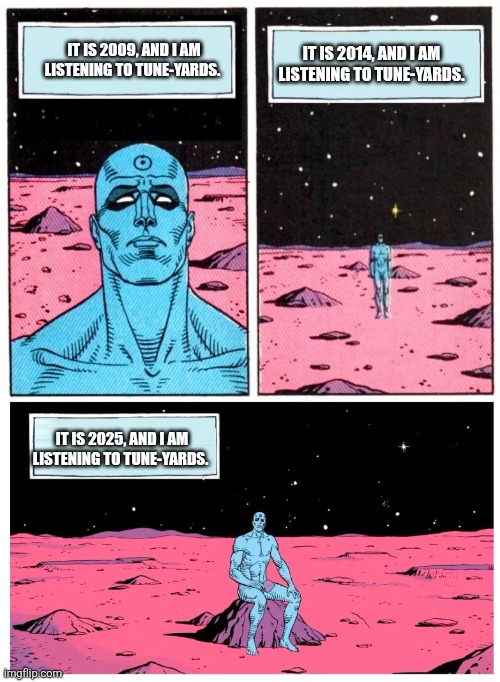
Unlike the erstwhile Jon Osterman, Tune-Yards became increasingly in touch with humanity and their fit within its teeming, unruly collective over the better part of two decades. Socially conscious concepts further permeated Tune-Yards’ body of work, which includes a dance album that spends much of its runtime grappling with identity and reconciling Garbus’ personal politics with the success she’s found as a white woman making music deeply indebted to artists of color.3
It’s not just perspective that’s expanded for Tune-Yards. By album No. 2, a project that started as an aggressively lo-fi Garbus solo effort grew to formally include bassist Nate Brenner. Garbus and Brenner have forged a partnership in music and life. Their young child can be heard on several songs on Better Dreaming, Tune-Yards’ fine sixth album. It’s just one of the ways the Oakland duo’s extensive history and progressive growth are on display.
Better Dreaming sometimes works in the jazzy atmosphere the duo established on 2021’s sorta slept-on sketchy.4 Other times, it dials up some of the politically charged dance music from 2018’s I Can Feel You Creep Into My Private Life. There’s even some intentionally caustic caterwauling reminiscent of Bird Brains or Whokill, although at this late year Garbus and Brenner have mostly sanded down the jagged edges that defined those LPs. In addition to being a synthesis of the pair’s past sounds, Better Dreaming is also a heightening of past lyrical themes. It includes Tune-Yards’ most trenchant and clear political statements yet while remaining musically interesting and often danceable.
Lead single “Limelight” is the most obvious dance track, and it is pure musical escapism. The song was apparently inspired by a family dance-along, and it sounds like it.5 “Limelight” is a bright dance song that plays with Minneapolis funk’s sonic palette and radiates pure joy. It’s one of the songs that features the giggling voice of Gabrus and Brenner’s child, making it a paean to childhood exuberance and innocent movement like an “Isn’t She Lovely” for the toddler years. It’d border on saccharine if palpable anxiety about both the present and near future weren’t such a big part of the rest of the album.
“Swarm” contends with those feelings by sounding a call for action and personal betterment in the interest of posterity. Garbus and Brenner manage to build a dance breakdown around “Promise not to be selfish/ Practice now, ’cause you’ll need it/ Promise you can be changed/ Promise you’ll rearrange your brain/ For the next in line.,” which is a feat. “See You There” takes an angrier tack. It’s a kiss off to holier-than-thou types of ‘real Americans’ likely to condemn or Garbus and Brenner. people like them and/or people they like. But that takes a while to become clear.
For most of its runtime, “See You There” is a hauntingly pretty song. It starts a cappella and gains just a smidge more complexity when its backing track kicks in. A subterranean bass pulse, quick snaps of percussion and some electronic blips that could’ve been samples from Pong provide a ton of space for Garbus to engage in vocal pyrotechnics, and it gets put to excellent use. Garbus’ full-throated self-harmonization on “See You There” comes close to inducing goosebumps. She finds a way to crank up the intensity even further in the song’s closing moments by revealing, that the song’s title is an excerpted phrase: “You say I’m going to hell/ Well, I’ll see you there.” Garbus then wails that phrase with a maniacal intensity that would be chilling if it didn’t also sound like a solute catharsis.
“How Big is the Rainbow” is an even combination of Better Dreaming ‘s firebrand spirit and its penchant for wringing foot taps and shoulder wiggles out of the most motionless bodies. It’s a big, bold song about living openly, defiantly and authentically in the face of prescriptive moralizing. It’s in no way a subtle song, and that’s not lost on Tune-Yards. To hear Garbus’ explain it, she knows writers who use subtext, but in light of current events, they’re all cowards — more or less.6 It could’ve been unintentionally goofy, but the song is good, and the brashly defiant sentiment behind it is decidedly cool.
Better Dreaming isn’t quite the culmination of all things Tune-Yards. Some of the album’s ideas have been done better elsewhere on the discography. While matured restraint can be admirable, it can also lead to stretches that feel somnolent or anodyne, which are not adjectives that often get attached to Tune-Yards’ music. However, it is a decidedly welcome return that turns disparate impulses into a cohesive LP that’s both fun and thoughtful. Better Dreaming extends a long run of interesting, principled music from a singular indie rock institution. It delivers a few jams and moments of transcendental that couldn’t have come from anyone else.
It’s a safe guess that whenever the next LP comes, I’ll be listening to Tune-Yards.
- I am foregoing the tUnE-yArDs stylization to preserve sanity. The band’s label, 4AD, also skips the alternative capitalization. ↩︎
- I am also listening raptly in 2018 when Tune-Yards’ music was featured in my favorite movie of the year, Sorry to Bother You. ↩︎
- “Colonizer” is a very catchy song that really lays out what I Can Feel You Creep Into My Private Life‘s thesis. ↩︎
- “Hypnotized” off that album is a gorgeous song with some of my favorite drumming on a Tune-Yards song. The duo’s music doesn’t often feature a full drum kit, so it’s not a super high bar, but that’s not meant to be faint praise. ↩︎
- George Clinton was the inspiration, but the song’s sound feels more like the Revolution. ↩︎
- “But in this day and age, there is no room for subtlety when it comes to advocating for every single human being, for our trans family especially. And SHIT, how big IS the fucking rainbow?! It feels like the time to prove it to each other, to show each other how big it can be.” (https://4ad.com/news/1513) ↩︎
What did we watch?
Andor, “Harvest” – Very well made and the last fifteen minutes got my pulse racing, but I feel like this arc really added little to the story. Doesn’t help that I found the wedding ceremony a bore (but then I find real life weddings a bore as well), and just not enough Cassian. Plus I hope we never ever see Syril’s mother again.
Kojak, “Kiss It All Goodbye” – Crocker accidentally shoots an innocent bystander while chasing two fur thieves, and naturally his guilt over crippling her turns into a romance. Only she’s not so innocent after all. A bit of a clunker since everything here was so utterly improbable. Plus Kevin Dobson is fine as Kojak’s most trusted subordinate but not really good enough to play anything romantic or nuanced. A 24 year old Christopher Walken is one of the crooks, his face not even a little craggy but his voice already gravely.
The first trio of episodes this season is probably the slowest, yeah. But Dedra verbally owning Eedy is so goddamn funny. Thematically, I guess the experience shows Cassian the need for the rebellion to get properly organized, perhaps a sort of rebel alliance, if you will.
Luthen forcing Mon Mothma’s hand is a very significant point in the story, and a real strain in their relationship going forward.
“How nice for you.”
Hallow Road – a new (mostly) single-location thriller from the director of Under the Shadow. Rosamund Pike and Matthew Rhys are the parents of a girl who has stormed out after an argument, she calls them later in the middle of the night to say she’s been in a car accident and needs help. The majority of the film is tense and realistic as they drive off to her rescue with updates via speakerphone. The tension is really impressive and the director does a good job keeping things cinematic despite being contrained to the inside of a car. And then… decisions are made, and things get a bit weird. And I’m not really sure anything after that point really works – although I found myself quite enjoying the attempt at a big shift even if it definitely wasn’t as successful as the tension leading up to it. Cautiously recommended, although if my viewing companions are anything to go by, the last 20 minutes will make some people really hate it.
More detail on Sunday, but the new episode of The Rehearsal was pretty interesting. And there was also randomly a new episode of Bob’s Burgers, which I thought wasn’t returning until Thursday the 29th. Fox is apparently scheduling their animation in an effort to be as confusing as possible.
Also been watching a few clips here and there of Conan’s podcast lately. When it’s the right guest and they get on the right subject, it’s pretty funny. Of late, I’ve found the Mulaney, Danny McBride, and Bill Hader clips the funniest. But I might need to set aside the time for the Larry David episode.
Ah, forgot to mention I caught up on the first episode of Everybody’s Live with John Mulaney, so we’re all caught up just in time for the season finale tomorrow night. Some very funny jokes in this one, which, again, I’ll save to discuss on Sunday.
O’Brien’s sincere appreciation of McBride’s characters is infectious, he gets why these guys are such funny assholes.
Hacks, S2E5 through 6 – Many shows would mine the Deborah-Susan story for an entire unnecessary flashback episode and instead we get a good, funny, dramatic conversation and reversal: Susan did drop out of comedy because of Deborah, but not for the reason Deborah thinks, and it ends with some subtle ownage. Susan doesn’t have Deborah’s success, but she’s a better, happier person with a family who clearly love her, and she might even feel a bit sorry for Deborah at the end. This also inspires Deborah to not go back to the old well of making fun of her image, but mocking the real thing, and damn if it isn’t funny (“I thought the tissue box was for cleanup!”) and a good dramatic choice. Good story pairing too with the B-plot of Kayla genuinely trying at her job and acknowledging how she’s not taken seriously, with Jimmy giving her some empathy and good advice in the process.
Notes: I noted Ava’s irritatingly performative goodness but her genuine joy for certain experiences is very loveable, like being happy to be at the state fair with Marcus or swimming for the first time. Kiki’s back and gets a star entrance! Damien working for Deborah but having no interest in comedy is a hilarious reveal. (“You all try too hard.” “That’s…actually correct.”)
Oh, shit, you got through “The Click”? So goddamn good.
The montage of joke writing is good, lot of shows about making comedy in the 2010’s but they took the medium so seriously, and this actually works at getting across what its like to write jokes that are actually funny. (Also Deborah banging the younger guy is genuinely sexy, and you see how his genuine empathy for her inspires something.)
Hacks does seem more true to the comedy process than any of those shows that I did see. (There’s also some benefit to having Deborah already successful, in that so many of the shows that try to show how a comedian goes from upstart to success make the process look a lot easier than it is.) The moment I knew I was in on the show came in the pilot, when Deborah stops Ava from leaving her compound to workshop the insults they’ve been trading. That was the moment I was like “Okay, these writers understand how comedians think.”
The actual titular moment in “The Click” is one of my favorite moments in the whole show – Deborah realizing her set is true but not honest, and therefore not funny; she has to be honest about who she is, not just play the version of a woman who’s made it in a man’s world that Ava might want to see her as. (Maybe my favorite moment in the series until the season 3 finale – and you will know that moment when you get to it.)
Great moment and Deborah is right! “It’s not that it was mean, it’s that it wasn’t funny.” And yeah, I think anybody creative can relate to “The Click”. I’ve had readings where something wasn’t quite right and then everything indeed clicked.
Andor – I’m not sure Kathleen Kennedy redeems her mismanagement of the franchise here. But by letting the guy behind the Bourne films and Michael Clayton do a Star War she comes close to moving in the right direction. Unlike recent installments that are poorly written or aimed at kids this has actual dramatic scenes between characters talking about feelings, how the world works and what they want from it. You don’t see that much in the series or even genre shows in general. All the characters are three dimensional with wants and desires. It’s smart and adult in that way. The show’s evil doesn’t come from Vader’s red flashlight or the Emperor’s magic laser fingers. It comes from showing how people are crushed and corrupted by giant bureaucracies that do not care about individuals, their rights or individual cultures, and how it enables awful behavior of people tasked to carry out its directives. There is an attempted sexual assault early on by an unbounded military official abusing his own small corner of power and doesn’t believe in the intrinsic rights of people. It’s also about how rebellions are born and how different factions come together. But the factions are also bound by their own bureaucracies, hierarchies and can’t agree on methods resulting in abuses of power. All this is written by Gilroy, a guy who takes the craft and fundamentals of drama and writing very seriously.
FWIW, Gilroy has been pretty effusive with his praise of Kennedy in terms of supporting Andor and protecting him from studio interference.
But, anyway, more to the point, great show. And I’m not even a Warsie! (That’s the equivalent of a Trekkie for Star Wars, right?)
What did we listen to?
Unplugged, Paul McCartney
Normally I skip the live albums, but this felt too essential. Which is a shame, because it’s just a pretty good time; I probably would have enjoyed actually being there a lot more. What’s funny about McCartney is that he’s charming, but in a normal person kind of way; this feels like an absurd and obvious thing to say, but he feels like my grandfather in terms of being witty without being, like, a comedian.
The Raven, Lou Reed
This is Reed’s concept album about Edgar Allan Poe, though charmingly this is considered a collaboration between him and Poe. He was honestly one of the coolest fucking dudes to walk the earth. I deeply enjoy the cameos, too – this might actually be my favourite rendition of “The Raven”, Amanda Plummer has some amazing performances, and hearing Steve Buscemi sing is surprisingly great.
I bought Unplugged when it came out. I think I might listen to it today.
What’s funny about McCartney is that he’s charming, but in a normal person kind of way
This reminds me of an item on Ian Leslie’s list about McCartney.
https://www.ian-leslie.com/p/64-reasons-to-celebrate-paul-mccartney
26. Pete Townshend: “The difference between the way Lennon and McCartney behave with the people that are around them is incredible. What Lennon does is he sits down, immediately acknowledges the fact that he’s John Lennon and that everything for the rest of the night is going to revolve around him. He completely relaxes and dribbles on and gets stoned and does silly things. Of course, everybody gets into his thing and has a good time. But Paul McCartney worries, he wants a genuine conversation, a genuine relationship, starting off from square one. One of us is fucking Paul McCartney, a Beatle, the other one is me, a huge monumental Beatle fan who still gets a kick out of talking to Paul McCartney. And he’s starting to tell me that he digs me and that we’re on an even par so that we can begin the conversation, which completely makes me even a bigger fan. That’s all it serves to do.”
Blank Check, Johnny Dangerously – How did I not know the cop calling out what Johnny’s car looks like over the radio is voiced by Alan Hale, Jr? Fun episode that is far kinder to this movie that I will ever be, though we all about about the testicles short.
Momma, Welcome to My Blue Sky and Household Name
I mentioned the live music yesterday; I had to appropriately prepare for it, of course.
1001 Albums, etc. – just a couple this week but one is a new favourite.
Curtis Mayfield – There’s No Place Like America Today: This blew me away, it’s an amazing sounding album and I love how powerful and poignant it feels despite the gentleness of his falsetto vocals.
Tom Petty and the Heartbreakers – S/T: Kinda thought I’d like this more than I actually did, there’s some scattered Tom Petty stuff that I really like but I found some of this to be a bit too… soft-rock leaning? A pleasant listen but I hoped for more. American Girl is great though, obviously. I hadn’t noticed quite how much the Strokes ripped it off, haha.
Screen Drafts, Harrison Ford – I like Harrison Ford very much as a screen presence but listening to this I realised I don’t really LOVE any of his work outside of Indiana Jones, which is odd. No complaints about Witness ranking very high though, I might get there with that one after a second viewing.
I always expect to like Tom Pety more than I do as well.
In the last years of his life he had a show on the SiriusXM ‘80’s station that was really interesting, going into the roots of all these different bands and sounds and how American music had evolved through the 20’s century, and I always found it kind of incongruous that he was so knowledgeable and could draw out all these connections when his music was just pretty good.
But then he died and they eventually filled that spot with what purported to be a similar show with Rick Springfield, and it sucked. Springfield didn’t know shit about music or musicology.
It’s always interesting which musicians can pull off the shift to radio and which can’t. I think I’d probably be more surprised if Rick Springfield WAS good though.
Song of Spider-Man – Glen Berger’s book about Spider-Man: Turn Off The Dark which is flattering to no one, including the author and musical book writer, except maybe The Edge and the actors. This confirms Tristan’s idea of bad art being rewarding to pick apart, as silly decision after silly artistic decision is made and no one suggests “Hey, this is stupid,” in part because of pretension, ego, money, and fear (Berger has the least money and status, and has a crush on Taymor, so he won’t really tell anyone when he has doubts about the project – to be fair, he suggests a Spider-Man musical is inherently silly early on and she shuts him down absurdly fast).
Also listened to some of the soundtrack which largely feel like meh U2 b-sides as someone suggests. “A Freak Like Me Needs Company” is fun though.
Getting a backlog of books so I shifted the second half of the Stephen King collection You Like It Darker to audio. I have a tendency to drift in and out on audio books, and this one, handed off between Will Patton and King himself, works fine for this. Once in a while I’ll perk up and have to hit the rewind button (was that guy just eaten by an alligator?) but for the most part it guns alongside my restless brain energy well.
Mekons latest record, Horror, brilliantly confronts the nightmare of history: awoke and dreaming, you might say? Turn the guitars up, anyway, whether a noisy entrance or exit.
Year of the Month update!
This June, we’ll be moving on to 1983, including all these movies, albums, books, et al!
Jun. 23rd: Sam Scott: El Sur
Jun. 24th: John Bruni: Legendary Hearts
Jun. 30th: Tristan Nankervis: The Big Chill
And there’s still time to sign up towrite about any of these movies, albums, books, et al!
May 23rd: Gillian Rose Nelson: Almost Angels
May 30th: Gillian Rose Nelson: In Search of the Castaways
“Cuddly” tracks with my vague, sleep-deprived memories of the one song I’ve heard from this album so far (“Limelight”). I remember thinking it was softer than I expected (although I haven’t listened to much Tune-Yards– I’m not doing the leetspeak either– because 2009 was about the time I hit my expiration date on being young and hip and up to date on new music.)
(P.S. Sorry to Bother You was 2018. I remember this because I remember where I saw the film– most of my memories at this point I can only place in time by remembering what city I was living in, or what apartment, or if some other distinctive event like the COVID quarantine was going on.)
Great catch on the year! Updated.
Nikki Nack (2014, double-checked) is probably the last album in the mold of the sound that broke Tune-Yards through. I Can Feel You Creep Into My Private Life (2018) pretty explicitly wrestles with the appropriative qualities of that sound and leans heavily into dance music.
They stayed in that lane while mellowing on the last LP, so the new one mostly tracks.
It’s been an interesting career arc. Spend three albums honing a sound, a full album reacting to that, and then two albums that use elements of everything that came before them.