At the heart of Silence, both the 2016 Martin Scorsese movie and the Shusaka Endo novel it’s based on, is a soul-crushing dilemma. The Portuguese priest Sebastião Rodrigues (Andrew Garfield) is forced to either apostatize or watch the continued torture and death of his flock. Rodrigues was not prepared for this dilemma — he came to Japan expecting martyrdom and found something much worse. The history of martyrdom looms large in the Christian imagination, and Rodrigues is no exception. Neither is Martin Scorsese; the film opens with the severed heads of friars and the torturous execution of Jesuits. The camera lingers on the suffering, as both a stylistic choice and a devotional one, like meditation on the stations of the cross or the arma christi1.
How do you weigh a scale with two immeasurable immensities on it?
Unfortunately for Rodrigues, his martyrdom is not at issue. It would be easy for Rodrigues to not trample the fumi-e and be martyred. If he did, Jesuits would have a feast day for Sts. Rodrigues and Garupe on their calendar to this day. What makes the Inquisitor Inoue (Issey Ogata) such a powerful threat is that he understands the role of martyrdom in the imagination. The more priests he kills, the more deeply the Christians believe. (Indeed, I am not aware of an instance in any culture where suppression of a movement by violence alone didn’t result in the movement growing only more defiant). Instead, the Inquisitor does an elaborate one-man good cop / bad cop routine to get Rodrigues to break the will of the local Christians for him.
And this leads to Rodrigues’ dilemma. He’s given a choice. Watch his flock be tortured, or apostatize.
So how does Rodrigues analyze this dilemma? Phillipa Foot first introduced the trolley problem as a way of illustrating moral intuitions. This sort of dilemma (do you flip the switch, do you throw someone off the lifeboat, do you eat someone on the lifeboat, can you drive over one person to rescue five) pits our intuitions against utilitarian calculus. At its most extreme, Ursula K. Le Guin gives us Omelas. What if we could make an entire city happy, with ideal lives, and all we have to do is keep one child in a constant state of torture?
Rodrigues is in such a dilemma, where pure utilitarianism is useless. How can you weigh their torture? How can you weigh their faith? Both intuition and utilitarianism support both prongs of the dilemma.
For Rodrigues, it is easy for him to encourage the believers to trample. The Jesuits by this point had been doing undercover work like this in England and Japan for decades; they had a considered doctrine of when one can effectively lie.
Scorsese and Endo are both silent about whether Rodrigues made the right call, but they are confident he was motivated by love. They want us to sit uncomfortably in the ambiguity. It’s like a thought experiment. How do you keep going when God is silent? How do you weigh a scale with two immeasurable immensities on it?
Garfield plays the ambiguity well. While Driver dives in with absolute moral clarity, Garfield shifts from his initial fervor to being wracked with doubt.
But maybe Rodrigues is not the hero of the story. Maybe the real hero is Kichijiro (Yosuke Kubozuka). From the moment we first meet him he plays a comedic wretch, like the servants in Hidden Temple or perhaps Eliza’s dad in My Fair Lady. He’s a cringing, rat-like drunk. He’s so obviously dishonest Garupe can barely believe him when he says he’s Japanese. He keeps being unexpectedly helpful, and then expectedly betraying the priests. It stretches to absurd lengths, providing the closest thing we get to comic relief. Even at the end, decades after Rodrigues’ apostasy, Kirichijiro shows up begging Rodrigues to hear his confession.
And I find myself more and more identifying with Kichijiro than Rodrigues. He’s weak but somehow still resilient. Kirichijiro may be weak-willed, a coward, a traitor, and a drunk, but he’s a true believer.
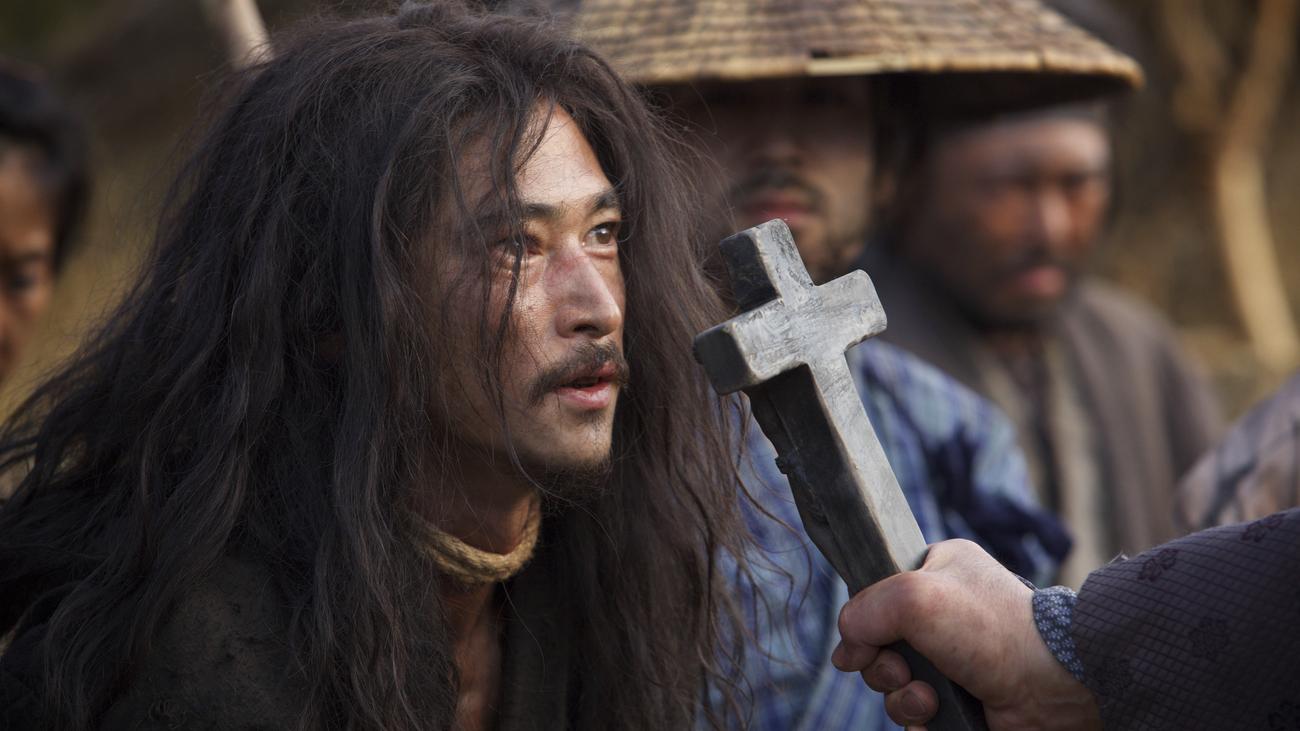
Endo and Scorsese did not mean to make a political book and movie. But I can’t help but think of this in political terms. Speaking personally, my own crises of faith as a left-leaning Catholic have rarely been about whether I believe but about whether the priests and bishops do. Whether it is attacks on immigrants, refugees, and asylum-seekers; trans people, Palestinians, children with IEPs and 504 plans, women, people of color, etc.2 it’s extremely rare that the U.S. church leadership speaks out with much moral clarity. When they do, it’s couched carefully in ambiguities and abstractions between groveling excitement to work with the administration for the sake of the common good. It’s extremely demoralizing. And you know who I can look to for inspiration and a willingness to keep fighting? It’s not Rodrigues. It’s the wretched, rat-like Kichijiro.
Kichijiro is weak. He does not know how to fight. He lacks the intellectual training and the fortitude to bravely face martyrdom. And yet he spends years trying to come back. In the end he’s taken to jail for it, while Rodrigues watches silently. He keeps coming back. He keeps trying — and failing — to be brave. He keeps trying to resist Inoue. He keeps trying to follow his ideals. There is nothing else one can do.
- The arma christi is a genre of early modern Christian devotional art, showing the tools used in the crucifixion laid for the viewer to meditate on. The image can take the form of a coat of arms, and is an inversion of images showing the weapons of a knight. ↩︎
- There are some obvious caveats on these issues, and I’m not going to pretend the Church is progressive on these points, but I do not think even a strict conservative reading of doctrine supports the level of what is being done. I could write an additional 10,000 words on the tension this creates for Catholics who are politically on the Left. ↩︎