There are two significant films in 1979, All That Jazz and Apocalypse Now. One is about death, fantasy, and endless conflict. The other takes place in Vietnam.
While Apocalypse Now has been deemed as the “Serious Movie,” All That Jazz is just as heavy, even though its classification as a musical might make it seem less so, especially when compared to a war film. Yet you haven’t seen a musical quite like All That Jazz. Sure, like many musicals, it has, at best, a loosely episodic narrative, but how the film expresses the feeling that death can be “too much fucking perspective” anticipates This Is Spinal Tap (1984), especially in poking fun at the pretentiousness of aging artists.
In All That Jazz, we enter the headspace of the film’ s co-writer/director, Bob Fosse, as he feels death approaching: he had already suffered a heart attack and was in poor health. To get this point across, we see the vicious cycle of his alter-ego, Joe Gideon (Roy Scheider), waking up, eyes bloodshot, taking prescription-strength amphetamines, and rushing off to choreograph NY/LA, his latest musical, and complete the final editing on The Stand-up, a film that he directed. If you’re aware of Fosse’s career, these references are to Chicago, which opened in 1975, and Lenny, the 1974 film about Lenny Bruce.
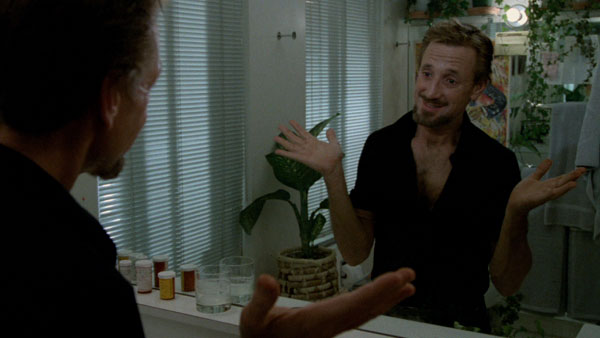
In a self-parodic turn, the choreography for NY/LA, with its erotic flourishes that satirize Chicago, goes big on the twitchy physical gestures that became Fosse’s trademark. Avoiding too many digressions into the past, which tend to shape career retrospectives, Fosse simply can’t afford to look back too much, given the relative lateness of the hour. All that he can do, he believes, is to pour what’s left off his life into his work. This is exactly how – he knows all too well – he got into this predicament in the first place.
The other project that Gideon obsesses over, The Stand-up, features Cliff Gorman, the star of Lenny, the 1971 Broadway play (rather than Dustin Hoffman, who starred in the film of Bruce’s life that Fosse directed). Gideon’s dour expression as he screens the work in progress, over and over again, says it all. Watching Bruce’s decline can’t help reminding him of his own accelerating fall. And the repeated footage of Bruce’s joking about the “stages of death” might seem too obvious, yet such bleak humor resonates with the overall tone of All That Jazz.
Despite the focus on Gideon’s tortuous work routine, which soon puts him into the hospital, Fosse’s expert editing guides a viewer easily; for one, it’s not afraid to openly dismiss his angst – check the film’s title, right? This undertone of mockery targets the banality of 1970s culture, summed up by the catch-phrase, “Who loves ya baby?,” of Kojak, another would-be king of NYC. And from the opening cattle call scene to Gideon’s final farewell-to-life performance, it’s obvious that everyone does love Fosse/Gideon.
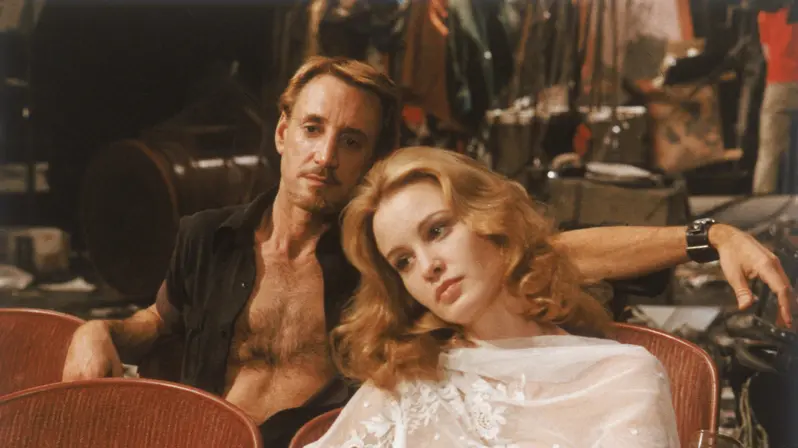
The most surreal love affair is between Gideon and Angelique (Jessica Lange), a celestial femme fatale. Not only do we see Fosse/Gideon open up to her about his regrets; this fantasy goes all the way. Maybe the angel of death really does look like Lange, at her peak-ingenue attractiveness, and who wouldn’t want one’s double to be played with such enviable coolness by Scheider? Scheider, a rather better-looking version of Fosse – and Fosse deserves all due credit for this casting choice – was nominated for Best Actor.
“Bye, Bye Life,” the literal show-stopper, pushes the value of artistic work far beyond any cliché Protestant ethic. Dancers, costumed as anatomical models, perform around Gideon in a hospital bed. In a riff on the behind-the-scenes drama that musicals tend to privilege, Gideon directs himself; in superimposed shots, he addresses himself as the bed-ridden figure, whose life drains away. The sound design, screaming electric guitars and SF effects, that could’ve been out of a disco/Star Wars number, is a stunning counterpart to the visuals.
While the dense connections in All That Jazz add an invigorating messiness that can’t be factored out of any viewing experience, Fosse can’t prevent the misinterpretation of the film as an extended charade of planning one’s own funeral (nor was Fosse fully clairvoyant: although he went out, as he predicted, from a fatal heart attack, he lived eight more years). But All That Jazz shouldn’t be reduced to merely a semi-autobiographical story; Fosse hits the artistic zeitgeist of contemplating the end of the road. Neil Young’s Tonight’s the Night (1975), which had once been floated as a Broadway show, was a rough-edged song cycle about the death of two of Young’s close friends from the excesses of the rock ‘n’ roll life. The Last Waltz (1976) staged the epic retirement ceremony of the veteran musicians known collectively as The Band. With special guests ranging from Van Morrison to Bob Dylan, this full-length concert film has been regarded as a formal ending to the classic-rock era.
Considering all of the views, some contradictory, of death, that Fosse splices together in All That Jazz, one that, in particular, hides in plain sight, is the cessation of all bodily motion.
A similar way of putting it is that All That Jazz “refuses emotional shorthand explanations.” These words, by John Cassavetes, sum up the pinnacle of 1970s cinema, such as Opening Night (1977), which Cassavetes wrote/directed, starring his wife, Gena Rowlands; Cassavetes acts out an intense relationship with Rowlands, who plays the self-destructive, aging star of a troubled Broadway play. Thus All That Jazz fits with the reappraisal of this cinematic decade, which has finally given filmmakers, such as Cassavetes and Elaine May, their long-overdue credit.
Considering all of the views, some contradictory, of death, that Fosse splices together in All That Jazz, one that, in particular, hides in plain sight, is the cessation of all bodily motion. Fosse, best remembered for how he put bodies in motion, invents a cold closer – which I won’t spoil – that is up there with one of the most unforgettable moments in cinema. You might even say that he choreographs the hell out of it.
Thanks to the members of the LA Movie Club for their insightful comments on this film.
A fantastic piece with an especially brilliant ending: I love your point about how we’ve watched a whole film about the significance and vitality of motion before reaching that last shot. This is the definition of death that makes the most deeply felt sense to Fosse, and he makes it have that impact on us as well.
We talked a little in Movie Club about how this film makes the collaboration involved in this kind of artistic process really stand out, and I love how that factors into the scene we see (and see, and see) of The Stand-Up: a stand-up comic may be a solo act in real life, but in the movies, he–even in all these close-ups–is buffeted by scripting, directing, editing, cinematography, and on and on. We see all the work Gideon pours into editing that one-man scene only to hear the critic effectively erase his work by saying he gave the actor his head during it all. Maybe during the filming, but not doing the editing! There was a lot of effort behind the camera here! But Fosse, unsurprisingly, handles this with a light touch rather than a vindictive one that feels like it’s lashing out: maybe the critic, too, is part of the artistic ecosystem. And either way, his work on the film has ceased, so he can let it go. Another benefit of motion. Ghosts haunt; humans don’t, or at least Joe Gideon and Bob Fosse never would.
“This is the definition of death that makes the most deeply felt sense to Fosse, and he makes it have that impact on us as well.” When I was writing this article, I kept thinking about how death always fits into both reality and fantasy. It’s a real event, but one that we can’t (unless we, somehow, have total consciousness in the last moment[s]) directly experience.
And although stand-up comics may be regarded as solo acts, they are interacting with audiences. You hear crowd noise, of course, during the footage that Gideon is editing.
If art outlasts the artist, then, maybe, the ghost(ing) is in the art; anyway, I’d like to think that artistic ghosts might be more friendly and their haunting more welcome.
Great essay; haven’t forgotten much of All That Jazz though I only saw it once and picked it up recently at a yard sale. Might be time for a rewatch. Scheider does so much here, as with Sorcerer and Jaws, by doing so little with his face.
Scheider appears as the man of the hour in later-70s U.S. cinema. He acts out the fear of dying at sea (Jaws), has the lead role in an epic film, made under tortuous conditions, that became overshadowed by the Star-Wars hype (Sorcerer), and plays the alter-ego of an artist contemplating his own mortality (All That Jazz).
He plays perhaps the apogee of the ’70s urban cop as well in both THE FRENCH CONNECTION and THE SEVEN UPS.
You know, John, this might be your masterpiece
I think the movie club discussion really clarified my feelings towards ATJ. It may be a very closed off vision of the process of theatrical creation (unlike CABARET, in contrast, the relationship between performers and audiences isn’t depicted), but, in ways that are often never shown in biopics, genius and work ethic, under the auspice of intense leadership, produce spectacular results, outcomes that are shown, not just assumed. In Fosse’s case we may be witnessing a dramatic interpretation of the processes of live theater and filmmaking, but it also documents the result of that work in the form of its musical numbers and repeated reshufflings of Cliff Gorman doing Lenny Bruce–Art presents itself as lived.
This is, in the end, a variation, and maybe the apotheosis, of the Great Man Theory, and it takes a lot of chutzpah for Fosse to even attempt pulling it off. But he does, in fact, pull it off, without backing away from the fact that Gideon’s particular genius rapidly consumes the fuel that keeps the enterprise afloat, and that the heat of this conflagration gives those closest to his heart short shrift–and then–poof. There is no maudlin, Dickensian plea to return to a more settled life, just the consequence for a lifestyle that demands what it demands to make art that is everlasting. It’s both entertaining, dazzling, and unabashedly honest to what is knows, with certainty about life, and what dying means within that knowledge.
“It’s … unabashedly honest to what is knows, with certainty about life, and what dying means within that knowledge.” I think Neil Young may have been the first 1970s artist to take up this idea. But the visual component of Tonight’s the Night, certainly, is minimal, compared with Fosse’s production in All That Jazz.
While Love Streams was made while Cassavetes knew his time was running out (like Fosse, he lived longer than he thought that he would), his farewell could be more freely cinematic (while using an operatic scene); that Fosse was under the limits of the genre of the musical is, arguably, even more dazzling.