Back in July 2022 (and yes, I did have to look this up), In the Name of Honor landed in my inbox. I was one of the first readers for Courtney and Clarke Collins‘s debut novel, a fantasy novel that owed quite a bit to Tolkien and Forgotten Realms but had some intriguing ideas and a solid, readable story.
Being a first reader means you know you‘re reading an early draft. You‘re ready for a book with some challenges, and you‘d better not fall in love with anything, because there are guaranteed to be more changes to come. But that also means you‘re free to think about things that don‘t work in the book, and are encouraged to change them. You just have to cross your fingers and hope that the person who was kind and brave enough to share their work with you will take your comments well, and that the sum total of the feedback they get will change the book for the better.
Fortunately, Courtney wrote back with enthusiasm, and I felt that even if none of my suggestions made it to the final work, I‘d been heard. (You can‘t please everyone, after all.)
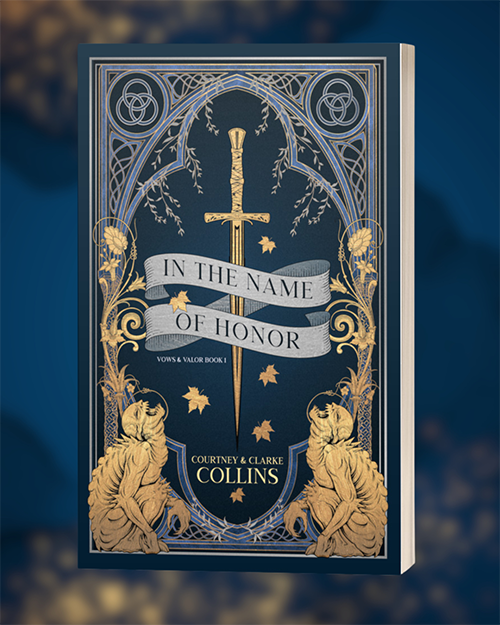
Now I‘ve had the opportunity to read the final product. In the Name of Honor is still a fantasy novel that still owes quite a bit to Tolkien and Forgotten Realms but has some intriguing ideas and a solid, readable story. Honor takes place in a high fantasy world populated with knights, kings, elves and the occasional dragon, and the central cast is the usual ragtag group of adventurers hoping to save the world. Fortunately, the cast avoids the “descriptions ready to be copied and pasted into the sourcebook” issue of those Forgotten Realms novels of my youth. (Also unlike those freaking books, characters who are attracted to each other actually act on it in a reasonable time frame, rather than wibbling over things for three volumes straight. What a notion.)
The greatest pleasures of In the Name of Honor are found in the details.
The novel opens with knight-in-training Dimitar bringing bad news to the kingdom he calls home: the kingdom and their allies are once again under threat from dark, violent creatures called the Corrupted, who have already murdered a key ally. Dimitar is originally assigned to look after the heir to the throne, half-elf Princess Kaleela. But soon–as the way in many of these novels–both they and Dimitar‘s best friend Olaf get caught up in a much larger adventure, eventually winding up facing the Corrupted themselves. They‘re joined by allies and guided by mentors, and…I‘m not going to pretend you don‘t have a good idea of where this is going if you‘ve read a fantasy story before, because I bet you do. Honor is the first of a planned trilogy, ending with a classic “happy for now” ending with several mysteries still left to be solved in future volumes. This book is far more evolution than revolution, though there is some welcome evolution to be found; like Vox Machina, it uses familiar tropes without being confined by them.
The greatest pleasures of In the Name of Honor are found in the details. The Collinses update the formula with a more diverse world, one with room for disability and queerness, with characters who feel more built from the ground up rather than taken from central casting to fill a party slot. Thief Ral‘s emotionally scarring backstory actually informs his character, rather than feeling tacked on for extra angst. Mysterious and powerful Karn is not so much “a mage” as “a single individual composed of ten mages who cast one heck of a spell combining their selves, and now they‘re a they/them sorcerer in the most literal way,” and that informs the way Karn appears and acts.
One of the richest themes in the book is Kaleela‘s separation from her mother‘s culture; her elven mother died when she was born, and her mother‘s family kept their distance as she grew up. Kaleela feels the absence of her mother deeply, and her emotional journey when she reunites with her mother‘s family is the real heart of In the Name of Honor. The separation between human and elven cultures is handled well, with the elves neither being a wholly alien group or just like humans with a slightly different coat of paint. (Human and elven cultures do appear to be monocultures, at least for now, but that might just be a consequence of the small-ish setting and the whole ‘first volume‘ business.)
I can‘t pretend to full objectivity about The Name of Honor, of course; I have known Courtney for years, and know some of the influences that underlie the work. But I can talk a little bit about the journey from “first reader” to “published book reader.” Of course, the manuscript is now more polished, and there‘s now a handy map in the front (who loves books with maps? This girl!). But the pacing of the early chapters has been adjusted, the timeline has been tweaked, and the spotlight has been adjusted to give some characters more time to shine. Once the elves appear I noticed that readers meet fewer of them so we can learn more about their individual characters. It‘s like watching a new staging of a play. (There were also some bigger structural changes, but those are spoilers all the way down.)
But I think even if you didn‘t get the fun of reading the before and after, In the Name of Honor is worth checking out. The publisher says it‘s 461 pages (I read the e-book), but it doesn‘t read like a doorstopper at all. You can get it in the usual places, and find it on Storygraph here.
Ha, Karn’s construction sounds very Pratchettian, very cool idea. And very cool write-up! Stuff like pacing matters so much, interesting to get a behind-the-scenes look at its tweaking.
Thank you!
It really does. It was fun to notice little tweaks.
Nice work here as a sometimes professional beta reader and also book reviewer! Definitely NEVER been frustrated by sexual tension in a book where the author’s, well, getting off on being withholding.
Thank you!
Hahah, yeah. They don’t have their final ride off into the sunset but they don’t do the will they/won’t they for no damn reason over the full length of the book. /slightly scarred still from Dragonlance
I had this experience with Carl Sagan’s The Demon-Haunted World. I was hardly the only early reader, but I was in a class with him at the time and he gave us all a copy of an early draft and one of our assignments was to write a critique. I don’t know if I’m the only person who gave this note, but the section I thought was unfair didn’t appear in the final published work.
Oh wow! I remember reading that book ages ago. That’s really cool.