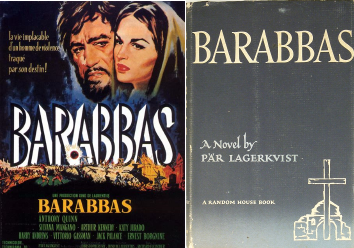
It is a well-established phenomenon in Biblical-adjacent movies that they tend toward a sort of Forrest Gump version of the New Testament, particularly the tail end of the Gospels and Acts of the Apostles, plus maybe some early Christian history. This is because most Biblical-adjacent movies are Christian. There are several versions of the Moses story, of course, but you’re less likely to get a movie that’s just about some random Israelite who happens to be along during the Exodus, for example. But there’s Ben-Hur and The Big Fisherman and Quo Vadis, all of which involve people who are aware of Jesus but mostly are not involved with him in any important way. Even the one named after an Apostle isn’t really about the Apostle.
The novel is considered to be the work that won its author, Pär Lagerkvist, the Nobel Prize in Literature. It is the story of Barabbas, the prisoner who was released from Roman captivity instead of Jesus. He is a bitter solitary man, and the experience of watching the crucifixion of the man killed while he himself lives does not improve that. A young woman with whom he was once involved is martyred in the name of Jesus. Somehow, the book does not explain how, he ends up a slave in the copper mines of Cyprus. Then, because the man chained to him is a Christian, he is freed into the fields. From there, Rome in time for the Great Fire.
In the movie, yes, Barabbas (Anthony Quinn), and, yes, bitter and solitary. Instead of “the hare-lipped girl,” there is the beautiful Rachel (Silvana Mangano), but the martyrdom is the same. He returns to the band of criminals he was with before his imprisonment, and he is captured while they attack a tithing train to the temple in Jerusalem. He is sent to the sulfur mines of Crete. He and the man chained to him (Vittorio Gassman) are the sole survivors of a cave-in and are sent instead to the fields. Their governor (Norman Wooland, possibly?) is sent to Rome and as his wife, Julia (Valentina Cortese), considers them good luck, they come along.
There’s this whole weird gladiator plot that was invented for the movie, if you’d like to see Jack Palance in a chariot attacking Anthony Quinn. In the movie, it’s how Barabbas is freed. (Supposedly, Sharon Tate’s in that scene, and director Richard Fleischer claimed she had an affair with Palance.) In the book, it’s more “he kind of wanders off.” Either way, the very end is basically the same. It’s a pretty faithful adaptation, all told, except for this one section which seems to me to have been put in so we can get some action in what is a fairly talky movie.
Barabbas is an interesting figure, inasmuch as there’s almost nothing about him in the Bible. (He almost certainly didn’t exist as a historical figure, and the custom referenced in the Gospels that the governor could free a prisoner for Passover is only referenced in the Gospels and makes no historical sense.) There’s an implication in certain verses that he might’ve been a revolutionary. Matthew only calls him a “notorious prisoner,” and Mark and Luke just say he was in a riot, which might be an insurrection. Hard to say. He gets no lines and vanishes from the narrative immediately.
But Lagerkvist, and the movie, do not make him into an insurrectionist, they make him into a criminal. A bandit. This is to contrast him with the innocent and divine who died in his stead. Barabbas is actually an atheist despite having watched as Jesus died and seen as the darkness covered the day—filmed during an eclipse for the movie, in fact, on February 15, 1961. Even as he talks to other followers, Barabbas cannot believe. After all, he saw the man die, and would a god die? As for other gods, he’s seen nothing to make him believe in them, either.
Barabbas seems to have little inclination toward self-reflection. He is sometimes tormented by why things have turned out the way they have, but only when he actually thinks, which he does not always do. He talks a little to St. Peter (Harry Andrews) at the beginning and end, but he doesn’t even know why he follows the procession to Golgotha. I know why I would’ve done it; I would’ve had to have seen. But in neither the book nor the movie does Barabbas seem to understand why he does anything.
This is not Richard Fleischer’s best movie. That, of course, is 20,000 Leagues Under the Sea, or else Tora! Tora! Tora! Still, it’s better than Soylent Green or Che! It does, however, seem like a waste of an awful lot of people’s talents. Mostly I preferred the book, except for the part where few characters had names. This left one character to be described as “the fat woman” for about fifty pages, and “the hare-lipped girl” was, in my mind, about seven or eight until it turned out she’d had a child by Barabbas before he was arrested. Still, the book is if nothing else short.
Next month, a science fiction adventure with an extremely impressive cast in Annihilation!