The first rule of going to a show is that if someone falls down, you stop what you’re doing and help them back up. The second rule of going to a show is that if someone falls down, you stop what you’re doing and help them back up. If the people at the aggro nu-metal shows I cut my teeth on in the 90s could follow that, anyone can. But beyond that, there aren’t really other rules for the music-going audience. It’s more about figuring out where you are and how your behavior fits in with that of your fellow attendees and the musicians you’re here to hear.
And this can be fraught. Or just annoying. People filming the entire show on their phones! People spilling their drinks! People who won’t get up and dance, or people who decide to stand in front of everyone else who’s seated, like the doinks at the brewery where Thalia Zedek and her band were playing at the beginning of last year. They did not like me asking them to sit down but to their credit they did and we could all watch Zedek play her latest songs of grim determination: “You’re so certain that it’s curtains, but I’m not so sure.” I think the general guideline is “don’t be an asshole,” and to follow that through the general feeling of the show. Which is created by crowd and band anew each time.
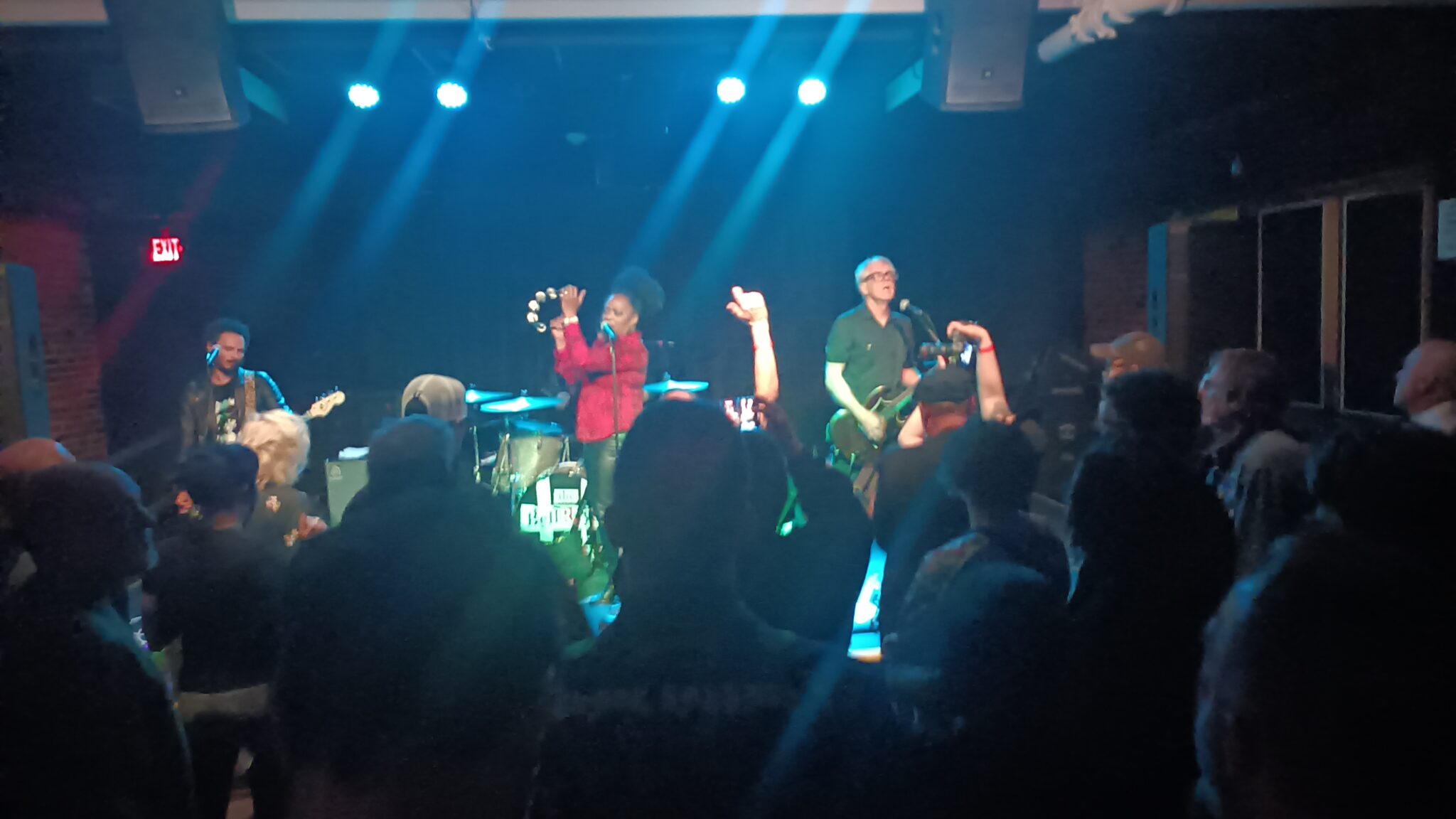
Sometimes, though, the musicians will let you know the expectation. “You get three bands on a stage in America in the middle of the week, you better fucking REJOICE!” Lisa Kekaula told us last spring, in a small club just outside of Boston. Kekaula was leading the Bellrays (local folks the Downhauls and Muck and the Mires rounded out the bill), one of the great rock bands and one that can be accurately described as “Aretha Franklin fronting the Stooges,” rock and soul that may slow down for a minute but never ever gets less intense. Kekaula was giving it her all on a Wednesday night and very early in the show told us what she needed in return: “I have a rule that whenever I say the name of a band, especially my own, you bust a lung! This is a ROCK SHOW!”
***
Last year was a pretty good one for concerts, starting off with an all-timer from Andrea Gillis at the basement bar and going strong through the last show of the year at a small jazz club in Greenwich Village, the Steve Ash Trio playing in a basement that somehow fit a grand piano in with the several dozen attendees and the conscientious waitstaff, one of whom (clearly a pro working a side gig) joined the band on trumpet for a song. It was not a particularly great year for jazz audiences, I do not know why people feel the need to not just talk but hold conversations that compete with the conversation on stage that we all ostensibly came for. The dipshit yakking away at the local arts center during the Marc Ribot Quartet was more disruptive than any noise Ribot or Ava Mendoza could skronk out of their guitars. And those skronks and sheets and runs demanded our concentration, to feel their pull without necessarily knowing what direction was coming next. An audience’s power does not always require expression, attention creates the space to perform and closes the circuit of sound. My experience may not be the same as the person next to me — for one song I heard bassist Sebastian Steinberg bowing the sound of the thinny from Stephen King’s Wizard and Glass while Mendoza, Ribot and drummer Chad Taylor constructed a canyon of thunder and gunfire — but we bring the same mindfulness and energy.
The audience for guitarist Mary Halvorson’s Amarylis sextet was more in the zone, although perhaps we were intimidated by the size of the band — besides the core guitar/bass/drums/trumpet/trombone/vibes lineup, a pair of local saxophonists sat in for the first half of the show at the longtime jazz club, stepping in and out like they had been with the group this whole time. Their final song was something very free and dark, a moody city street turning into a car crash turning into an earthquake, thrilling in its sense that it was being built and nearly flying off the rails entirely in the moment. The band was holding on and we were holding on with them, breathless and exhilarated.
***
It was a year of big bands. After listening to Niko Stratis talk about the dad rock that made her a woman at a local bookstore, I went up the street to the no-cover dive that shut down after pandemic problems but re-opened earlier this year. The Baker Thomas Band still holds down Wednesday nights, eight or nine or ten people not even trying to fit on the tiny stage (the horns were off next to the bar, you know everyone involved is a pro when the trombone is in time with his slide to pull back from the bartender casually laying down drinks in front of him). The band plays originals and covers, that night Thomas called for people to try to stump the keyboardist and I requested Britney Spears’ “Toxic,” which he nailed. The band then launched into Eddie Rabbit’s “Driving My Life Away” and somehow I woke up on Thursday pretty hungover for a day I had to go to work. At one point Thomas noticed a few passersby outside looking through the window, he yelled for them to come on in. Join the crowd.
That small club outside of Boston has a hell of a booker, they locked down the Ryan Davis Band earlier in the year and by November the band had blown up so the 250 capacity room was completely packed, including myself and two old buddies of many a show in years past. It was great to catch a band with them again instead of being a singleton in the audience like I usually am. Fellow alt-indie-country rising stars Florry played the same place earlier in the year at the end of their tour, they seemed exhausted (no better time to cover Commander Cody’s “Seeds and Stems,” which they nailed) but the capacity crowd was there to prop them up. Literally, supplying them with a tambourine at one point — the Davis audience felt a bit like a lot of people checking out the next big thing (hey, guilty) but this crowd was there for the band, ready to roll with their racket and get after it on a Sunday night. I used to notice the old guy at the show and have now become him, and that is fine — I stay back and let the young people take the lead on driving that back and forth between performers and audience that keeps a tired band rocking out. Which isn’t to say I’m not shouting and clapping along with them, I have a role and responsibility too. What I want from the band doesn’t come from nowhere, what I need from a show I have to bring the possibility of with me.
And I needed a good time from Florry at a small club after the previous night, when I went to the big new venue to see Godspeed You! Black Emperor with 3,000 other middle-aged dudes. These are my people and they know what they are doing at a show like this, no asshole shouts or performative “Free Birds” as the anxious and ominous opening of plooping double bass and violin scrapes resolved into the longing of the title “Hope Drone.” Three guitarists, two bassists, two drummers and a violinist can make noise that is resilient and relentless and one of my favorite things at a show is to see someone headbanging out of the corner of my eye, penduluming on a parallel plane because I am headbanging too, and the band’s blasts of resistance offered plenty of opportunities for this. But they closed with the unsettling “BBF3,” which is built around a vocal sample of a guy railing against the government in the form of a judge making him pay a speeding ticket and then that guy talking up how many guns he has and how he needs to be ready for what’s coming, and the band built off of that with tension and no release, no catharsis. The music ended in a five-minute feedback ripple and drone and eventually small licks crept in until, as the wash of noise faded, that hopeful violin line crept back, muted but present.
“I don’t know what that was about,” the guy next to me told his buddy as we walked out of the venue. But I knew what it was about. It was the loneliness and despair I go to a show to tamp down or forget, thrown back at me. GY!BE is a collective that stands in opposition to larger state brutality and indifference but here in that sampled vocal was one guy’s fear and hate and isolation, the certainty and savagery of getting your own because no one else is there for you, spinning out and feeling like it was conjuring up everything horrible and oppressive of the moment, the year. And that’s what I walked away with, past that dude and his buddy, by myself to catch the bus back home. You go to a show to give what you have and to take what the bands offer, and no one said they had to give you something uplifting.
***
There are other opportunities for that, anyway, although those opportunities can fall flat. I went to the second big No Kings rally at the Boston Common in October and some dillweed with an accordion played “America The Beautiful” and no one really gave a shit. Thousands of people were on one of the oldest public spaces in the U.S. and we were not there to think about beauty, we were there because we were pissed off. Fortunately, Abbie Barrett and her band played afterward. I’d caught Barrett at the pub earlier in the year after too many years of sleeping on her and was knocked out of my socks, now I’m actively looking to catch her shows. But I wasn’t aware she was on the bill here and it was a welcome surprise to see her take the stage and a thrill to see the songs that rocked a back room of a hundred people scale up several orders of magnitude, pushing their power out on a crowd that pushed it back. She changed a line in the bridge of “Here To Stay” from “take them down” to “take Trump down” and if it is corny it also got an enormous rise out of the crowd because “Here To Stay” the song kicks enormous amounts of ass and is something you can ride a lot farther and harder than the staleness of spacious skies and amber waves of grain. What we needed was an outlet, something to pour our frustration into, and Barrett gave it to us. “Sound your horns and ring the bell, say your prayers and cast your spells.”
The first No Kings rally eventually brought out the Dropkick Murphys, but beforehand we bemoaned the lack of protest music that brings people together not so much through the message as through the rhythm. What we wanted was HONK!, the annual street marching band festival of dozens of groups blasting out songs of solidarity and also 80s bangers. HONK! takes over Davis Square in Somerville, with bands performing in their designated areas and pulling in passers-by to clap and stomp and dance. Bands from all over the country and beyond come to play, I wound up watching Kandjanwou Rara, who are from over the river in Dorchester. The group has Haitian roots and instead of a marching band-centered lineup is half drums and percussion and half vuvela-esque homemade horns, instead of protest songs (and 80s bangers) they play groove/drone that places hooks in service of an unstoppable rhythm. It demands you dance, and if you dance then maybe the person next to you will also dance. And maybe the band’s flag guy will pull the person next to you out into the audience’s circle to dance there, and that dance will turn into a conga line that snakes around the park. Or maybe you can just clap to the beat and hear the guy behind you start clapping a measure later, and the woman next to him just after that. There is a freedom in giving into the music and its demands for response and a power in hearing your response set off echoes rippling through the crowd and band and back, renewing as long as the beat goes on.
***
The beat goes on, the beat changes up. That no-cover dive still doesn’t charge at the door but has moved to mostly hosting cover bands on the stage, instead of original groups. And these bands generally trend younger, with the audiences to match. I stopped in with some former housemates, we all lived together in the area when we were in our 20s some mumblemumble years ago, and we were the old folks at the show while 20-somethings were partying as South Street played “Pink Pony Club.” This is not to say we were not partying as well. The energy was there and the band and crowd were having fun, if the sound was different than it used to be the vibrations were still pretty good.
One of the many roots artists who used to hold court at the dive, Dennis Brennan, has since moved to another bar with his band the White Owls, where they have a residency every Monday. We stopped in one night (hooray for holidays falling on a Tuesday and the ability to stay out late on a weekday) and the band was great as they always are — what caught me off guard was the number of young people there as well. And they were there to dance — full peacock mode, steps and twirls that had been practiced and honed and readied for their fullest expression on the floor in front of as many people as possible. I was their age when I started catching Brennan’s shows and if I wasn’t busting moves like that it was delightful to see the continuity of people still finding great music wherever it plays.
There were a bunch of young people out to see Boris at the rock club where Drew Bledsoe nearly broke a woman’s neck, and I’m guessing some of them were not even born when “Pink,” the album the band was touring behind as a 20th anniversary, was first released. Perhaps that activated my lizard brain, which kept me from moving to the middle of the floor and thus getting caught in the pit that broke out pretty much immediately, despite my moshing past I am literally Too Old For That Shit now. But I was happy to hang on the periphery and keep people from spilling out, I’m not about to step all the way back just yet. Not when the music is this loud and ferocious — Boston has a not-unearned reputation for audiences doing the standing still so being among people thrashing and headbanging and spasming while still trying to film the band, like the kid in front of me as the band hit the release of “Feedbacker” during the encore, is a savage joy.
But like the audience for GY!BE, the crowd also pulled back for the band’s slow builds, none slower than “A Bao a Qu,” where a slow rhythm rode forever while guitarist Wata’s three-note riff echoed without resolving, until her solo took over in Eddie Hazel tones — it was mesmerizing and made me think about how I had recently read about Damascus aka watered steel, how skilled smiths folded metal over and over in a process that creates an incredibly strong blade with remarkable and distinct patterns. The result is a masterwork but I think the art is the action, the discipline of creation. Watching people make something like this before your eyes, giving them the space to make it on this scale, completes the action in witness.
I’ve lost track of how many times I’ve seen Caspian create their emotional and explosive post-rock live. I know I saw one of their record release shows at a venue that has since gone under and been revived, with the stage on the opposite wall, and going there now still feels weird. And despite it being a much smaller club than the band normally fills, they played their only show this year there, packing it full of old-timers and folks from their home on the North Shore. The band pulled from 20 years of songs, from their first EP to a new track not yet recorded, and while they’re an intense band they were clearly having a great time. I was in a nice pocket of folks who were also rocking out and as the rolling drums of “Arcs of Command” built in power the woman in front of me started banging her fists against the air, beating back on the song not to stop it but to push it to even greater heights. And it worked — the final movement crashing in was not a sound but a SOUND, a shattering thing I have never quite heard before, a hammer of the gods slamming back on the mortals who had helped bring it into being and readily welcomed obliteration as one.
***
Here is Michael Gutierrez, writing in the local paper about the friends you see at a show:
“There were ‘show friends,’ the people you’re glad to see, exchange a few warm words with, but otherwise only see in the clubs.
There were ‘band friends,’ the people who play in other bands with the performers, and come out to cheerlead their fellow band member’s other projects.
“There were ‘supporter friends,’ the people who might not play music, or even like music, but know the performers from work, school or church, and want to show love.
“There were ‘friends of the club,’ the people who have no idea who is performing, merely like the vibe of the establishment, and attend regardless.
“And, of course, there were the standard “friend friends,” average, ordinary, yet always appreciated.”
And here is Jesse Michaels of Operation Ivy, writing about playing with his band:
“Music is an indirect force for change, because it provides an anchor against human tragedy. In this sense, it works toward a reconciled world. It can also be the direct experience of change. At certain points during some shows, the reconciled world is already here.”
And here is musician and musicologist Guy Carawan, on becoming music director at the Highlander Folk School and helping to shape the songs of the Civil Rights Movement:
“My job would be to help get people singing and sharing their songs. When someone began to sing, I’d back them up softly on my guitar so they’d get courage and keep going. Sometimes in sharing a song, people find bonds between themselves that they never knew they had.”
***
Go to the show. This not a rule for behavior at a show, but a precondition. You can’t do anything if you’re not there and it is always better to be there than not. I’m lucky to live in a city that has all those venues I’ve listed here and others I did not, places that provide a home for the music, and people who will create places when they are needed. I dithered about going out to the vigil for Renee Good the Friday after she was murdered by ICE goon Jonathan Ross — it was cold and I was feeling down and I was by myself. But I dragged myself out and stood with 300 other people on the church lawn in the town square, some holding signs and some holding plastic light-up candles as the sun went down. I didn’t have either of those things but I was in the crowd lining the street as cars drove by and honked support and it felt good to be there.
The rally leaders read the names of Good and everyone else who has been killed by ICE and we replied back. And the musical leader of the event, a man with a strong low resolute tenor, led the verses and fed us our responses for “Ain’t You Got A Right To The Tree Of Life,” a Gullah folk song that Carawan had helped popularize during the 1960s. A week or so ago I had made my annual trip to church because that is where my family wants to be on Christmas Eve and I love them and want to be with them, and while the choir always performs well I like the sound of the carols in the congregation, a muttering that rises to a melody because everyone knows the words and the tune and can sing along. That’s what I heard and sang on the lawn and like the park at HONK!, I could hear myself reacting to others and others reacting to me to make something bigger. A guy drove by and heckled us with some pro-Trump nonsense; he sounded very lonely.
Later that night I went to the club I saw the Bellrays and Florry and Ryan Davis and a bunch of other bands at earlier in the year for the first show of 2026; the woman behind me walking in said something to her friend about how she was hoping the music would provide a counter to the dark feelings of the past few days. We walked in on Daughter Of The Vine obliterating the packed room with heavy Velvety psych, so that was a damn good start. The Davis concert had been full of people catching a band rising past playing a room this size in the future, this show was just as packed for bands whose members have been around for three or four decades, who may not be rising higher (although you never know) but can still bring out a crowd of people ready to rock on their level. Some audience members had even more motivation. Spiller’s poppish punk/hardcore got a solid response but none greater than when the frontman sang a tune about his wife — their daughters, right there up front, cheered their heads off. Family, friends, club friends, supporter friends, band friends, show friends.
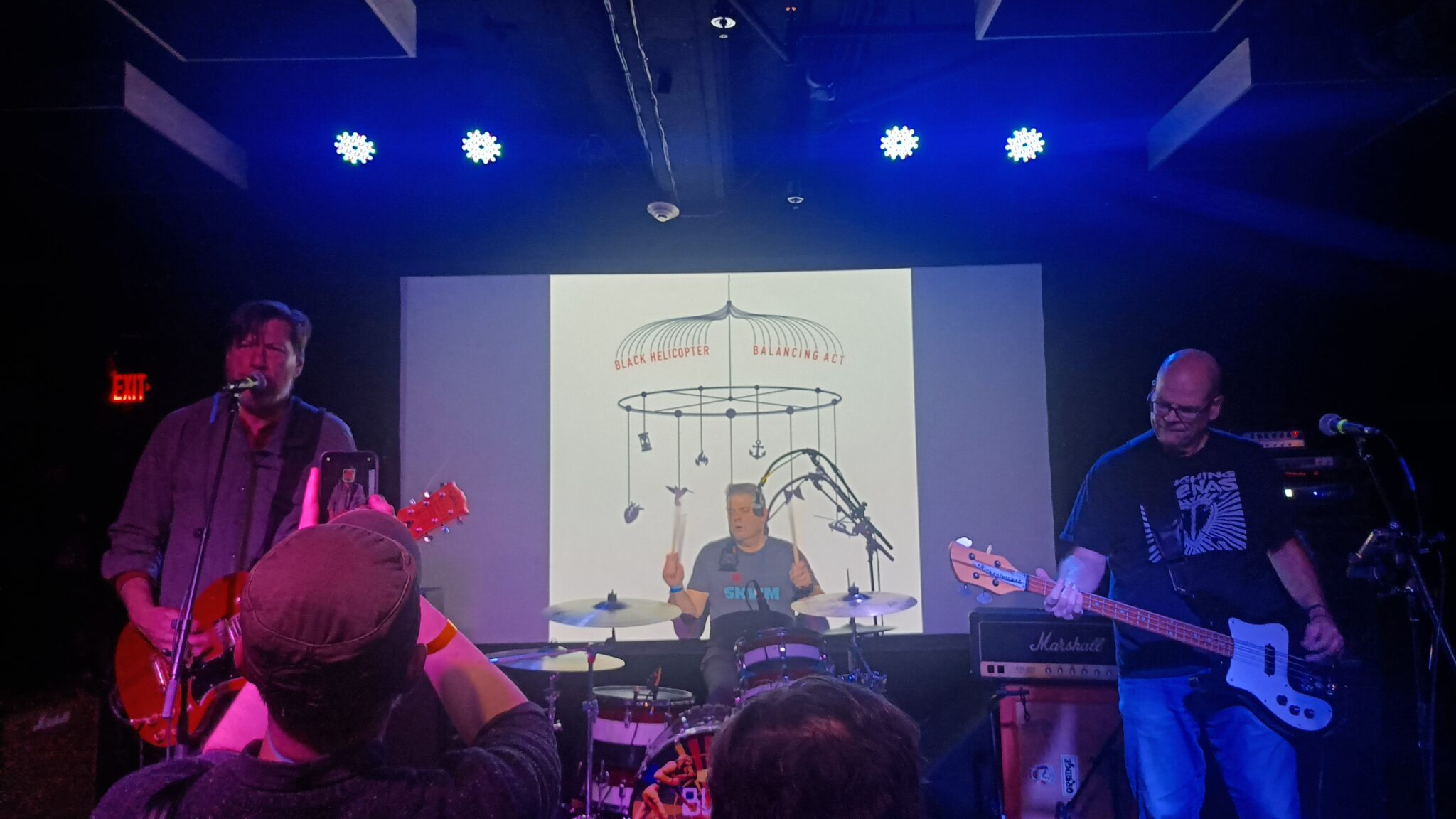
One of Spiller’s guitarists used to be in the late 80s/early 90s Boston band Green Magnet School with the guitarist from headliner Black Helicopter, they reunited at the end of Spiller’s set to play one of their old songs and it whipped ass. The show was slightly belatedly celebrating the release of Black Helicopter’s new album Balancing Act, which contains one of the best 60 songs of 2025 and is pretty damn great — and, full disclosure, has liner notes written by myself. I shot the shit with the band before the show and they were thrilled by the turnout and pumped to build off the groups that had played before them, an energy that fits their latest work. Black Helicopter doesn’t dispense with their thrashing frustrations and pissed-off blasts of previous albums, but they’ve added some more melody and perspective — per the title, they’re trying to stay upright and find a way forward instead of just giving in. And at the show they sounded loose and tight at the same time, letting the jagged riff and bitter despair of “Tailspin” (“Watch the world go breaking down / Watch the world go tumbling, tumbling”) coexist with the determined drive of “Egypt, MA” (“Got a message for ya, it’s not too late to change / Got us working for ya, in so many different ways”).To my left was a guy herking and jerking directly in front of the speakers, to my right a woman headbanging along with me, the songs cathartic and the energy joyous. After playing the album straight through they played a few oldies, bringing out a longtime scene friend to help out on vocals and one of their previous bassists for additional low end, and if these songs are among their darkest, played in that room they were a celebration.
***
And we didn’t want it to stop, so we dragged them back for an encore — another older song that I think they had in their pocket if necessary but wasn’t a guaranteed play. A true encore, in other words, and in terms of concert behavior the encore is a contentious thing. Some bands don’t play them because that doesn’t fit their show’s dynamic — after 2 hours of sound from whisper to cataclysm, GY!BE waved goodbye with no expectation of returning — but others are just tired with the cliched ceremony, the walk off stage for a few minutes just to come back on again because it’s what’s expected. It’s not a performance in the sense of the show they just played, but something performative.
I have no problem with bands who don’t want to take part in the encore gesture, I may have paid the piper but I did with the knowledge that they will also call the tune. And if a show doesn’t move you, there’s no reason why you should fake enthusiasm or hang around for more. But a show is a two-way street and the encore ritual is only the most explicit demonstration of that. It’s a ritual I deeply believe in, on one level for practical reasons — the unwritten rule of the venue is that the show is over when the lights come on and the house music comes up, the unspoken promise is that before those things happen, you might be able to keep the show going just through your desire for more — but for deeper ones as well. I go to shows to get music in the most direct and immediate way it exists, an incredible and life-affirming thing, and that means I need to give as good as I get.
This isn’t just clapping to bring Tinkerbell back to life, it’s how I — we — can respond to the generosity of the band’s performance through performance of our own. And it does have to be we here, one or two people are not going to make it happen. I think part of what makes bands suspicious of encores is how a lot of people in the audience will just stand around and assume the additional music is their due, without clapping and hooting and hollering for the band to play more songs. Without doing any work of their own. A show can be a reconciled world, but only if each part of the sum is there to make that new balance. “I’m not talking about the power I brought here for you,” Kekaula told us at that Bellrays show. “I’m talking about the power you brought here for me.”
So you go to the show. When someone goes down, you stop what you’re doing and help them up. And the rest is finding the energy and meeting it, whether it’s holding the hush for a solo voice or screaming with several hundred of your closest new friends to match the sound roaring at you, and you keep it going as long as you can, and you come away somehow both exhausted and invigorated, ready to do it all again. And that, as Lisa Kekaula told us after the final encore of the night, is a rock show. You better fucking rejoice. See you in — or next to — the pit.
Gorgeous stuff. I’ve been a longtime encore skeptic, which I think I’ve mentioned before, but this makes me see the beauty and significance of the ritual. Like the other musical experiences mentioned here, it is, at its best, genuinely communal rather than commercial. That aspect feels more important now than ever, and I love how it’s amplified (in experience and in this essay) through organization, protests, and mutual aid.
Thank you! I think a lot of performers share your skepticism, if nothing else because of how much they’ve had to do it — David Thomas of Pere Ubu has a great bit on a live album where he trash-talks the whole business, how it’s just the band going back to get some wine in the green room and waiting for a minute. And I’ve seen shows where the band just sits up on stage to get those drinks and take a breather before playing more. But I do really like the ritual on its own, it’s a powerful release and if nothing else it does get the band that extra drink.
Fuck, finally finished this one. Shout-out to The Top 60!
Got me thinking about the shows I went to in 2025. Ended up being a mix of current bands and classics; I saw three different 20th anniversary album shows among them, including the two bands I’ve seen the most in my life. And I had to miss a few acts I was really interested in (Wunderhorse canceled; I was sick for The Velveteers; Beach Bunny and Water From Your Eyes were sold out, and MJ Lenderman was the first time but we caught him the second time).
Of the 20th anniversary shows, some highlights:
Best album show: Of Montreal playing The Sunlandic Twins
Best surprise moment at show: Ted Leo opening his set after Shake the Sheets ended with “Tell Balgeary, Balgury Is Dead”
Most epic / majestic show: My Morning Jacket playing Z at MOTHERFUCKING RED ROCKS
And of the other bands:
Most improved opinion of after show: Fontaines DC
Most raucous fun / Funniest moment not related to the actual music / Best song performed twice at a show: The Beaches
Most intimate venue / Most “being the old guy at the back, let the young kids have their fun” / most crush-worthy singer/guitarist: Momma
Most Unexpectedly running into friends at show / Most MJ Lenderman: MJ Lenderman
I’m pretty sure at least one of them, maybe Of Montreal, didn’t play an encore. But they basically told us they were playing the album then a selection of their other songs, in this case all either from Satanic Panic in the Attic or Hissing Fauna, Are You the Destroyer?. And then it ended.
I don’t really see the point in fake encores, either. To be honest, the only actual encore I think I’ve seen that was legitimately spontaneous and not planned was the third encore at Wilco in 2001.
I gotta look into what’s coming this year. I know clipping. is here Sunday (with Open Mike Eagle opening), which is an odd day for a show, especially since I usually play poker on Sundays.