Note: This review discusses the entirety of the plot of Burn After Reading.
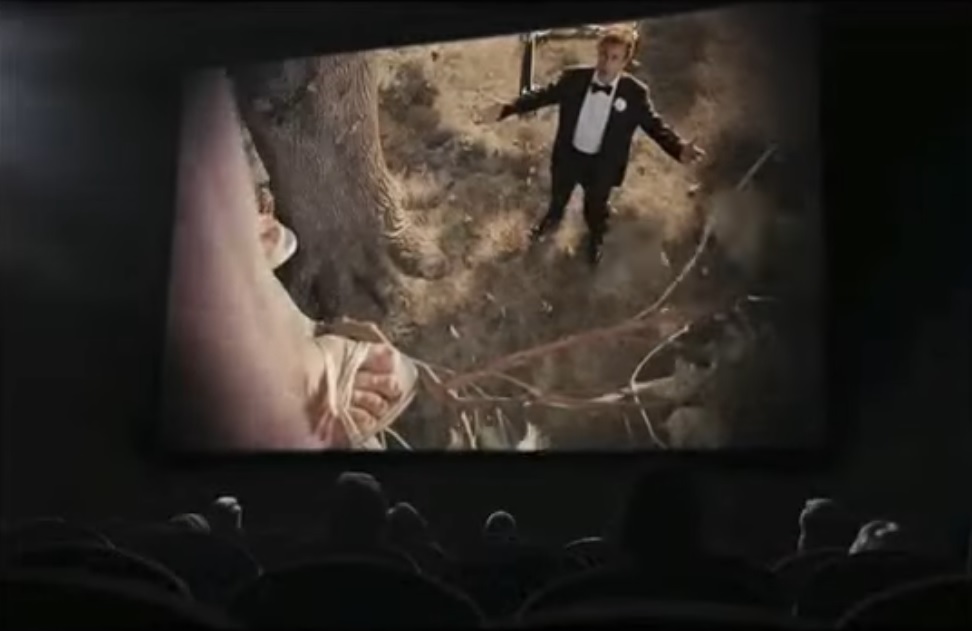
The poster for Coming Up Daisy does not look promising. (Although let’s spare a moment to appreciate the romantic comedy’s title — the simpler pun on a name of “Coming Up Rosie” is subverted for a different flower and a more ominous implication, as daisies do not come up but are pushed.) A laughing Claire Danes on a swing, an upside-down business-attired Dermot Mulroney bemusedly gazing at her — this is clearly the same cliched story of a free spirit upending the uptight on the way to true love we’ve seen again and again. And the clip of the movie we see multiple times confirms this impression, as Mulroney stares up at a woman in a tree and exasperatedly pleads with her: “We’ve been over, and over, and over this, first you say you can’t commit and then … would you come down from there?” Pretty dopey stuff, right?
That line gets a big laugh from the crowds watching Coming Up Daisy, which is after all a fake movie for the characters of the Coen brothers’ Burn After Reading to enjoy (or not). This seems like a pointed dig at how lazy entertainment scores big with lazy audiences, but it’s worth considering another perspective. After all, the Coens titled their biggest crowd-pleaser O Brother, Where Art Thou? after the would-be message film attempted by the overreaching hero of Preston Sturges’ Sullivan’s Travels. That filmmaker wants to make something more meaningful than comedies but finds out that even audiences in tough situations can really use a good laugh, and creating one is harder than it looks. Coming Up Daisy is a parody but also an acknowledgement of a certain ability and a skeleton key to the film that surrounds it. Because when the Coens try to make a rom-com, what they come up with is Burn After Reading.
Burn After Reading is generally read as a satire of political and espionage thrillers, and this is certainly part of what it is up to. In particular, Emmanuel Lubezki’s cinematography and Carter Burwell’s score are played entirely straight. Lubezki frequently shoots from the viewpoint of watchers both seen and implied, a deep focus keeping the viewer on alert, while Burwell’s ominous tones deepen the unease. The style is pure paranoia; the subject is people being dumb and venal; the implication is that this foolishness and not high-minded policy and delicate matters of state is Washington DC’s real focus; the reaction when the film was released at the end of the second Bush II administration was bitter recognition and laughter. But while the plot of Burn After Reading turns on extortion and the possibility of political intrigue, its engine is love.
Ultimately, two triangles of unreciprocated attraction intersect and three people wind up dead, with the remaining points scattered and unconnected. Nobody winds up with anybody.
All Coen movies revolve around crime in some way. (Even the ones with no apparent criminal connection — Inside Llewyn Davis is set in motion by a killing, Mike Timlin’s suicide; A Serious Man is about the crime of uncertain existence and the suspect is fleein’ the interview.) Here the iniquitous MacGuffin is a CD-ROM of extortable material (really just bank figures and drafts of a terrible “mem-wah”) is created because of curdled love before making its way to the movie’s twisted knot of would-be crooks. The disc is copied by Katie as a way to determine the assets of her husband and recently fired CIA agent Osborne, whom she is planning to divorce in order to marry Harry; it falls into the hands of Linda and Chad, personal trainers and platonic friends who share a boss in Ted, who is in unrequited love with Linda. As these groups collide via Chad and Linda’s attempt to get money out of Osborne for return of the CD (and later attempted sale of the CD to the Russian embassy), Linda and Harry start dating and even go see Coming Up Daisy before everything falls apart in bloody fashion. Ultimately, two triangles of unreciprocated attraction intersect and three people wind up dead, with the remaining points scattered and unconnected. Nobody winds up with anybody.
But almost everybody is chasing somebody, unhappy with where they currently are. Osborne is too bitterly self-absorbed and soused to see that Katie has tired of him and is sleeping with Harry, a Treasury employee who has never shot his gun but bangs any woman he sees (four in the movie, including his wife). Harry is a cad but an oddly sweet one, he genuinely enjoys the company of the various women he is leading on and fucking, as opposed to another cheating husband who grimly mounts Linda earlier in the movie. (Contra Harry, who is cheating on his wife but spends a good chunk of the movie making a sex chair for her.) Linda met that man through the same internet dating service she later meets Harry through; she is trying to find love from someone else and more desperately trying to change herself in order to have a better chance finding that love — the plastic surgery and tummy tucks and liposuctions she desires cost thousands of dollars, hence her jumping at the opportunity to get money out of Osborne. And while Linda is desperate to alter herself, Ted loves her just the way she is, at one point telling her outright. Linda does not pay attention to the expression of his heart, she has her body to think about.
Physical transformation and surface appeal is a major theme of the movie — even Osborne, during one brief moment of renewed willpower, is shown sweating to the oldies of an old Richard Simmons tape — and this is ripe material for the rom-com. Learning to see what is true and worthy, not what is flashy and superficial. But Harry and Linda are well-matched in their self-obsession. Harry is constantly trying to maintain his personal machine, trying to “get a run in” at any opportunity, and he supports Linda’s desire to look better. The filmmakers and in particular ace costume designer Mary Zophres do superb, subtle work to underline this: besides being played by George Clooney at prime silver fox age, Harry is clad in casual but sharp clothes accentuating his physique, while McDormand has never been lit less flatteringly and given worse style, her best date duds are not gauche or bad, but feel like what a person who wears a gym polo all day and has a gym trainer’s paycheck would consider high-end, they’re certainly not the upper-class cuts of Katie’s clothes. It’s easy to see why Linda wants to be something more than herself, and why she thinks her time to change is running out.
Which makes Ted’s inability to see this ultimately not endearing, but frustrating. As portrayed by Richard Jenkins, with his craggy face and kind eyes, Ted could not be more of a Nice Guy — the person in the rom-com lead’s life who is supportive and kind and ultimately the person the lead realizes they should’ve been with the whole time. But how supportive is a guy who refuses to hear what the woman he loves is actually saying? Ted is not wrong that what Linda seeks is only a surface-level change and not the way to find love, that she is yearning without understanding – but so is he. Linda really is a superficial person, and Ted refuses to acknowledge that, blinded by his own superficial love. Harry, for his part, really loves the women he attracts but in the way the narcissist loves the mirror, as a reflection of his own desirability. His love without commitment is just another smooth and empty surface.
There is one person here who is all surface with no pretense, and delightfully so. If Linda is the rom-com lead, Harry is the False Charmer who seems right but is wrong and Ted is the Nice Guy who the lead should be with all along, Chad is the Sassy Best Friend. If he is not gay, his frosted tips and toned physique code him as metrosexual, that oughts-era quagga of sexual signifiers. And he is only interested in helping out Linda as opposed to having any romantic drive of his own. Brad Pitt is consistently hitting a max of 25 watts on a 40 watt bulb, he is a hilarious dumbass, but his dumbassery is honestly directed toward getting Linda the money she needs for the surgery she craves. It’s why he agrees to break into Osborne’s townhouse to get more information (Linda doesn’t understand computers), and it’s why he gets his head blown off by Harry, who is there because he’s banging Katie. Chad’s inconvenient corpse is disposed of in an anonymizing fire; his disappearance leads Linda to panic and hatefully dismiss Ted for being unable to help. So Ted performs what he thinks will be the Bold Action that Proves his Undying Love — he also goes to the townhouse to hack Osborne’s computer on Linda’s behalf, but this time Osborne himself is there and ready for drunken revenge on the people who have been after his data. For his undying love, Ted is first shot and then hacked to pieces with a hatchet.
The Nice Guy and the Sassy Best Friend are brutally slain, which if nothing else clears the field for the False Charmer. And Harry may really want to clean up his act, after finding out his wife has been onto his adultery and is planning to divorce him. He bares his soul to Linda and hears her own fears as well, promising to help her find her missing friend. But when he ultimately realizes Chad is the man he himself shot, he freaks out and abandons Linda to the mysterious men in dark suits circling around in their ominously nondescript cars. He flees to Venezuela — the rom-com’s last act mad dash through the airport performed solo, to escape a bond instead of seal it.
Those spooky men are of course spooks themselves, CIA agents trying to follow what the hell has been going on since Osborne was canned and his allegedly valuable secrets started being passed around DC. Linda might be able to clarify things, but the CIA is more interested in her keeping her mouth shut, which she agrees to for the cost of all her surgeries. The search for Chad is forgotten, Ted was never even really thought of — Linda was and always has been out for herself. She gets that newer self, but any real connection seems out of reach, Harry for one is down in extradition-less Venezuela.
It’s one thing to expect cold emptiness in the corridors of power, another to find it in the pathways of the human heart.
But this is as good an outcome as can be hoped for the CIA superiors, Gardner and Palmer, who have observations and intel and a pile of bodies — besides Chad and Ted, Osborne is slowly expiring in a coma after a Fed shot him in the street following his hack job on Ted — but no real understanding of what the hell has happened. They do have, in their terse but familiar exchanges and offhand casualness with each other that clearly goes back years, probably the least dysfunctional relationship in the movie and they are comfortable with each other to admit ignorance in the film’s most famous exchange. “What did we learn, Palmer?” “I don’t know, sir.” “I don’t fucking know either. I guess we learned not to do it again.”
‘Tis better to have loved and lost than never to have loved at all, the saying goes, encouraging the attempt over the result. How grim to take away from love’s labor lost the message “I guess we learned not to do it again.” Gardner and Palmer are not equipped to understand the emotion that caused so much carnage here, but it’s hard for the viewer who did see it all play out to look at these fools and their actions and come to a different conclusion. I think this is why Burn After Reading’s bleakness can really rub people the wrong way — it’s one thing to expect cold emptiness in the corridors of power, another to find it in the pathways of the human heart. But as another Coen character might say: What heart?
However, even in this withering film where the bleak com comes from the mockery of the rom, the Coens smuggle in a happy ending. Harry’s wife Sandy is on the West Coast for a book tour while the major players are killing each other off and losing their shots at love in the DMV, and she is preparing to cut him loose and write off their relationship herself. In her final scene in the movie, before Ted’s slaughter and Harry’s flight and Linda’s choice and the CIA closing the books on the whole mess, Sandy leaves a particularly insipid morning show segment — up next, Dermot Mulroney, star of Coming Up Daisy! — and heads to her dressing room. Where a handsome younger man awaits. “Let me scrub this crap off my face,” Sandy says, referring to her caked-on TV makeup, as they prepare to make love. She’s following the rom-com beats, disdaining the false surfaces and being rewarded with honest pleasure. The main characters of Burn After Reading find their endings in death or solitude, but everything’s coming up Sandy.
This is a fantastic, illuminating write-up that makes me want to immediately rewatch the film with this (mostly) curdled rom-com framing in mind. I especially love your point about Harry’s flight to Venezuela paralleling, and subverting, the traditional romantic run through the airport.
Thanks! It took a while for all this to sink in but it’s surprising how much of the movie is devoted to feelings. It echoes Miller’s Crossing in this regard, another movie about organized crime on the surface but with love and betrayal (another pair of love triangles fatally crossing!) as the real motive underneath.
Agreed. I really appreciate the observation that the only truly healthy/trusting relationship is between the baffled agents at the end!
What Did We Watch?
Kojak, “Night of the Piraeus” – A newly arrived crook from Greece is killed at the docks. Soon his girlfriend, a sex worker, is also dead. The first half of the episode focuses the victims as Kojak tries to find out why. The second half shits to the motive, which is the theft of a very rare stamp. It’s an interesting if somewhat scattered approach, especially once we meet a stamp collector who cares more about stamps than about people. Guests include Norman Lloyd as the main bad guy, Ivor Francis as the heartless collector, and Elizabeth MacRae as an upscale escort.
Frasier, “Slow Tango in South Seattle”/”The Unkindest Cut of All” – In the former, Frasier discovers that a hot “Bridges of Madison County”-like book is based on his teen affair with his older piano teacher, and is moved to track her down. A lot of funny moments but the front half focusing on the author and the back half focusing on the teacher don’t really match. John O’Herlihy plays the author. In the latter, Martin’s failure to fix Eddie leads to unwanted puppies and tension between Frasier and Martin. I am starting to get a bit weary of Frasier vs Martin, but the puppies aer adorable (and one is actually the pup of Moose, the dog who plays Eddie and will take his place some day).
I had to send my laptop off for repairs on Tuesday, so I’ve been putting off writing, because it’s a pain on my phone and I’m not even sure anyone reads the writeups. Anyway, here’s the last two days, with any commentary I previously wrote. You can ask about anything you’d like more detail on.
St. Denis Medical, “Nobody Even Mentions the Brownies”
High Potential, “Let’s Play”
Season finale. Already renewed for another.
American Dad!, “The Mystery of the Missing Bazooka Shark Babe”
Wheels and the Leg Man episode!
Mythic Quest, “The Villain’s Feast”
Great episode.
Abbott Elementary, “District Budget Meeting”
A bunch of Suburgatory, since my wife had Tuesday off and I had a pretty light work day (and also wasn’t feeling all that well). I think we have one episode left in the series.
And more The Shield commentaries. Jay Karnes and David Marciano are very funny together. It’s a little disturbing how often Michael Chiklis mentions real cops coming up to him like “just like the good old days” or “that’s how you do it.”
The original “dudes who missed the point!”
Wheels and the Leg Man make me laugh every time. Every. Time.
I didn’t think it was the strongest Abbott episode but I did like the idea of Ava’s attack of conscience coming back to haunt her.
I think I would’ve liked that more for Ava if it wasn’t so predictable. The bingo cards were really funny, though.
One of the funnier things about this “Wheels and the Leg Man” episode is that Hayley actually does all the investigating and Steve and Roger barely do anything. (They spend more time on their fake undercover jobs, especially Steve as an accountant, than they do investigating Danuta’s disappearance.)
The square about Jacob killed me.
Steve and Roger are committed to the bit but not much else, which is one of the reasons those episodes are such gold.
Heretic – Hugh Grant taps into that deep, visceral fear we all have of being trapped listening to a smug atheist. Unfortunately, this means the movie spends a sizeable chunk of its time making you listen to the ramblings of said smug atheist, to the point that when it finally turns into a horror film proper, you’re sinfully excited to see the blood spray. The idea of tying a test of faith to Jigsaw-like sadism has a lot of potential. The catalog of saints who met bloody ends is arguably one of the oldest horror franchises in existence; Bartholomew getting flayed alive would fit right in. Grant’s buoyancy through his monologues is essential, but even he can only tread water for so long. A lot of good work here by the small cast and especially by the production designer. The script’s twists are clever, but some too many resemble its villain – not clever enough to justify the verbosity.
Live poetry and music! I read as part of a monthly live performance series and I think I got a really good reception, the funny poems got laughs and one piece got a “Whoa.” The other stuff was a little more mixed as this was an astrology-based/very woo-woo event, as the host acknowledged, including some weird “make eye contact and hold palms with your neighbor” exercises. But still felt rejuvenating and I hadn’t performed in a minute, so I needed it.
Some Walton Goggins talk on Ruck’s Discord got me rewatching Vice Principals, especially for Russell doing the right thing at his dad’s funeral…then smashing the airplanes to fuck over his sisters. The Sopranos isn’t right exactly but it’s not wrong – you can change, but not always that much. I also like how much the Hill/Green/Bride projects value the truth – what undoes Russell over time is his compulsive lying, though Gamby is also honest to a fault, as he says to Justine.
Woooooo live poetry and music!!
Woo-woo live poetry! It’s good to get out, right?
Year of the Month update!
This February, you can sign up to write about anything from 2016, including these movies, albums, and books.
Feb. 13th: Cori Domschot: Ghostbusters
Feb. 14th: Gillian Nelson: Milo Murphy’s Law
Feb. 18th: John Roberts: Silence
Feb. 20th: Bridgett Taylor: Rogue One
Feb. 21st: Gillian Nelson: Pete’s Dragon
Feb. 23rd: Ben Hohenstatt: My Woman
Feb. 27th: Cori Domschot: Hidden Figures
Feb. 27th: John Bruni: Jet Plane and Oxbow
Feb. 28th: Sam Scott: Popstar: Never Stop Never Stopping
And March is going to be Silent Era Month, where you can join these writers in examining your favorite silent movies and anything else from the 1910s and ’20s!
Mar. 26th: Sam Scott: Peter and Wendy by J.M. Barrie
Mar. 31st: John Anderson: The Lodger: A Story of the London Fog
2/20 for Rogue One.
Murder, She Wrote “The Days Dwindle Down” (s3e21) – Gimmicky but fun episode that is a sequel of sorts to the 1949 noir Strange Bargain. The three stars of the original film – Martha Scott, Jeffrey Lynn and Harry Morgan – reunite 40 years later so Jessica, while ignoring the original ending, can solve the crime in the film. Without going into two different plots the episode is told in flashbacks using footage from the original film and, of course, new MSW footage. A unique mystery is told about bringing justice to a wrongly convicted man who just got out of prison after 40 years. Richard Beymer plays a slimy sleazebag, in his first of six?!? appearances on the show. Pretty sure he’s a sleazebag in all six. He does it so well.