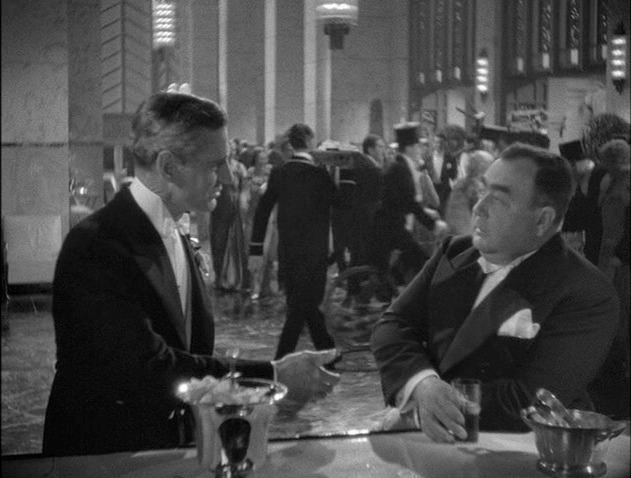
It’s so strange to think that Eugene Pallette got his start as a stunt man in silent films. He was young, dashing, and agile in the 1921 The Three Musketeers. I’m honestly curious as to whether or not he was reacting to having served in the Flying Corps in World War I. We are absolutely not here for body-shaming, but it is true that he gained a substantial amount of weight in the years after the war. It’s true that he was also hitting thirty at around that point, but one way or another, he was settling into the body type that made him memorable throughout the late ‘20s and the ‘30s; the silent part was actually at least as important, because I remember his voice better than his face.
Pallette dropped out of a military academy to act. There are claims that he had a vaudeville act with three horses, but Wikipedia wants a source for that and IMDb doesn’t provide details. Still, he started doing silent movies and touring with stage shows. From there, he made his way to Hollywood. First, he was a stuntman. He made an enormous number of one-reelers, then ended up in D.W. Griffith movies. (Including, sigh, a blackface performance in Birth of a Nation.) Then came the war, and IMDb wants us to know how much he started eating. It’s frankly kind of gross.
The coming of sound was great for his career, though. His voice was deep and rough; you get terms like “froggy” and “gravelly.” And it is incredibly distinctive. If you’ve seen him in pretty much anything, you remember the voice even if you don’t remember the face. As I said. He was also older by that point and slid easily into roles like Friar Tuck in the Errol Flynn Adventures of Robin Hood and Alexander Bullock in My Man Godfrey. The voice makes him memorable even in wild movies like Topper, where there’s so much else going on.
What ended his career is a matter of some debate. Pallette himself said it was the “throat troubles” that ended up being the cancer that killed him. Otto Preminger claimed he was a horrific racist who believed, in 1944, that Germany would win World War II. (So far as I can tell, only Preminger seems to have called him out about it, but I don’t know where else the documentation could be.) Either way, his last film was Suspense in 1946. (Two years after Preminger claimed Daryl F. Zanuck fired Pallette for racism.) He died eight years later at the age of 65.
There is a belief that Pallette spent at least a few of those years hiding out on a ranch, waiting for the end of the world. This was your standard early Cold War nuclear terror, the same thing that gave us Godzilla and Kurosawa’s I Live in Fear. It’s not necessarily true. It’s not necessarily false. There seem to be claims and denials on both sides, with it being possible the ranch was just the sort of thing a lot of Hollywood types had, to go and get drunk with their friends in the middle of nowhere. Impossible to know. More interesting to contemplate than maybe he was a horrible racist?