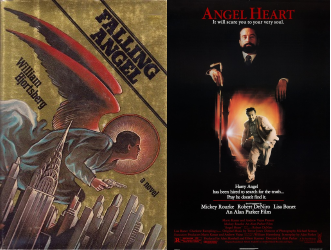
Obeah is a real religion. It is not Satanism. It is one of many African diasporic religions, the best known of which is voodoo in its various spellings. I am frankly far too white and far too much from the West Coast to lecture with any degree of confidence on them, but the best description I can provide is that Obeah, voodoo, Santería, and the many others are syncretism between the African practices brought with enslaved peoples and the religious beliefs they would come into contact with in the New World. This is primarily Christianity and often specifically Catholicism, but it can also include Hinduism and Islam. I have no reason to believe that William Hjortsberg was an expert on the subject, either.
However, his book, Falling Angel, is steeped in the practice. We start in the office of low-rent detective Harry Angel. He gets a call from a high-end attorney named Herman Winesap, who is himself in the employ of a man calling himself Louis Cyphre. Cyphre wants to pay Angel to find Johnny Favorite, a singer who was just beginning to hit it big before World War II. He and his band were attacked while onstage in Tunisia, and Johnny has been in a veterans’ hospital since 1943. Or has he? Cyphre wants to know if Johnny is alive or dead, having a personal interest in the subject.
Unfortunately, as Angel starts looking, people die. First Dr. Albert Fowler, the doctor who has known for more than a decade that Johnny is not in his hospital, a veterans’ hospital, or any other. Then Edison “Toots” Sweet, a pianist who knew Johnny before the war. Toots leads Angel to Epiphany Proudfoot, the daughter of Evangeline, with whom Johnny was involved even though he was officially engaged to Margaret Krusemark, the daughter of a shipping magnate. Evangeline has been dead for years, making her the only one not endangered by Angel’s search.
The movie is mostly the same, with Mickey Rourke as Angel, Robert De Niro as Cyphre (apparently doing a Martin Scorsese impersonation), and Lisa Bonet as Epiphany. Unlike in the book, which is completely set in New York except for brief trips to Poughkeepsie and Coney Island, the movie version includes trips into the voodoo realm of Louisiana. This makes the movie considerably sweatier than the book, appropriate for a July movie. (It’s 87 degrees F as I write this.) Some details are trimmed; others are kept word-for-word the same.
This makes the movie considerably sweatier than the book, appropriate for a July movie.
The biggest change is that Obeah is not voodoo. Obeah is, from what little I know—I am willing to learn but have put off this article too long to do the level of research I’d have to in order to consider myself fully aware of the details of either—apparently seldom considered a religion by those who participate in it. It doesn’t have the same sorts of ritualistic behaviour that, frankly, the book portrays, so changing it to voodoo makes a bit of sense. And not just because boy do most white Americans not know anything about African diasporic religion even to the level I do.
I don’t want to talk about one of the big things that’s kept the same inasmuch as, wow, that would spoil the final about twenty pages of the book unless you can work out certain details for yourself in advance and not just the reality of Louis Cyphre which I figured out the second he appeared on camera. But I could have done without those details. Honestly the relationship between Angel and Epiphany bothers me. Mickey Rourke was in his mid-thirties and Lisa Bonet was nineteen when they filmed their sex scene. Never mind that it’s unprofessional, which it super is, the power imbalance today is extreme and would have been only more so in the 1959 setting.
Oh, and we can pin that setting to the day. Probably a savvy reader could’ve earlier than I did, but Angel mentions at one point that “Volare” was the big song of the preceding summer, so even without the invitation to a Black Mass that has the date embossed on it you can work out what day everything happened. And I checked, while I was at it, and the dates all line up. The Palm Sunday Black Mass really was Palm Sunday that year, and the book starts on Friday the thirteenth, which really was a Friday the thirteenth that year.
The book is pretty clear that Satanism is different. Epiphany, who calls herself a mambo (or priestess when she’s translating to the white dude), tells Angel a fair amount about the fact that she respects the evil forces but doesn’t work with them. It’s established all the way through that Johnny was evil. No one likes him. Margaret worked with evil forces. Epiphany didn’t; no more did Evangeline, when she was still alive. The movie’s less clear on this but of course has less time to work with it. I still don’t blame practitioners for not being best thrilled with the portrayal of their beliefs in book or movie.
Next month, we’ll be getting into a book and movie that touches on a fate that comes for us all. Enter the American funeral-industrial complex with The Loved One.
A pleasant surprise, to have a movie make a change to make things slightly more accurate!
Though I am quite sure it was more because white Americans don’t know what Obeah is and do know what voodoo is.
I found this a surprisingly successful movie even as weird and as schlocky as it is when I saw it for the first time a few years ago.