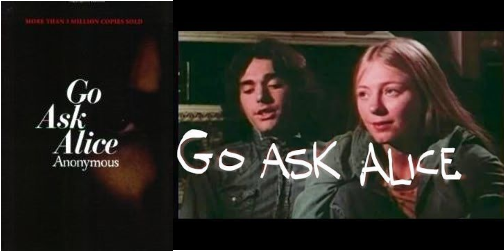
I grew up in the days of Just Say No. My older sister actually went to a luncheon or some damn thing with Nancy Reagan as the special guest. I only went to a bunch of rallies at the Rose Bowl, personally, as well as taking ridiculous numbers of classes. I have not passed on the knowledge from it to my children, preferring to be accurate and matter-of-fact instead of scaring them straight. This is not the approach used in Go Ask Alice.
In the book, the narrator never gets a name, though she does at one point meet an Alice. She is a teenager in an unnamed college town. Her father gets a job as a dean at a new college, and the family moves. The narrator has no friends. She gets to know a girl named Beth, but when Beth goes to summer camp, the narrator is bored and lonely. She returns to their original town to stay with her grandparents. While there, a group of kids gives her LSD without her knowledge. From there, she within days moves on to shooting Speed. Over the course of the book, she tries practically everything. She runs away twice. She runs a popular jewelry store and hangout in Berkeley. She ends up in a mental institute. She turns her life around and of course dies anyway.
We get less in the movie, where she’s actually Alice (Jamie Smith Jackson, twenty-five at the time). Because it’s a whopping 74 minutes long, quite a lot is trimmed, including one of her siblings and her time in San Francisco and Berkeley. Her father is William Shatner, and eventually she has a stupefyingly long talk with a priest who really gets kids, played by the only obvious choice—Andy Griffith. She returns home, cleans up her act, ends up in a mental institute, turns her life around and of course dies anyway.
The book has been published since 1971 as being based, at least, on the real diaries of a real teenager. However, it’s officially published as nonfiction and the copyright paperwork is in the name of Beatrice Sparks. She claims to have worked as a youth counselor at the Utah State Hospital; this is a lie. Her volunteer work there was all administrative. She would later claim a PhD; I’m not even sure she had a college degree of any kind, and none of the multiple schools she later cited had any record of her attending for more than a few months. She eventually published nine books allegedly based on teenagers’ diaries; only one of them can be proven to be a real person, and most of the book was fabricated.
She claims to have worked as a youth counselor at the Utah State Hospital; this is a lie.
Mostly, our narrator serves to push a certain view of what the drug culture is “really” like. Obviously, I can’t speak to that. Not just because the only drugs I’ve ever used have been prescription but because the book was published five years before I was born and the movie made two years later. I reread it recently with a critical eye, and the parts that ring the truest have the least to do with drugs. The narrator’s grief over her grandparents, for example. Her concern about wearing the right clothes. Her frustration with her younger siblings. And, uh, that’s it.
I’m sure it’s possible that there were people who were invited to parties where they were given LSD without knowing it would happen. Less likely is that you’d go from LSD to Speed and from there to pot—specifically to injecting Speed, a thing I looked up this time around because I thought it was pills. Which it is, and, yes, you can crush and inject them but it’s not the most common way. The narrator doesn’t mention diet pills, which at the time were basically just meth. There’s an old SNL commercial that refers to “the tiny blue diet pill you don’t have to be overweight to need,” and it’s for Speed.
I’m not going to pretend I’m not aware of some of the horrible things that happened to kids in those days who thought they were just doing a little casual weed or LSD or what have you. Actually, it seems shooting Speed can have serious consequences not just because of the meth but because not all of the bits dissolve and can cause real health problems beyond that. And life has never in human history been good for kids living on the streets; while the narrator’s specific experiences may not ring true, plenty of girls like her would over the years meet up with the wrong person and never be seen again.
But this was the work of a Mormon woman in her fifties, and it kind of shows. One of the horrors of drug use is that, gasp, the narrator becomes attracted to women. The way she finds out that her boyfriend is using her to push drugs is that, gasp, he’s sleeping with her best friend’s boyfriend. Her father, despite being a college professor, is explicitly conservative. The kids who use drugs are all constantly stoned and go out of their way to pull the narrator back in; no one just uses a little weed at a party now and again, or even just on weekends. The narrator is apparently the only person she knows who quits.
One of the problems is how often our drug-avoidance education lies to us. Even flashbacks aren’t what people say and tend to be, at most, weird visual effects more like static or persistent eye floaters than actual full-blown hallucinations. How can you trust the actual risks of heroin or cocaine when they’re explained to you if you’re waiting to throw yourself out a window like Helen Hunt? And having seen Helen Hunt do that, are you going to believe that increased risk of suicide is a known side effect of angel dust? Works like this are laughable, and you can come to believe it’s all propaganda and paranoia. It’s not hard to imagine stoned people watching the movie and laughing.
Next month, we go from anti-drug melodrama to Sirkian melodrama with Written on the Wind!