When the newest casting for Heated Rivalry dropped—Justice Smith and Charlie Gillespie as Harris & Troy, another couple in Rachel Reid’s series of interconnected hockey romances—I couldn’t help but remember that both stars were featured in short-lived Netflix series: Julie and the Phantoms and The Get Down1. Now, to be fair, I believe by 2030 every actor active in Hollywood will have been in a short-lived Netflix series. But still, the parallels are kind of weird!
Julie and the Phantoms
It’s 1995 in Hollywood. A band on the rise, Sunset Curve, is about to play what should be their breakthrough gig at the Orpheum. We watch them play through their sound check, confident, cocky.
Don’t look down
‘Cause we’re still rising up right now
They look good. They sound good. They’re ready to go. Three of the bandmates head out for some food before the show; the last one lingers behind to flirt with a pretty girl.
“After tonight,” lead singer Luke (Charlie Gillespie) tells them, “everything changes.”
He’s right enough about that.
They don’t make it to the gig. They don’t make it at all.
This somewhat morbid joke kicks off the one-season Netflix show Julie and the Phantoms2, a show that picks up 25 years later with the titular Julie (Madison Reyes), a high school musician who’s been creatively blocked after the death of her mother. Julie, going through some of her mom’s old things, puts Sunset Curve’s demo into a CD player3, and three Gen X ghosts come crashing into her life. Luke, drummer Alex (Owen Patrick Joyner) and bassist Reggie (Jeremy Shada) realize that they’re ghosts, but they don’t realize at first how much time has passed. “I have been crying for 25 years?” Alex asks at one point in outrage. “How is that possible?” The pilot spends the necessary amount of time fleshing out the leads, and the early episodes lay out the basic rules of the world (Julie is the only one who can see the boys, unless they’re playing music together, and some other basic ghost stuff). They decide to pass the boys off as holograms and re-christen the band “The Phantoms.”
The remaining eight episodes of the season introduce tensions big and small; Julie’s father considers selling the family home, Julie deals with a mean girl with a competing band, the ghosts get recruited by a supernatural club owner (Cheyenne Jackson!) with a sinister agenda, and Alex falls in love with a fellow ghost (Booboo Stewart). Producer and director Kenny Ortega brings the same high energy that made those High School Musical movies so infectious, and he even got to put a real gay romance onscreen this time.4 The episodes clock in around the half-hour mark: the longest is the pilot, at 38 minutes. Julie and the Phantoms talks about art, and grief, and has a gentle touch, even with the goofiness.
I would genuinely love to know what the hell went wrong with this show. The original music and performances must have cost a good penny, but the lead actors were all almost unknowns5, the sets and costumes stayed pretty simple, and surely the critical praise and Daytime Emmy recognition must have counted for something. Netflix pushed it hard—there’s even a series of mini-documentaries still up on the streaming service—and Ortega had a five-year deal. But the show stayed un-renewed and was eventually quietly cancelled. (“No one watched it” is an obvious answer, but then why did it stay on the metaphorical bubble for so long?) Maybe it was just too weird to last.
The Get Down
The Get Down starts in 1996, with top-of-the-world hip-hop artist MC Books (played as an adult by Daveed Diggs with Nas providing the rapping, yeah, I don’t get it either) at a performance, talking about his early years. The show then jumps back to New York in the 1970s.6 Justice Smith stars as the future MC Books, in his earlier life as Zeke, an aspiring musician hopelessly in love with his beautiful classmate Mylene (Herizen F. Guardiol). He ends up teaming up with graffiti artist and DJ Shaolin Fantastic (Shameik Moore); in the pilot, once they’ve completed a brief enemies-to-allies arc, they bluff their way into making a DJ play a specific Misty Holloway song at the nightclub Mylene’s hoping to make a splash at.
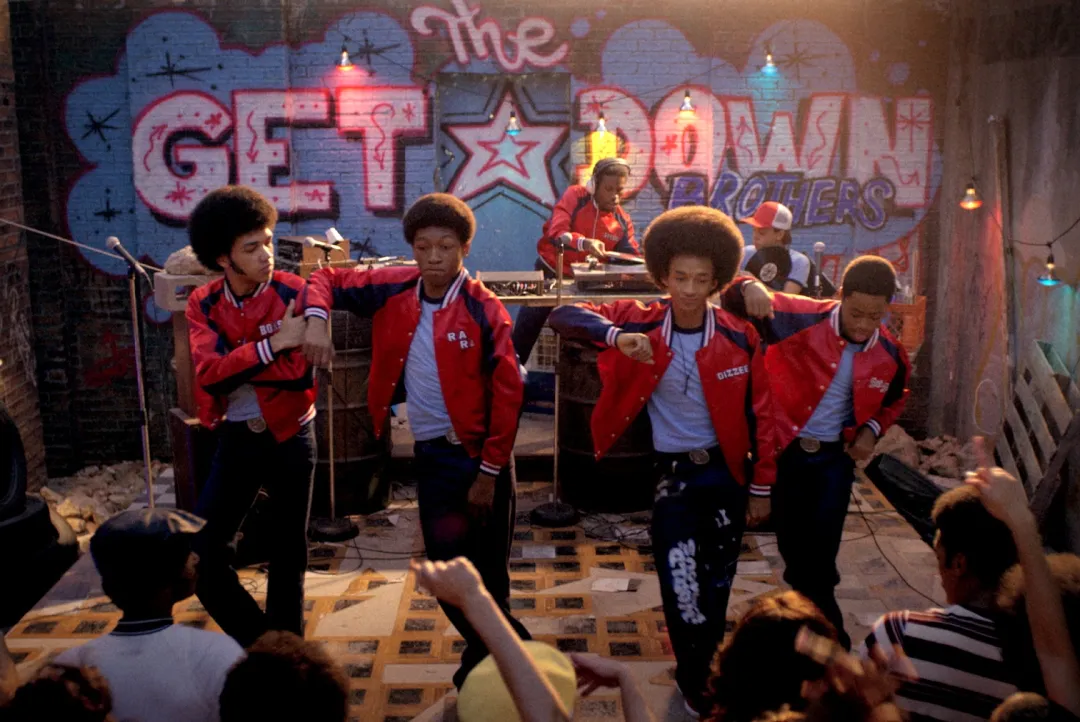
Where Julie and the Phantoms kept things simple, The Get Down keeps things spinning. There’s Zeke’s romantic storyline, his artistic ambitions, his relationship with his family; Mylene’s got her own ambitions and family struggles. In the first episode alone, there’s a dramatic scene with Zeke and his teacher talking through the grief he feels after his parents’ deaths, several side plots set up involving local politics and the drug trade, an extremely funny sort-of-fight between Zeke and Shaolin over that Misty Holloway record, a literal fucking shootout7, and “the flyest secret underground party in the entire Bronx.” It’s at that party where Zeke discovers rap, in a sequence just as fantastical as anything in Julie and the Phantoms.
The first season is only eleven episodes, but they’re all at least an hour long; like many early Netflix shows the episodes range pretty wildly in length, from 53 to 93 minutes.8 Unlike Julie, it’s not a family show with four-quadrant appeal; it’s a Baz Luhrmann period piece set in 1970s New York. Julie was clearly budget-conscious; The Get Down is whatever the opposite of that is. Famous songs get needle-dropped, disco lights glitter, there are crowd shots and wide shots and more period-accurate costumes and props than you could shake a record sleeve at. Look, there’s Giancarlo Esposito as Mylene’s hyper-religious, abusive father! Jimmy Smits as a political boss and Mylene’s uncle! That nightclub DJ was played by fucking Billy Porter9, and what the fuck is Eric Bogosian doing here? The Get Down’s brief, glorious life isn’t really a mystery: the full series run cost $120 million. It’s probably a miracle it existed at all.
And now here we are, in 2026, with Smith and Gillespie cast in a streaming show that will definitely get two seasons. Smith, of course, has done very well since The Get Down, while Gillespie has mostly done things I hadn’t heard of until I was looking him up for this article.
Tierney has a real gift for introducing music into his shows, and I won’t be surprised if we get another “All the Things She Said”-style sequence in Season 2, but I’m pretty sure this Netflix connection was just a coincidence. Still, it’s fun to check out these early shows. Smith makes a bigger impact than Gillespie—Madison Reyes honestly should have been the breakout star of Julie and the Phantoms, and Smith is just phenomenal—but they’ve both got charisma, and it’ll be fun to see what they do together when Heated Rivalry returns. Who knows, maybe they’ll sing karaoke or something
- The Get Down was produced by Sony but it was clearly a “Netflix show.” ↩︎
- A remake of the Brazilian show Julie e os Fantasmas. ↩︎
- I told you, 1995. ↩︎
- They’re cute. I was rooting for them. Goddamn it, Netflix, you could at least have given us a movie. ↩︎
- Jeremy Shada is best known still as a voice actor; you may know him better as Finn the Human. ↩︎
- This is weird, right? Julie jumps forward, The Get Down goes back, but both of them start within a year of each other. I’m sure some of it is ‘Gen X, lol’ but. This is weird, right? Two nickels! ↩︎
- There’s an incredible shot late in the pilot of a disco ball spattered with blood. ↩︎
- Emily St. James had a great review of what a glorious mess it is on Vox. ↩︎
- Billy Porter’s disco DJ falls, but the underground DJ (Grandmaster Flash, played by a standout Mamoudou Athie) is on the rise. This is not a subtle show. ↩︎
They really cast an actor named Booboo as a ghost?
“That’s like an ice cream man named Cone!”
He was using the name well before the show, too!
What did we watch?
M*A*S*H, Season Four, Episode Seventeen, “Dear Ma”
“As usual, I’m writing real slow coz I know you can’t write fast.”
“It used to make me mad that Pop died, until I figured that dying wasn’t Pop’s idea.”
“What we’ll do is, we’ll get the guy and put the shrapnel back in.”
“I wouldn’t let you touch my feet with a ten foot pole.”
“Radar, cancel the ten foot pole. Stretch Polaski, tallest Pole you ever saw.”
“The colonel said one day we’ll have a war in which all the cooks fight each other, take out the common enemy.”
“Just keep your nose out of my feet!”
“Well put.”
“Stop dawdling.”
“Dawdling? I wax poetic.”
Gotta use this one next time someone tells me to shut up.
I think Radar’s letters home are one of the better examples of the form specifically because his voice is so different from everybody else’s, what with the gimmick of him being artfully inarticulate – this show is so good at writing artful awkwardness (whether naivete in this case, stupidity in Frank’s, or drunkenness in general) so it has a lot of fun with his letters home. The other overall structure here is Radar accompanying Hawkeye on a foot inspection, and I love this use of such a tiny procedural detail as a plot point; the show correctly assesses that it could generate a completely different scene out of each character doing something so stupidly simple.
BJ gets taken in by a scammer; I don’t care for this in the sense that BJ, while fundamentally decent, is also too smart to be taken in by this, though he has a lot of fun when the scammer ends up under his knife again which makes up for it. Potter also gets shot in the ass, which is reliably funny, especially when they work his wife’s premonitions into the plot alongside it. That is a fascinatingly consistent thing; I had a situation once where I felt a strange compulsion to leave my house for work half an hour early and found my car surrounded by plans for a worksite, forcing me to move it. Coincidence, maybe, or some other rational explanation.
House of the Dragon – Haven’t been recapping this show on here at all because I’ve been so frustrated by the plot and filmmaking, but yeah, I watched the third season. Positives: they’ve done a much better job with a “female leader go crazy” arc than GoT, in part because there are female writers here and no one is itching to go write a Star War. Emma D’arcy is a far better actor too than Emilia Clarke. The battle scene in the finale largely ruled and I laughed out loud at “Fuck you too.” Every actor is giving their all especially Tom Glynn-Carney’s gleeful “I’m alive!” and then his irritation that he hasn’t enjoyed dressing down a repentant Aemond.
The downside is, well, almost everything else. The filmmaking is bafflingly BLURRY, as if no one on the production side has heard of deep focus, the plotting is a sludge because HBO doesn’t want to spend all the money on dragon battles even though I have been promised dragons, I want more goddamn dragons, gimme, gimme the dragons, and most of the characters just say what they are thinking and feeling out loud. It’s what I get for watching the most prestige of prestige shows; I remember critics critiquing the fast plotting in S1, but it meant we got the most important decisions made by each character over twenty years, which translated to actual drama. The audience got the most impactful decisions, not always endless conversation, something this show has so, so much of. I enjoy watching this with my friend; I don’t know if that means I enjoy the show.
Detour – The classic B-movie noir about the worst experience anyone has ever had hitchhiking. On the one hand, this does a lot with very little, with a lower than low budget and a cast of unknowns and a mood. On the other hand, this is that famous “shade darker than black” that goths dream about, and it’s just really hard to watch. I can see what it has so many fans, but I don’t plan to take this trip again.
Elementary, “A Study in Charlotte” – Yes, the title is derived from that of the very first Sherlock Holmes story, “A Study in Scarlet,” and the use of the word “RACHE” is borrowed from there as well. (This might be the first time both Elementary and Sherlock drew inspiration from the same story.) The mystery involves the death of several people from poisoned hallucinogenic mushrooms and a matter of revenge (which is what “rache” is the German word for), and is reasonably satisfying. The B plot involved Joan working to smooth over relations between Sherlock and the man who owns the next door brownstone (Richard Kind) and is a bit more satisfying.
Barney Miller, “The Guest” – The guest is an accountant for the Mob (Herb Edelman) about to offer his testimony, being hidden at the 12th Precinct, only the Mob is one step ahead of things and sends poisoned sandwiches! And while this is happening, Marty the gay thief is arrested again and gets a crush on the Mob accountant, and Chano needs to borrow cash from everyone to complete a drug bust. This one mixes some very good gags and some well done serious business, starts to treat Marty more like a person and not a stereotype, and flows pretty well. We’re definitely finding our footing.
Huh, I wonder if you watched a weird print, because Detour is one of those films that’s in the public domain and is thus easy to watch in crappy rips anywhere.
It was a crappy print. None of the streaming services that are not Criterion seem likely to pay for the Criterion restoration.
Babylon 5, “Soul Hunter” and “Born to the Purple”
I’ll probably mostly be doing an episode a day, Monday-Thursday, but last night was a twofer since I couldn’t make Monday.
“Soul Hunter” takes a supernaturally tinged setup–an alien race who appear as reapers, collecting souls, and are dreaded by most of the galaxy–and makes it feel more SFnal (and more dramatic) by turning it into a cultural clash exacerbated by a fanatic. And it increases the long-term drama by using this plotline to reveal that Delenn has more power in Minbari society than she’s revealed, and now Sinclair knows it. But what he doesn’t know is that she has some kind of plan that shocked the soul hunter, though the significance of it is still up in the air. We also get a bit of Dukhat backstory: I’m assuming this will factor in more heavily later since I remember hearing about this guy, the dead Minbari leader.
“Born to the Purple” brings Londo (and, to a lesser extent, G’Kar) back after last episode’s absence, and this is a very Londo-focused episode, as he’s honeypotted for scandalous high-level information on other Centauri and still mostly takes his heartbreak in stride and focuses on getting the info back and getting her out of trouble. (It helps that the woman in question is genuinely attached to him, even if probably not as much as he would like to believe.) Sinclair does some good political maneuvering, accompanied by some nice “don’t think of pink elephants” work from Talia; I liked this more than him killing a guy with a soul laser. Londo and G’Kar both deputize their seconds to negotiate on their behalf and both warn them not to give away the homeworld: I always like a good “more alike than they think” beat. The Ivanova-Garibaldi subplot has a nice conclusion, with Garibaldi handling Ivanova’s grief and desire for privacy with tact but also warmth.
Vague but great spoiler: Delenn’s assistant Lennier will go on to be the best goddamned character on the show.
One of the downsides of early B5 is that when G’Kar and Londo aren’t in the room, I’m always asking where Londo and G’Kar are.
I did spend most of “Soul Hunter” asking that same question!
I’m excited to properly meet Lennier. As a Twilight Zone person, I’m already very fond of Bill Mumy on general principles.
The good news: Lennier (and Mumy) is as great as you’ve been told
The bad news: Outside of him and Delenn, everything else about Minbar sucks mondo ass. Their whole deal feels like if Ursula K. Le Guin got kicked in the head and spun around in a Natural Wonders store.
I recall hearing about The Get Down, probably because the budget/director meant it penetrated areas I follow, but have never heard of Judy and The Phantoms, which sounds wild. And also wildly out of time, not in its conceit but in its style — The Get Down is clearly Prestige (with shades of Vinyl) but “as you may have guessed, my musician friends are actually ghosts that I’ve been passing off as advanced technology” feels like a high-concept show from the 70s. Very weird. And I assume the surviving guitarist would have something to say about this…
There were some other high-concept kids’ shows around that time, still. I believe those Descendants movies are still going!
The surviving guitarist actually shows up in the series! He profited off his dead bandmates’ music. It’s a whole thing.
Year of the Month update!
This August, send us your pieces on any of these movies, albums, books, etc. from 2001!
TBD: James Williams: Millennium Actress
Aug. 14th: Gillian Nelson: The Princess Diaries
Aug. 16th: Tristan J. Nankervis: Mulholland Drive
Aug. 21st: Gillian Nelson: Disney’s California Adventure
Aug. 27th: Cori Domschot: The Mummy Returns
Aug. 28th: Gillian Nelson: Walt Disney Treasures
Then, this September, you can write about any of these movies, albums, books, etc. from 1937.
Sept. 4th: Gillian Nelson: Moose Hunters
Sept. 6th: Tristan J. Nankervis: Lenin in October
Sept. 18th: Gillian Nelson: Pluto Quin-pup-lets
Sept. 20th: Tristan J. Nankervis: The Hobbit
Sept. 22nd: Lauren James: Stage Door
Sept. 25th: Gillian Nelson: Donald’s Ostrich