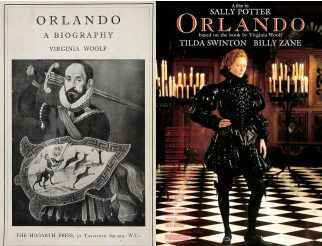
Sometimes the column is torn between dueling forces. It makes sense to cover the gender-bending world of Orlando for Pride Month, given its plot and its history. On the other hand, Pride Month is at the beginning of summer, which means that sometimes, it’s ninety bloody degrees Fahrenheit out, and I’m stuck trying to plow my way through Virginia Woolf, whose sentences I’m not convinced are ever going to end, when I can barely think. The things I do for my art.
Virginia Woolf’s Orlando: A Biography is the story of the eponymous young lord, born late in the reign of Elizabeth I. He is one of her last favourites. Upon her death, he remains at the court of James I, his name paired with various court women; he is eventually engaged, but he breaks his engagement for a tumultuous relationship with the Russian Sasha, who goes back to Russia when the Great Frost breaks. Orlando returns to his home and his poetry; he is mocked by poet Nicholas Greene and goes into seclusion. Eventually, he becomes English ambassador to Constantinople under Charles II. Where she is physically transformed into a woman. She spends time with a troop of Romany, then returns to England.
The Archduchess Harriet who had pursued Lord Orlando turns out to be the Archduke Harry, who proposes to her. She spends time in high society, engaging with Pope, Addison, and Swift. The nineteenth century hits, and with damp comes lugubrious prose. She wins the assorted lawsuits her changed sex created. She marries a sea captain in part because marriage is such a Victorian thing. She at long last publishes the poem she’s been writing for centuries, since her long-ago Elizabethan boyhood.
Sally Potter’s Orlando hits much the same notes. Orlando is Tilda Swinton in every incarnation. Perhaps the most important difference is that the book’s Orlando ages to a perpetual about thirty and stays there for no good reason; the movie’s is bid by Gloriana herself, Queen Elizabeth (Quentin Crisp), to not age or fade or wither. And so she goes through history as instructed. Eventually, she meets the sea captain, and he’s Billy Zane, and they are perhaps the most beautiful couple to appear onscreen in the entire history of film.
Woolf intended her novel to be a musing on her lover, Vita Sackville-West, if she had lived through all of history and also been born a boy. Actually, tracking the Sackville family is kind of a pain; there should just be a Wikipedia page with the family tree. Sackville-West herself was the child of cousins; her grandfather’s marriage was deemed bigamous and her mother illegitimate, and the title passed from him to her other grandfather’s son, who was his nephew. So yeah. The original illustrations of Orlando passing through history were just Sackville-West’s ancestors, including a cousin of Anne Boleyn.
What I hadn’t realized was that, in the book, Orlando is not the only one to live implausibly long. There’s Nicholas Greene, who eventually publishes “The Oak Tree.” The servants don’t necessarily live as long, but the same housekeeper is there for at least a century; it’s implied there are three between Elizabeth and Victoria. Why do the people live so long? They just do. Don’t worry about it. Most of the world ages and withers and dies, but a handful of figures live on. Indeed, Orlando’s chance-met husband, Marmaduke Bonthrop Shelmardine, also lives on unchanged.
Why do the people live so long? They just do. Don’t worry about it.
The book is also, it seems, intended to be a satirical history of English literature, hence Greene’s early distaste for Shakespeare and so forth and insistence that English literature is dying and then his later distaste for the new writers and fond remembrance of Shakespeare and so forth. One rather wonders if “The Oak Tree” is actually any good or if it’s just that it’s written in a more Elizabethan style and therefore deemed more worthy by Greene. We’re never given so much as an excerpt of it, so we’ll never know.
It’s also not difficult to see Woolf’s struggling under the expectations placed on women in her day. The film retains the awful, sexist garbage pontificated on by the Augustans. Woolf does that one better and as a narrator goes back and forth between blatantly satirizing it and seeming to have internalized it and therefore believing it. It’s no wonder that Orlando spends so much of the book gender-bending; physically female she may be but I wouldn’t want to live under those expectations, either.
One of the many advantages the movie has in dropping most, though not all, of the narration is that you aren’t as heavily trapped in Woolf’s prejudices. She was, after all, writing in the 1920s—the book ends the very day it was published. There’s still things Woolf believed about gender—and, after all, she didn’t have a clear distinction between gender and sex. By changing bodies, Orlando also changed gender, even though she would continue to dress as a man regularly. The most it seems to have done is loosen her attraction so that she is interested in both men and women. And boy there is sudden surprise racism scattered throughout, most notably in the people that Woolf definitely didn’t call Rom.
The movie remains absolutely gorgeous. It was a packed year for the Oscars, and the film lost Art Direction to Schindler’s List and Costume Design to The Age of Innocence. However, the theme for the canceled 2020 Met Gala would have been based on the scene in the movie where Orlando starts running through a maze in the height of Georgian fashion and emerges from it in mid-Victorian. From his Elizabeth boyhood to her 1990s androgyny, Orlando is always well dressed, and so is everyone around the film’s glittering star.
I don’t blame people for not reading the book. Certainly I can’t recommend reading the book for Pride unless you’re in the Southern Hemisphere somewhere it gets cold. But the film is worth watching if for no other reason than its sheer beauty. It’s the film that made Tilda Swinton an indie star, and deservedly so. She’s fantastic in it, conveying weight by a single raised eyebrow that some other actors couldn’t do with their entire body. There is full-frontal nudity to show that, yes, Orlando is a woman now, and we do see her and her captain in bed, but for most of the movie, everyone is clad in period fashion, meaning enough fabric in one gown to outfit about fifteen people at your average Pride parade.
Next month, we’ll be up in my neck of the woods with The Egg and I, and you will learn everything you ever wanted to know about Port Townsend and its environs!