Level 1 – The Place (No spoilers)
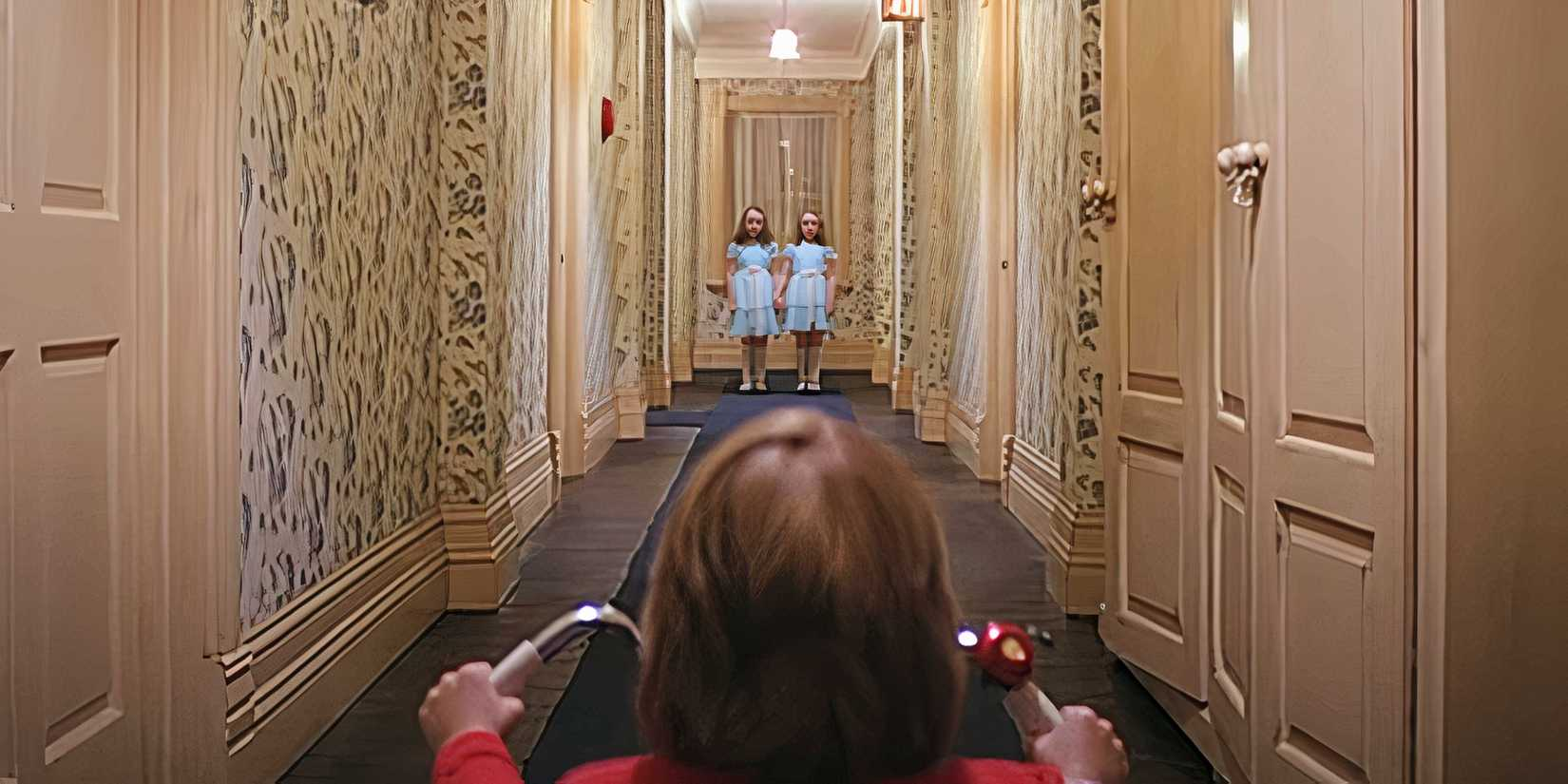
A simple glance at a classic still from Stanley Kubrick’s 1980’s The Shining and a promotional still from Backrooms is all you need to for the vibes in these two architecturally minded horror flicks to start prickling your brain. Despite this shared penchant for wringing scares from carpet, Backrooms was directed by Kane Parsons who is – and I hope you’re sitting down as you no doubt hear this for the first time – quite young. Infuriatingly young! Remember that twerp who stopped mowing your lawn so he could direct Whiplash? Younger than that guy.
As such, Parsons is mostly discussed in terms of the immediate influences he represents (and cites), mostly video games (like Portal 2) and of course the endless backrooms of YouTube material which he has contributed to for a major percentage of his time on earth. When Backrooms is compared to anything made before 2020, it’s typically a comparison that doesn’t assume any direct influence influence (he’s only been able to see R-rated movies for the last two years!) and tiptoes around direct comparisons. Fair enough. This newcomer needs more of an oeuvre and time under critical scrutiny, otherwise putting his name too close to Kubrick’s could be an embarrassing look in the future. What if he turns out like the Whiplash kid?*
Both movies take place in uncanny spaces explored extensively by their makers. Kubrick spent a year and a half at the Overlook during an insanely long shoot, and Parsons has been creating Backrooms content for his web series for at least four. The rooms form the basis for the action in both films. Superficially, they have the same moves, familiar spaces made unsettling by their deviation from unfamiliarity. But the difference in the way they arrive at that unsettling feeling is interesting.
Kubrick famously takes the already repetitious scenery of a hotel hallway and adds more symmetry:
Whereas Parsons’ frames often eschew symmetry even with plenty of opportunity:
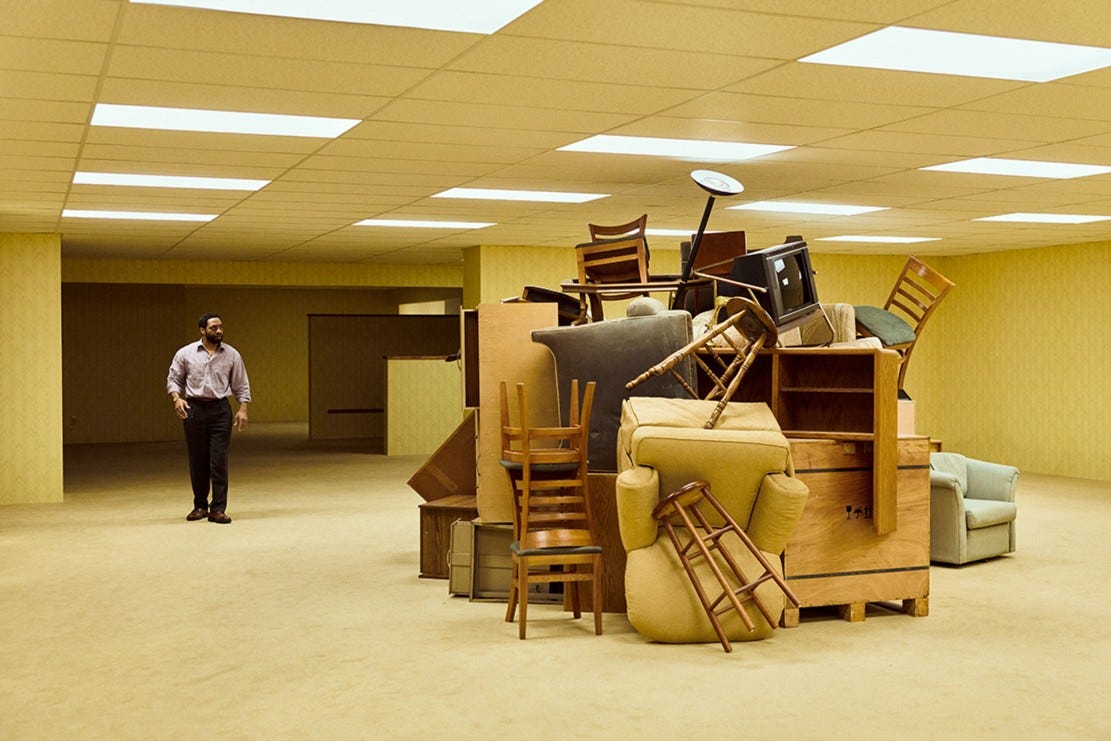
The potent element is repetition, but in some ways The Overlook and The Backrooms are opposites. The Overlook starts with a symmetrical environment and Kubrick frames it in a symmetrical way. Characters can break this symmetry (like the hotel’s famous ghostly guests, Tub Lady and Blow Job Dogman), but the “liminal space” as they’re calling it these days is defined by its symmetry. Order imposed on order.
The Backrooms break the repetition in ways that also break the symmetry. Couple this with Parsons’ penchant for handheld in a number of sequences (a holdover from the found footage conceit of his webseries) and you have an environment as creepily sterile as the one dreamed by Kubrick but navigated without the hush of a Stedi-cam. The endless hallways are almost always punctuated with piles of things: furniture, clothes, concrete. Disorder in an orderly space.
Level 2 – The Time (Moderate spoilers)
The Shining was filmed in the late 1970s and takes place in the early 1980s. Presumably. Much of it feels out of time, from odd details like Danny’s pop culture knit sweaters all the way to Jack’s visage showing up in a photo dated sixty years prior. But it speaks strongest from the vantage point of late-20th century America.
There’s a lot of junk hauled back from the deeper explorations of The Shining (captured in the documentary Room 247), but one of the more intriguing ideas that emerged from the obsessive theorizing is that the movie reflects Kubrick’s thoughts on genocide. Possibly brought on by years of research for an unrealized Holocaust movie, Overlook spelunkers have cataloged the way the film particularly invokes the genocide of Native Americans.
This theory has barely any explicit evidence, only a passing line about the hotel’s location on “Indian burial ground.” But whether or not the movie has any intentional nods toward specific historical events, the idea of repressed time and memories makes a lot of thematic and emotional sense, starting with Danny’s visions of blood pouring out of the lobby’s (symmetrical) elevators and woven throughout the hints at the hotel residents’ past misdeeds. The horror comes from the orderly environment disrupted.
Backrooms informs us that it takes place in 1990, not that many years after The Shining. This is so the movie can take advantage of the lo-fi and less thoroughly connected (i.e. smartphone-free) past. But the film’s voice nonetheless comes from the early 21st century, and not just because its director was born six years after the previous century (but also not not because of that). The plot of Backrooms can seem like a secondary concern to the production design but plenty of time is spent setting up a story for our characters before they go wandering in liminal space. That plot centers around therapy: our main characters are Clark, a depressed divorcee, and Mary, his therapist who is haunted by memories of a childhood in an unsafe home. Much of the non-backroom scenes involve Clark’s failing sessions with Mary.
Therapy existed in 1990, but the amount of time the characters spend on introspection about past traumas seems much more in line with modern horror films. The Backrooms draws a much clearer line between the problems below the surface and the horrors experienced above. The climax is directly related to the problems of the characters. Yet for all the explanation for what happens in the backrooms (and there’s quite a bit of it), the actual explanation for why the backrooms exist and how they function remains enigmatic (the one character that attempts to start an explanation is, hilariously, more or less ignored by the movie). Meaning is imposed on at least one of the monsters of the backrooms, but it’s insufficient to explain why, for instance, there’s a prominent backwards stop sign, or random seagulls crashing around the hallways. We’re given a series of images related to the therapist and just enough to go on to be unsatisfied by the information we have. The attempts to put order on the space fall short.
Level 3 – The Meaning (Full spoilers)
The Shining endures at least in part because its horror drafts from the feeling that all the order the 1980s took for granted – the durability of old propriety and the nuclear family – is rooted in chaos and blood. Jack may be unsuccessful in killing his progeny, but he seems to still exist as an eternal part of the Overlook Hotel. The certainty of the age, built on tragedies and perversions undiscussed in polite society, could it all come crumbling down?
Backrooms has no evidence of even this illusonary 20th century certainty. Its illogical and further off-kilter rooms have inspiration in a world order already betrayed. Therapy is no help – Clark goes mad within the backrooms, Mary is found out to be a terrible therapist, and Clark dies declaring that he doesn’t have to change a thing. He’s literally consumed by a past version of himself that he sought to control. After years of analyzing buried feelings and history and coming no closer to answers, we’re confronted with a disordered world with an explanation just out of reach. Maybe buried in one of these piles, maybe just the other end of this narrowing hallway.
The Shining imagines a constructed space of refuge and order that can be threatened with the horrors of the world. Backrooms regards last century’s detritus at an amused remove. Its observations come from someone born into the Internet that sees into infinite space where the horrors are preserved, and we can walk among them, but woe to those who try to find solace in doing so. Kubrick tried to map the backrooms from the outside. Backrooms suggests it’s no easier task from within.
*I actually think Damien Chazelle is a gifted and often exciting filmmaker. But he’s also younger and more successful than me. So I must strike at the soles of his shoes before the grave dirt between us grows too thick.
What did we watch?
M*A*S*H, Season Four, Episode Twelve, “Of Moose and Men”
[boom]
“Sounds like the truce talks are going well.”
“He always gets the cowboys and I get stuck with the Indians!”
“I am one fourth Cherokee.”
“Oh. How.”
“I’m honoured. Touched. And aroused.”
This is a great scene updating Margaret to her more famous characterisation; it’s pretty delicate, actually, how they present Hawkeye as completely unaware of Margaret’s respect for him until she says something.
“Don’t you understand, man, you’ve struck coleslaw!”
“I put a colonel back together. Used the spare parts of two majors.”
I happened to be consoling a friend who is going through the worst possible time right now – the worst I’ve ever seen them – and I actually ended up using BJ as the model for how to approach trying to help her, because she lives on the other side of the world and words are all I have. I think one of the reasons the BJ to BJ’s moustache part of the show appeals to so many of us – to the point of often just skipping to season four – is because it feels like a model for decency. Hawkeye often demands it; BJ lives it, and so do many of the others.
There’s two opposites to that this episode; Zale, who reveals he’s cheating on his wife and hypocritically wailing about doing the same thing. This fits into the show’s broader sense of sexuality; wild consensual sex is simply living out a human impulse, cheating on one’s partner is a failure of self-control. BJ gets a kick out of being committed to his ideals; you could see him as an expression of discipline. Conversely, there’s the Colonel that Hawkeye accidentally splashed with mud, whose commitment to his ideal – forgiving Hawkeye for annoying him as opposed to writing him up – is laughable, even contemptuous.
Star Trek: The Motion Picture – I missed this in the theaters (I think even as a kid, reviews could affect my desire to see something), and only saw it for the first time on network TV, after Wrath of Khan had come out. So I was not very impressed. I didn’t see it again till 2019, after I had spent three years on a weekly “Trek@50” project, and found that while it isn’t a good movie, I enjoyed it some. And now, after 60 years of Trek, of sequels and prequels and reboots and retcons and fan service and far too many bad choices by writers and directors and the studio, this is actually quite enjoyable. Yes, the Voyage Around the Enterprise and the Voyage Across V’Ger are still too long, and this is still a more philosophical reworking of a TOS episode. But if you know what is coming, you can focus on what works. Like a cast that, for all their unhappiness with the story, feels like it’s picking from where it left off. And gorgeous special effects that owe more to 2001 than Star Wars. And a great Goldsmith score. And a story that does not have a conventional bad guy or phasers set to stun. In some ways, this is the most Star Trek of the Star Trek movies, which makes sense since it’s the only one when Roddenberry was in charge. I love Wrath of Khan to bits, but it lacks the humanism of TOS and of TNG. And we have to celebrate that this does not have a character dying but being brought back as an android. Or Benedict Cumberbatch trolling the audience. Or anyone turning into a lizard. Or the sort of fan service designed to paper over how bad the plot is. After the past two decades, one can really appreciate this more.
Elementary, “When Your Number’s Up” – Alicia Witt kills two people who are beneficiaries of victims of a plane crash as part of a scheme to make sure she gets the biggest settlement possible. A simple plot made livelier by this being something of a “howcatchem” since we see her commit the murders first, and by the story casting a light on the practice by lawyers, insurers, and corporations to base their settlements on the potential earning power of the victims, reducing human worth to a formula. Holmes is of course offended.
I got TMP as a Movie Gift a while back and wound up liking it quite a bit — the story feels like a TV episode stretched to the breaking point but the movie looks fantastic and as someone with no connection to Trek I still really liked the long sequence showing off the Enterprise. It looks boss! But this and everything else are elevated by Goldsmith’s magnificent score, the overture in particular is lovely.
Yes! Yes!!!
https://www.the-solute.com/where-no-man-went-again-star-trek-the-motion-picture-yotm/
TMP is still the Trekkiest movie ever to exist, for good and bad. Frankly none of the Star Trek movies entirely live up to the promise of a feature-length Star Trek, even the pretty good ones. It was created for the right format from the start.
I think the Next Gen movies come closer, but they are also less ambitious.
Generations and Insurrection are okay representations of the show. First Contact is fun but coloring outside the spirit of the show. Nemesis should be shot out the airlock. The problem with any of them for me is none are as good as the best two-parters in the series.
Robert Wise could adapt and just about direct any genre he wanted well.
Seinfeld, S8: “The Money” – solid episode with a lot of good Seinfeld / Costanza parent stuff. Also Kramer is dating Sarah Silverman. Another slightly overstuffed episode (I’m not sure it needed the J Peterman stuff as well as everything else) but it’s hard to go wrong with Frank and Estelle Costanza.
Veronica Mars — Looking up the characters’ ages is interesting, all of the “teens” were in their early 20s when this began and Francis Capra is actually the youngest person in real life! But in general they pass, so it is very funny to see Jonathan Taylor Thomas, who is in the exact same age cohort, looking much, much older playing an ATF narc undercover at the high school. Part of this is his acting, which is warmed-over Christian Slater, but he just looks tired. As stunt casting he’s fine, but he’s more meaningful as a cautionary tale for a show that is not cast as well as this one was — this is also the episode where Veronica and Logan finally kiss and Bell and Dohring’s chemistry is fantastic.
Andor — I have been informed we are done with the stupid forest children, we better be. The non-Avatar parts are pretty good and the shootout in the junk hangar is a fantastic setpiece. And per comments on Jerry Goldsmith above, Nicholas Brittell is one of the most reliable composers out there these days, he’s doing very good and varied work so far.
Wild at Heart – What for a time was a tough movie to find is streaming on Criterion, guessing a disc release is forthcoming. I don’t know if I outright loved this one as much the second time around since it didn’t get to surprise me, but knowing the tone to expect meant I was laughing out loud from the start at every crazy turn. Almost – the flashbacks to Lula’s abuse go a bit too far for comfort. Fishing around for the border between humor and horror is part of the point, but this is the one sport where the otherwise glorious Laura Dern doesn’t work in the movie’s favor. I think the saving weird humor is supposed to come from a fully adult Dern playing a young child, but I’ve seen Straight Talk and I know Dern has looked like an adult since birth. A later harrowing scene with Willem Dafoe as the reprehensible Bobby Peru works better mapping the funny/horrifying line.
Between this and Blue Velvet, it’s astounding how Dern was on Lynch’s wavelength from the start given how bizarre that wavelength can be. I may need to circle back to Inland Empire, but I’ll do it in chapters this time.
Stopped reading after the first section, I still need to see this, but already intrigued by the comparison. Also laughing a lot at “Blow Job Dogman,” which sounds like that Wimpy Kid guy is writing Tijuana Bibles.
“You never heard the tale of Blow Job Dogman?”
“Uh…”
“He’s exactly what you’d think!”
Hey, this isn’t TV!
Bwahaha! That’s for stealing Legally Blonde! Viva la cinema!