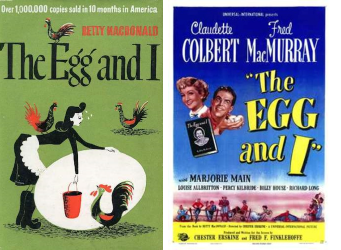
When I was eighteen, [mumble mumble] years ago, I left Los Angeles County and moved to Port Angeles, Washington. And boy howdy was that some culture shock. But at least I moved into something approaching an actual city. Even if it was half the size of the unincorporated region of the county where I’d grew up which I always thought of as a small town. (Growing up in a megalopolis does strange things to your sense of scale.) If Betty MacDonald grew up in places like Boulder, Colorado, and Butte, Montana, and eventually Seattle, Washington, which a century ago were considerably smaller than they are now, well, the isolation of her farm was even greater than Port Angeles even by my standards.
In 1927, Betty Bard married insurance man Robert Heskett. Who turned out to hate selling insurance and instead, with Betty’s agreement, bought a chicken farm on the Olympic Peninsula. This was some miles from the never-named Port Townsend, Washington, and up against the Olympic Mountains. Her nearest neighbours were the ne’er-do-well Kettle clan, four miles away, and the terrifyingly clean Hicks family, five miles in the other direction. Together, Betty and Bob fix up their decrepit farm and deal with wild animals, wild locals, and wild nature.
The movie is clearly set closer to the time it was made, in 1947, since book-Bob was a World War I vet and the movie references Okinawa. Betty (Claudette Colbert) is on her honeymoon when Bob (Fred MacMurray) tells her how much he wants to be a chicken farmer. In fact, surprise, he’s bought a chicken farm which is if anything in worse shape than the one in the book—its previous owner apparently abandoned it. While some of the events of the book make it into the movie, most of it involves the modern chicken farm down the road, owned by the lovely Harriet Putnam (Louise Albritton).
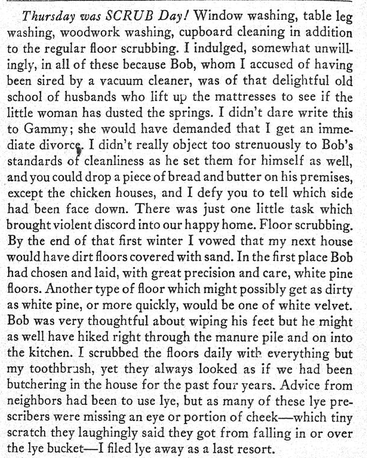
It is with great satisfaction that I report that MacDonald was, in fact, her second husband’s last name, and she divorced that utter creep Bob. I was messaging my best friend as I read the book, and it became a running thing to list characters who would make the book better if she ran off with them instead of staying with Bob, and it started with an actual literal bear. Though he was firm that she couldn’t have noticed the bear and instead it must have been squirrels. Other people she could have run off with include the local bootlegger, her brother’s sister, and her brother’s sister’s husband, all of whom treat her better than Bob does.
And in the movie, he’s worse. Bob can’t understand why Betty would possibly be jealous of the time and energy he gives Harriet, even though he completely ignores all the things she does around the farm. He’s perfectly willing to jaunt off with Harriet to deal with things at her farm and leave Betty to do work on theirs, even though Betty suggests that Tom Kettle (Richard Long) is better at machinery and would be more helpful than Bob would. Movie-Betty even finds time to find a way for Tom to go to college for engineering and Ma Kettle (Marjorie Main) to win the quilt show at the county fair.
Sure, I know that we’re only getting Betty’s side of things, and given she had almost no contact with Bob after 1931, it’s clear that she didn’t like him anymore. Still, there’s no sense in there of why she married him in the first place. She says almost nothing about their courtship, but the way she describes herself leading up to that makes it feel as though she married him because she thought he might be her only chance. He was thirteen years older than she; she had been raised to believe that a woman should always accept her husband’s job if she wanted a happy marriage. With that in mind, it’s hard not to pity her.
Well, until you get to chapter sixteen. There are rumblings much earlier about what she would eventually be sued over. Her discussion of Native Americans from her time in Butte is bad enough; what she had to say about the local S’Klallam people is appalling. Honestly the whole history of their people is depressing, and she doesn’t seem to have any sympathy for it. She talks about their drunkenness and lax parenting, about how slovenly and violent they are. She clearly describes nearly being raped by a “breed” while her husband was at a grange meeting. And I don’t know; maybe it’s true. But it’s only part of the story. The people who lived near her farm before the coming of white people had essentially died out and their language rendered extinct decades before she got there.
Honestly, there’s no little classism in the book. There’s a throwaway reference to the idea of how hard it will be for her daughter to go to school, but it’s quite clear education isn’t prized there. She’s explicitly the only person to do much reading. Betty is disdainful of it, but at least she can get away. The movie shows Tom Kettle as an intelligent man who would do well by going to college, but the book’s Elwin Kettle is disdained for always tinkering around on cars. Maybe Elwin is that smart and there’s just no way for him to use it.
I do think that it’s a waste for Betty to be on that farm. Working eighteen hours a day at something that doesn’t suit her isn’t the best use of her talents. She doesn’t have a love for it. In fact, she’s quite clear that she hates chickens. Bob loves being a chicken-farmer and loves having someone to take a share of the work. Betty is myopic and unskilled and unhappy. The most moving part of the book is when her sister- and brother-in-law are visiting and actually seem to see how hard it all is for her. And no less because her brother-in-law admires her paintings and her husband is too busy reading a magazine about chicken ailments.
There’s a struggle in the book between Betty’s quite real admiration of the scenery around her, which she describes in such rich prose that I, at least, could picture everything. And not just because I know exactly where her farm was, having passed the road now called Egg and I Road. She loves the mountains, even if she never feels the mountains love her, and she speaks with pleasure about the food she and her husband and community are able to gather from the land around them. Heck, one of the reasons I want to take her to an eye doctor is so that she can get a better view of the loveliness around her.
The movie doesn’t have a feel for it. Sure, that’s because it was of course filmed in California. There’s a brief reference to the amount of seafood you can get here, but that’s it. Honestly, the farm feels more like it’s in the US South; you barely touch on the mountainous aspect. The Olympics are an ongoing presence in the story, both for their beauty and for the challenges they present to people living among them, and they’re absent from the movie. I haven’t seen any of the later Ma and Pa Kettle movies that were spun off from this, but it wouldn’t surprise me if they transplant the Kettles from the Olympics to, for example, the Ozarks.
I can’t in good conscience suggest that anyone else read the book. Certainly don’t bother with the movie. But I do kind of wish a Washingtonian would read it so they can discuss it with me, because I do want to talk to someone about the contrasts. I actually grew up on MacDonald’s prose, as she would also go on to write the Mrs. Piggle-Wiggle books, but some of the writing here is even better. I would find an abridged version that stripped out pretty much the entire plot rather soothing, because it is such a beautiful portrayal of a region I know and love.
I’ve meant to read this book or see this movie for years. In part because there are so many spin-off movies, but also because it’s part of the cultural memory of older Washingtonians. I think my partner’s mother told me about it, when she was still alive, and I think I’ve talked about it with my best friend’s grandmother. My firstborn lives not that far from Egg and I Road and went to high school in Chimacum, the settlement near the farm, but I’m not sure he knows anything about this. His adoptive mom might, but I’m not sure. Either way, the memories of this are fading, and I do not particularly feel sad about that.
Next month, we get into bonkers anti-drug propaganda with Go Ask Alice. Maybe someday we’ll cover actual quality media again.