Larry McMurtry was — is — a major figure in American letters. A prolific and popular writer, a Pulitzer and Oscar winner, that guy who loved books so much he owned one of the biggest antiquarian bookstores in the United States. He wrote daily, by all appearances up until his death at 84 in March 2021. The Last Picture Show, Terms of Endearment, and Texasville were all adapted from his bestselling books. But 1985’s Lonesome Dove stands above the others.
Another notoriously prolific and popular writer, Stephen King, picked the novel as a favorite on The Late Show with Stephen Colbert in 2001:
More recently, a 40th anniversary reissue with a foreword by one of the Yellowstone creators spiked a resurgence in sales. Sales had previously spiked in 1989, when a wildly successful TV adaptation of the original book premiered, and in 1993 with the sequel miniseries Return to Lonesome Dove. (Return was something of a step down. It wasn’t based on any of McMurtry’s work, and Jon Voight made a poor replacement for Tommy Lee Jones’s Cobb.)
Out of curiosity, I checked my library’s Libby app. The Green Mountain Library Consortium, which serves the whole state1, has 40 people waiting for three available copies of Lonesome Dove, its only McMurtry e-book, at the time of writing. Lonesome Dove is hot again.
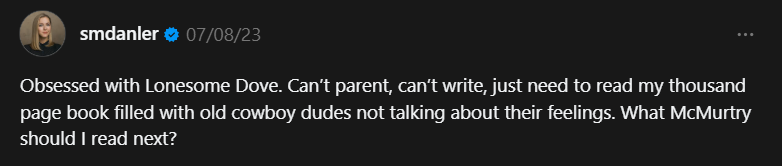
There are a lot of theories as to why. The success of Yellowstone has definitely fueled a resurgence of interest in Westerns, and Lonesome Dove is a pretty good gateway drug. It’s not as dated as Zane Grey or Louis L’Amour, but it’s still populated with cowboys, horses and local color. Woodrow Call and Gus McCrae are fascinating and flawed, engaging enough for the reader to want to follow for a thousand pages, just like every McMurtry character I’ve been fortunate enough to encounter. Lonesome Dove is the kind of book that people who think they’re too good for genre fiction allow themselves to read2. It’s also the kind of book that people who love genre fiction point to as an example of how damn good genre fiction can be.
McMurtry himself had mixed feelings about the book’s legacy. When the book was reissued in 2000, he said:
I thought I had written about a harsh time and some pretty harsh people, but to the public at large, I had produced something nearer to an idealization; instead of a poor man’s Inferno, filled with violence, faithlessness’ and betrayal, I had actually delivered a kind of Gone with the Wind of the West, a turnabout I’ll be mulling over for a long, long time.
Gone with the Wind is a fawning love letter to a society that very much deserved to be shot behind the barn. But it also contains much more than the author intended. Margaret Mitchell thought wet blankets Ashley and Melanie Wilkes were the heroes of that story, but Rhett and Scarlett caught fire in the American imagination. There are no heroes in Lonesome Dove. Readers might see Gus and Call that way, but no writer will ever be able to control what readers take from a work.
The Western is often about community. In the American myth, people go west to find a new start, to escape their past, to find wealth and adventure. Lonesome Dove asks how strong those communities are, what happens when they’re tested, and how we determine who belongs. I am not sure I need to outline why this has become such a relevant issue in the second Trump administration, but I’d recommend you listen to Jamelle Bouie talk about it anyway.
Who belongs to us, and what do we owe them?
Lonesome Dove talks about how we treat one another, our own family and friends and lovers. It explores when and how their lives become cheap. Who belongs to us, and what do we owe them? Call travels from Montana to Texas for the love of his friend but won’t claim his own son. Black cowboys belong but American Indians are enemies. Lonesome Dove doesn’t condone this, exactly, but there’s not a lot of interrogation, either. The author’s voice remains coolly engaging; we see these men and women as they see themselves, we see the world as they see it, and there’s no room for outsiders in this difficult, challenging place. But the isolation pays its price as well; when you divide the world up into enemies and allies, there are enemies everywhere.3
And when there are enemies everywhere, sometimes they come from within.
Early in the book, academic Roger Walton Jones4 quotes Deets, the African-American cowboy and tracker who has been working with Gus and Call for years:
He had known several men who blew their heads off, and he had pondered it much. It seemed to him it was probably because they could not take enough happiness just from the sky and the moon to carry them over the low feelings that came to all men.
Jones identifies death and its acceptance as a major theme of McMurtry’s work, and death certainly hangs over Lonesome Dove. Call’s illegitimate and unacknowledged son is an orphan. Men are murdered. Murderers are hanged. Gus chooses to die of gangrene rather than lose a second leg to infection.
Suicide was the United States’ 10th leading cause of death in 2024 (and previous years were even higher). Males make up 50% of the population but nearly 80% of suicides; (non-Hispanic) white and American Indian/Alaska Native populations have the highest rates of suicide by ethnicity. Reading Lonesome Dove is a reminder of watching people you love struggle and die, for reasons you may never know, or no apparent reason at all. Now, after a COVID-19 pandemic, a decades-long opioid epidemic, and semi-regular school shootings all showed staggering indifference to life, readers are trying to come to terms with death, too. Michael Sebastian at Esquire thinks the book resonates with readers looking for a new model of masculinity, and I think there’s some truth to that too, in a chicken-and-egg sort of way. But I think Sebastian’s theory glosses over some of the pain and self-sabotage that characterize the men of Lonesome Dove. McMurtry is cannier than that; his characters can be caring and kind, yes, but they’re still capable of the cruelty and callousness that modern masculinity might do well to leave behind. Gone with the Wind raises its ugly head once again.
Lonesome Dove, like so many great novels, is layered and complicated enough to hold all these interpretations. Like the country it’s set in, it carries the contradictions in ways that can be ugly and can be shatteringly beautiful. It shows us who we are, who we could be, and who we hope desperately that we’re not. At a time when our nation is facing what can only be called an existential crisis, no wonder we keep returning to it, wondering where in the imagined past we can find a hint of the future.
- Population 648,493, though we do have a higher-than-average number of readers in some surveys. Fun fact: McMurtry’s Booked Up bookstore in Archer City, Texas, had around 400-450,000 books on hand at its height. ↩︎
- I say this mostly with affection. ↩︎
- No, this isn’t a “racism hurts white people too” statement; this is about barriers between people and how they isolate and damage them. The racism is connected, but it’s not the whole issue ↩︎
- “CRITICAL READINGS: Coming to Terms with Death in the West: Anticipation of Death and the Effects of Loss in the Novels of Larry McMurtry,” in Critical Insights: Southwestern Literature, 2016 ↩︎
This is a beautiful grappling with a complex and beloved text. The way works of art are bigger than they’re intended to be and the way audience responses to them are beyond authorial control (for better or for worse) is one of my recurring interests, so I love how you explore that here. And thinking about this through the lens of how we grapple with chaotic, unexpected death is so interesting; I think that also resonates well with the various unexpected mental health crises in the book, from Xavier Wanz burning down the saloon after Lorena’s departure to the guy making pyramids out of buffalo bones. We see the proximate causes with Lorena’s (well-described) PTSD, but some of these cases are relative mysteries, where even when we know the trigger, as with Wanz, we don’t know the whole shape of the gun.
I was very happy to have an excuse to revisit this after it had spent a few years on the shelf, so thank you for that! And this piece has given me even more things to think about.
Thank you! This is very much a book that stays with you.
I have been thinking about death in fiction a lot lately, so it was the right time to revisit this, I think.
Great Westerns, of which I think LONESOME DOVE is one, are, as Lauren indicates, bigger than the reductive mythology often attributed to them by their fans and critics. There is both mystery and a dialectic concerning the notion of borders and legitimizing who is allowed in, excluded, and how hierarchy gets recognized. These political subtexts have room to play in here, in staged conflicts that transcends the moralism of conservative nostalgia. My main criticism of YELLOWSTONE was how the more McMurty like complexity of the first season, where authoritarian politics and mass murder secured the Dutton’s rights, got smoothed out into a tamer romanticism. I suspect this was due to a feeling that fans weren’t really into seeing ranchers, with all the cowboy mythology attached to it, tied into the prison-industrial complex and acting like the Corleones.
That’s really interesting about Yellowstone. We like big, simple stories a lot of the time. (In fandom, you’ll see a lot of stories where Author’s Favorite is proven right in all things while the other characters either grovel or get driven out of town, but the impulse is hardly confined to fandom.)
Great stuff, had never made/heard of the Gone With The Wind connection but that makes a lot of sense. I am way overdue for a reread here and I’ll be thinking about the death angle — I’m wondering if the two big failed connections of Gus/Clara and Call/Newt are part of this. I think guys (although this is surely not strictly gender based) often have a sense of freedom that is tied to lack of attachment, of being weighted down and obligated and unable to escape when the time comes, and there is some death denial there. And to your point about suicide, this also denies dependence — Gus refuses to live in a crippled way and that is his choice, and part of the tragedy is that his profound connection with Call is not enough.
I think you’re on to something with the failed connections, especially with Newt’s eventual fate (revealed in Streets of Laredo.)
There was a post on BlueSky yesterday or the day before about the protests in Minneapolis by Sarah Jeong. It’s mocking a conservative guy for calling a center set up with snacks and handwarmers proof of outside funding, and she says “part of this [assumption that someone must be paying for it all] is dudes who are so out of touch with feminized labor that they think children’s birthday parties exist as a spontaneous act of parthogenesis.”
https://bsky.app/profile/sarahjeong.bsky.social/post/3mdbxlkkbx222
And I think there’s a social expectation on women to build community that is, in the history of the US, only sometimes expected of men, and why both the freedom and isolation are easier for men and the dependence and interdependence less natural.
Hahahahaha, I like the idea of ball pits spontaneously generating toddlers a la rotten meat and flies. It makes sense, dammit!
And yeah, this is as basic as the Western dynamic gets, right — the man restores order and then rides off into the sunset, away from said order/interdependence? All these cowpokes meeting up at the bar occasionally to tell the cautionary tale of this guy McCabe who stuck around a town and look where it got him…
Ballgonia, if you will.
I thought that was the planet they invade in Futurama.