This article is co-written with John Anderson (aka Son of Griff)
Night Moves (1975) presents two scenes from a marriage:
Harry Moseby, a 40-year-old LA private investigator, discovers that Ellen, his wife, is having an affair, and confronts her when she returns home. While their argument escalates, Harry throws a glass into the kitchen sink, then turns on the garbage disposal. The sound of grinding glass helps him to extract a sort of confession; Ellen says, “I think if you had asked me, I would have told you.” Almost preternaturally attuned to the rising sense of futility, he replies, “Yeah, well, we won’t know now, will we?”
Later, Harry departs for Florida to solve the mysterious death of Delly, a 16-year-old whom he had previously tracked down when she ran away from home. At the airport, Ellen sees him off. Harry tells her that he bears some of the blame for their estrangement: “I didn’t mean just you.” After Ellen responds, “I know what you didn’t mean,” she softens, “Harry, if you don’t go, you can’t come back.”
These two scenes, however, suggest that Harry is already gone, and it’s too late for him to come back. In one of his finest roles, Gene Hackman plays Harry as a world-weary private eye, of whom the world has grown equally tired. In his football-playing days, Harry was All-Pro as a defensive back, a distinctly unglamorous position. As a semi-pro PI, his tawdry divorce cases dredge up the past lives of other people; Hackman conveys that Harry’s got a knack for this line of work, much like intercepting a pass (although you might say that he drops the ball when dealing with his own marriage).
Harry’s declining fortunes signal how Night Moves uses genre traditions to convey ambivalent feelings towards the PI archetype. Robert Warshow points out that, in the 1950s, Hollywood’s mythic configuration of the gangster and the Western gunfighter stylized masculine ideals of self-reliance and steely composure. Likewise, the PI, working outside of the legal establishment, could provide a semblance of restorative justice to those who could not rely on that establishment – often to mixed results. Night Moves thus tracks the tarnished ideals that culminate in the 1970s version of the PI. Almost as soon as the PI emerged in its most heroic form, in the film adaptations of Raymond Chandler’s Murder, My Sweet (1944) and The Big Sleep (1945), the character was portrayed in more compromised terms, as in Out of the Past (1947), where the conspiratorial web of evil becomes too overwhelming to escape – yet dignity is bestowed upon how the flawed (anti-)hero loses against such evil. For Jonathan Kirshner, the fatalism of Night Moves can be traced to Out of the Past, particularly in Harry’s answer when asked who’s winning a football game: “Nobody. One side is just losing slower than the other.”
From the dignified loserdom of Out of the Past to the limits placed on Harry throughout Night Moves, the PI archetype, however, has not been as consistently, or as sensationally, present on American screens as might be expected, given the sustained popularity of film-noir iconography. By the mid-late 1940s, for example, the detective’s role became absorbed into civic institutions (The Naked City [1948]) or attenuated in the story of an amateur drawn into a criminal conspiracy (D.O.A. [1946]). All the while, the gunfighter protagonist prevailed through the 1960s, absorbing modes of psychological duress in Anthony Mann’s Westerns, for example, or professional hyper-competency, as in Howard Hawks’s films. Thomas Schatz has argued that perhaps the Western’s “historical and physical distance from contemporary audiences allowed filmmakers to assume an increasingly negative view of the American hero and of American urbanization.” The persona of Humphrey Bogart, with his trademark trench coat, fedora, and dangling cigarette, seemed analogous to John Wayne as both a symbol of a masculine ideal and as an outdated, problematic vision of American identity.
In the 1970s, the updating of Bogart, in hard-boiled urban films, and Wayne, in revisionist Westerns, compliment the post-classical revival of the PI, all of which dialogued with past archetypes in confronting the ideologies of capitalism, individualism, and isolationism. But it’s Hackman, better than perhaps no other actor, who could portray men haunted by a rather iconic-70s failure: the inability to resist far bigger, more powerful systems that redraw ethical boundaries. In The Conversation (1974), Hackman plays another Harry (Caul), a surveillance expert unable to reconcile his skill at eavesdropping on private discussions with his conscience concerning the repercussions of his job. In Night Moves, Hackman may, through Harry (Moseby), look at the messiness of divorce cases through a pragmatic lens (serving the legal system pays off in some ways), yet he does so with the increasing awareness that the particular forms of masculine behavior epitomized by a PI such as Sam Spade, in The Maltese Falcon (1941), no longer seem acceptable or relevant to his character.
But it’s Hackman, better than perhaps no other actor, who could portray men haunted by a rather iconic-70s failure: the inability to resist far bigger, more powerful systems that redraw ethical boundaries.
Initially, Night Moves could be observed as tracing how Harry is forced into reactive masculine postures as he toggles from Ellen’s affair to his latest case: a former Hollywood starlet, Arlene Iverson, wants to locate Delly, her daughter; it just so happens that Delly’s trust fund underwrites her mother’s lavish lifestyle. In both situations, Harry takes blows to his pride. When Harry confronts Ellen’s lover, the man, whose frail stature and walking cane contrasts Harry’s relative fitness, mocks him: “Well, come on, take a swing at me, Harry, the way Sam Spade would.” And while Ellen is making bank as an antiques dealer, Harry must compromise his self-reliant pose in having to accept, from his friend, Nick, the owner of a larger and wealthier detective agency, the Delly case as a belated handout (or handoff).
Unlike a PI, such as Sam Spade, being a step ahead in even the trickiest of cases, Harry always seems a step behind from the start. In Nick’s office, where the Delly case is first discussed, the tone is genial as they reminisce about Harry’s football glory days, but the focus shifts to Nick’s collection of pre-Columbian statues. He says that Harry should invest in “one of those little guys,” for the cost to smuggle them out of Mexico is presumably less than what these statues are worth.
You might miss this moment on first viewing, because the film feels so semantically overloaded by the screenplay of Alan Sharp (who also scripted the revisionist Western Ulzana’s Raid [1972]) that details, for instance, Harry’s chess obsession, i.e. “knight moves.” Yet the interchange in Nick’s office previews that Harry’s involvement hinges, not on specific persons, but on their relationships; beyond his and Ellen’s overlapping social circles, there are new players, such as Joey Ziegler, the Hollywood stunt supervisor whom he bonds with. Simply put, the opaque nature of these relationships would flummox even Sam Spade.
And that’s what the Criterion release of Night Moves should make more visible. Previous sub-par video transfers washed out crucial moments where what is and can be seen depend upon one’s own point of view. This release should do justice to director, Arthur Penn’s, and cinematographer, Bruce Surtees’s, complex visual compositions, intended to shine light on some facets of the case, and obscure others.
Some obvious clues lead Harry to the Florida Keys, where he finds Delly. Played by Melanie Griffith, with the vulnerability of a teenager forced to act like an adult, Delly is one point in a triangle comprising her stepfather, Tom Iverson, and a younger woman, Paula, who’s decided, after a past of making questionable but survival-based decisions, to settle for less with Tom. Yeah, we know exactly what predicament Delly is in; Harry knows it too, pressuring Tom to let her go.
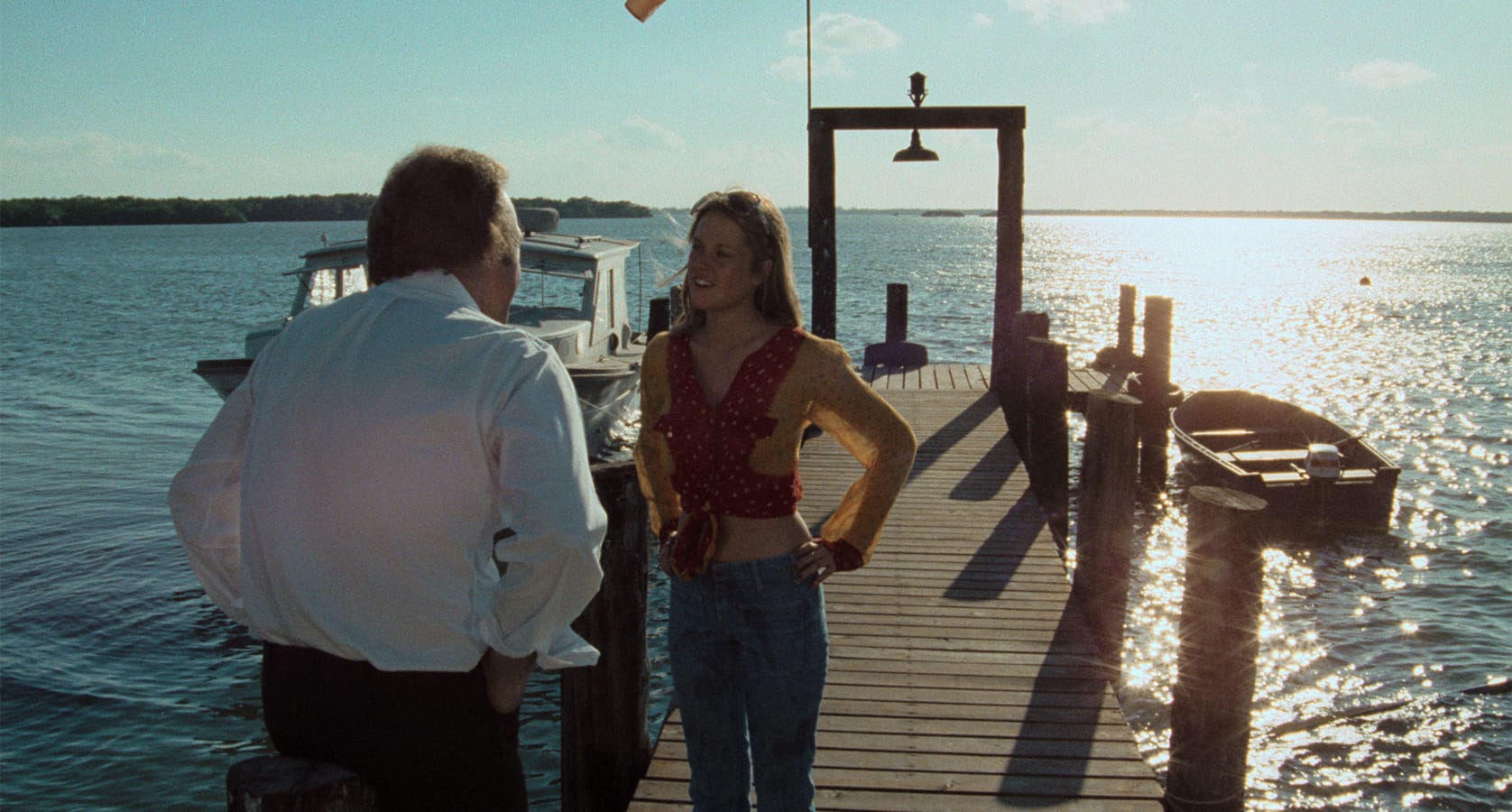
While they’re all out together on an evening boat ride, Delly sees a decaying corpse of a pilot in a crashed plane underwater that freaks her out. That night, Harry and Paula get hot and heavy in a scene where Paula acts as a femme fatale, distracting Harry from any further attention to the crash site.
Although Paula’s performance, as Kirshner notes, appeared much more intense in the rough cut, Penn decided to considerably edit the passionate sex/dialogue between Paula and Harry due to his concern that it would dilute the power of Harry and Ellen’s marriage scenes. The subtext, however, remains in that Harry and Paula’s conversing intimately about their past lives relates to a troubling national past: JFK and RFK’s assassinations as an ultimate betrayal hang over Paula’s own “night moves” (Bob Seger’s song of the same title, an ode to teenage fumbling in the dark, would be released a year later).
As Delly is more than ready to leave, Harry brings her back to LA. The moment that she arrives at her mother’s house, we see, with Harry, that her family situation is no better than the one in the Keys. Harry has reached a psychic breaking point, compelling him to consider what Ellen wants him to do, and what accelerated the argument in the first scene from their marriage: give up his relative independence and join Nick’s agency.
While working as a stuntperson, Delly dies during a botched car chase. Joey, who drove the car, gets banged up. Harry watches the blurred, inconclusive footage (with an obvious reference to the Zapruder film of JFK’s assassination). Joey looks on, pained, his arm and shoulder in a cast. What he says, “Look, Harry, I did it,” can be taken in multiple ways, but Harry feels guilty too. Having had the best intentions in bringing Delly back, he sets into motion her demise. Thus contextualized with the Watergate scandal (Nixon went down more for the cover up than the crime), “best intentions” become a damning historical shorthand for how the country got into such a mess – and any way out will require some much tougher decisions, telegraphing the endgame of Night Moves.
Harry revisits Arlene, setting the stage for some of Hackman’s most indelible acting. Arlene attempts a verbal knockout punch, referring to Delly, “By the time I was her age, I’d been on my knees to half the men in this town;” Harry looks downward. What Hackman does here is to let this woman’s words sink in, and recognize her perspective, realizing how damned painful it would be to really try and understand her life. Then his anger returns, and he looks back up at her as a person no longer of interest in the case.
Before Harry’s return trip to Florida – Ellen’s goodbye at the airport as the second scene from their marriage – he confides in Joey. He tells him that what Delly saw underwater would be the needed evidence to bust the smuggling operation involving, you guessed it, those statues. Harry thinks that whoever arranged for the stunt-car accident is in the Keys. But Joey now has the incentive, if he just so happened to be one of the people implicated (and, it turns out, the dead pilot worked for him and had been seeing both Delly and her mother), to execute a murderous cover-up scheme.
Any viewing of Night Moves will culminate in a list of what Harry doesn’t or can’t see, including the details of Joey’s scheme. If Harry, upon his rearrival in the Keys, has the physical prowess to outlast Tom in a bloody brawl, he fails at getting Paula to explain herself. More bluntly than Ellen put it (“I know what you didn’t mean”), Paula says, “You’re asking the wrong questions,” thus amping up the paranoia to lethal levels.
Which makes it all the more evident, with the Criterion release, that Night Moves is a crucial 1970s conduit between political-conspiracy films, such as The Parallax View (1974) – the boat where the closing action of Night Moves takes place is called Point of View – and a triptych of PI films that offers a contemporary look at the American past, focusing on rapacious development (both historically and metaphorically), racism, and exploitation. In the period romance Chinatown (1974) the hero plays a stunned witness to the making of modern LA as a murderous confidence game concerning water rights. The heroes of The Long Goodbye (1973) and The Late Show (1977) are principally defined by their antiquated views of honor and loyalty.
Harry may, at times, exhibit his predecessors’ discretion; for example, he doesn’t take the bait of Ellen’s lover’s wisecrack about Sam Spade. But he ultimately represents how the gruff directness of the 1970s Hollywood PI – when Tom tries to excuse his treatment of Delly: “There oughta be a law,” Harry replies, “There is” – conflicts with a new cultural sensibility preferring to talk, analyze, or feel one’s way out of a mess, rather than to take action. As Night Moves foretells what Jimmy Carter, who had to clean up the toxic waste spill of Nixon’s pardon by Gerald Ford (also a former football player), would call a “malaise” shadowing the national mood, the film is a powerful reflection of this sensibility that has seldom since emerged in American cinema.
Great stuff here, this is so bleak and despairing even for the 70s. And I think Sharp outdoes Chandler here, the opaqucity of the script can ultimately be tracked as opposed to The Big Sleep, and as you note the mystery develops in a way Chandler’s do not, lower players make desperate decisions that shift the story. Hackman ultimately is one of those lowest players and his getting played is an indictment of his loser mentality, articulated in that famous football quote. He winds up with neither money nor nobility, not a husband or a surrogate father, just a guy bereft and adrift because he couldn’t see what was there and was comfortable circling the drain.
To sum up Night Moves, I’m reminded of one of the bleakest songs, “Tired Eyes,” off of Neil Young’s epic downer album Tonight’s the Night, released in the same year: ““He tried to do his best but he could not.”
An excellent appreciation of an incredible film. I was already in the mood to rewatch this–both in general and in honor of Hackman specifically–and this really sealed the deal. I’m fascinated by that sense of the ’70s reappraising male cinematic archetypes in an era that saw their appeal but could not believe in them in the same way.
When Hackman’s PI character confronts his wife’s lover, you really see the reappraisal of “male cinematic archetypes.”
I’m waiting with bated breath for your appraisal.
A question that I’ve pondered over is how popular this era’s reappraisal of male cinematic archetypes was, and if it registered as powerfully with mainstream audiences conducive to the frequency of its appearance. There does seem to be a correlation between the tenor of these types of films and the way that the media painted the mood of the era, but the observations of the news media (and the critics) may not have been in synch with what movie audiences were paying to see , as evidenced by the fact that many of these films weren’t exactly big hits, and more romantic yarns of male adventure began reviving the box office by the 70s end. I wonder how the overall decline of the film industry in its corporate structure and economic volatility (and the end of the Hays code) played a role in allowing a different kind of writer or director to have access to the Dream Factory for a time beginning in the late sixties, before the blockbuster formula was re-established and the re-integration of the components of exhibition (via home video and subscription cable) began closing the door.
That’s a really interesting question. Our picture of the cinematic “mood” of the decade tends to come from the acclaimed films that have lasted, but of course, as you say, that doesn’t necessarily mean they struck a universal–or even popular–chord at the time. I certainly think you’re right that the brief opening-up of the production side of things made for a more interesting dreamscape; wish we hadn’t (mostly) lost that.
I’m always intrigued by this too. There was that awful profile of a terrible critic I won’t name that said she was the only one who thought long-shot Titanic would win the Oscar, and like, lol. LMAO. But I wasn’t paying attention to film discourse in the 1970s, and we don’t have the Internet to give us the same idea of what the vibes were. What people seek out in media and what ends up resonating is often different, too.
Good writeup; I’ve never seen this and clearly need to.
Based on discussions I had in 1998 with a couple of Academy members I knew TITANIC seemed like a shoe-in. For films like NIGHT MOVES, I recall (yes, I am that old) that the reviews were pretty mixed, but it did receive more critical attention due to the fact that the New Hollywood films, and the critics, were more or less on the same page as far as the potential for movies comments on society.