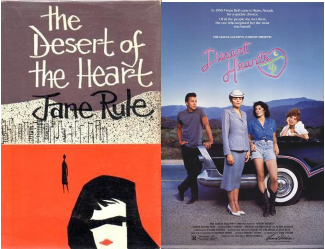
Reno is, as the book Desert of the Heart makes clear, a town that exists despite nature if anything. In the time of this story, it was the refuge for mostly women from around the country trying to get divorces. Women were generally considered more able to pick up and move to Nevada for six weeks to take advantage of those laws. The history of divorce in the US is long and complicated, but at the time, Reno was considered the divorce capital of the world. Reno had gambling, divorce and marriage, so it didn’t matter that there was no living to be wrung from the land.
In the book, Evelyn Hall is an English professor at the University of California. Sixteen years earlier, before George Hall went away to World War II, they married. When he returned, it seems likely he had PTSD. But it wasn’t diagnosed; he just slowly dissolves into himself. He is now institutionalized, and the doctors tell Evelyn that a divorce will help him. She goes to Reno and stays in the boarding house of Frances Packer. Frances has a son, Walter, and a quasi-stepdaughter, Ann Childs, and she takes in women waiting out their six weeks and serves as their witness to promise they have never left the state.
Unfortunately, Evelyn is left with nothing to do. The library is very small and charges a deposit for every book checked out, so it’s hard to do her work. She befriends, or is befriended by, Ann, who is a cartoonist and a “change apron” at a casino. (It is called “Frank’s Club” and is a fictionalized version of the real-life Harold’s Club.) Ann is also a sexually liberated woman, who has had relationships with both men and women. She has recently broken up with her boss, Bill, and has occasional sex with her best friend, Silver, who is getting married to Joe. However, her determination not to fall in love is broken as she and Evelyn become entwined.
In the movie, Vivian Bell (Helen Shaver) is a professor at Columbia University. We know very little about her marriage. She goes to Reno and stays at the Ranch of Frances Parker (Audra Lindley). Frances lives with her son, Walter (Alex McArthur), and her quasi-stepdaughter, Cay Rivvers (Patricia Charbonneau), and she takes in women waiting out their six weeks and serves as their witness to promise they have never left the state. Cay has recently broken up with her boss, Darrel (Dean Butler), and her best friend, Silver (Andra Akers), is getting married to Joe (Antony Ponzini).
So yeah, mostly the same story. A few differences. Book-Ann is more explicitly bisexual than Movie-Cay, We get a lot more of Evelyn’s inner life. In both versions, Frances had been married to Walter’s father and was the lover of Ann/Cay’s father. She loved him, but marriage simply didn’t happen. Her relationship with Ann/Cay is somewhat complicated by it. She doesn’t feel like a parent even though she served as one, and since her lover is now dead, her quasi-stepdaughter doesn’t have any parents available.
Ann has scars from slit wrists, which appears to have been from a death pact with her father.
Actually we get quite a lot of information between the lines about Ann’s father. Ann has scars from slit wrists, which appears to have been from a death pact with her father. He apparently never stopped looking for Ann’s mother who walked out on them to go off with a lover, and Frances was barely a consideration for him. Walter doesn’t seem to have any longing for him, but Ann’s life is shaped by her father unto who and how she loves or doesn’t.
Donna Deitch’s goal in directing the movie, she said, was to have a movie where two women have a romance that doesn’t end in heteronormativity or suicide. Which, you know, wouldn’t that be nice. Both women have had at least one sexual relationship with a man. Evelyn is described as having a relationship with a woman during the War that became sexual, and both Ann and Cay are well known for relationships with women. There’s underlying Freudianism to the book, but be fair—it’s from 1964. Of course it’s Freudian. And it’s never implied that she is wrong to fall in love with Evelyn, just to try not to do anything about it.
Of course, book and movie both talk a lot about the potential fallout in Evelyn/Vivian’s life if she were to be in a relationship with Ann/Cay. It’s one thing for Ann/Cay, who in the book at least is independently wealthy from inheritance from her father, to swan about the desert outside Reno having as many lovers as she wants of whatever kind she wants. But Evelyn/Vivian lives in the conventional world. Ann attended Mills College (no longer extant but real; a friend from high school dropped out of it as well) and the University of Nevada and is a smart woman who could have been in that world if she’d wanted. But Evelyn/Vivian is new to Ann/Cay’s world, and what can she do there?
What both works do well is establish the conflicting world of Reno. The stark beauty of the desert. The sad, pained world of the women seeking divorces. The loud, frantic world of the casinos. There is both loveliness and ugliness to Reno. What Evelyn/Vivian and Ann/Cay must do is decide whether they are choosing loveliness or ugliness in their own lives, and they must do that in a world that sees the loveliness of their relationship as ugliness. It’s a fascinating study.
Next month, we go from stark desert beauty hearts to bonkers New Orleans neo-noir hearts with Angel Heart.