Hidden Figures reminds us that the freedoms we have today were not always there. For some people in our country, I am sorry to say, their freedoms are being stripped by our government. Diversity Equity and Inclusion, the very things that this movie stands for, are being challenged in our world today. Sometimes a woman is the best person for the role, sometimes a Filipino is the best person for the role, sometimes a Black American is the best person for the role. The job needs to be filled by the accomplishments and education of the person filling it. Katherine Gobel Johnson (Taraji P. Henson), Mary Jackson (Janelle Monáe), and Dorothy Vaughn (Octavia Spencer) show us that in Hidden Figures.
The movie takes place between 1961 and 1962, during the space race. Right away, we see how the fact that these women work for NASA gives them certain courtesies that may not have been given to others. Americans seem to bind together in our fear of anything unknown or other. This is definitely seen as the color of our main characters’ skin is dismissed due to the bigger issue of Russia spying on us with Sputnik. Tensions are high as Dr. Martin Luther King is leading the fight for civil rights in segregated Hampton, Virginia.
Dorothy Vaughn has been doing the role of a supervisor for a year without the pay or benefits that go with that role. Vivian Mitchell (Kirsten Dunst) insists that, while Dorothy is doing a good job, NASA is not able to promote her at this time. Now, it is possible that Vivian would’ve fought harder if a team of white ladies were left in the same lurch. Throughout the movie, it is clear that Vivian is unaware of her own racist tendencies. Like many women doing more work than they should without the pay or title to go with it, this frustrates Dorothy to no end. On her way to deliver some numbers to Vivian (do they even say which computing group had worked on the numbers, and if they do why do they still need to be handed to a white woman before they can go to the person who really needs them?), Dorothy notices the IBM getting built. With what Vivian tells Dorothy, she is able to deduce that they will all be out of jobs soon. Dorothy goes to the library to find a solution. When the colored section does not have the book she needs she goes to the white section. A white librarian tells Dorothy that they don’t want trouble in the library. Dorothy explains she just needs a book.
Librarian: They have books in the colored section.
Dororthy: It doesn’t have what I’m looking for.
Librarian: Well, that’s just the way it is.
So, in a marvelous although risky move, Dorothy takes a book on FORTRAN computer language. When her boys question her, she lets them know that her taxes help pay for all the books. She can’t steal something she already paid for. She then shares that book with all the other women in the West Computing Group. This ends up being brilliant, as Bill Calhoun (Scott Michael Morgan) and the other NASA workers hired to work with the IBM cannot get it to work properly. Dorothy is able to come in, move one cord, and get the machine to work. It is unclear how many days that Dorothy works on the IBM and learns its specific instructions before she fixes it. When Calhoun catches her in the IBM room, he is initially frustrated, insisting that it is a delicate piece of equipment. Then, Bill’s IBM tech (Chris Cavalier) lets him know that the machine they’ve been fighting with is finally working. Time passes again as Al Harrison checks in with the IBM team just to learn that the machine is not reaching its full potential still. Bill lets Al know that he needs more people.
Vivian brings the reassignment to Dorothy to move the IBM team. Dorothy pushes and asks about the others of the West Computing Group. Vivian admits that after the launch the computing groups are being dissolved. Dorothy stands up for her people and says she will not go without them. Not only does she need them to program the IBM properly but they are all trained and ready to go. She wins; the entire West Computing Group gets reassigned to the IBM!
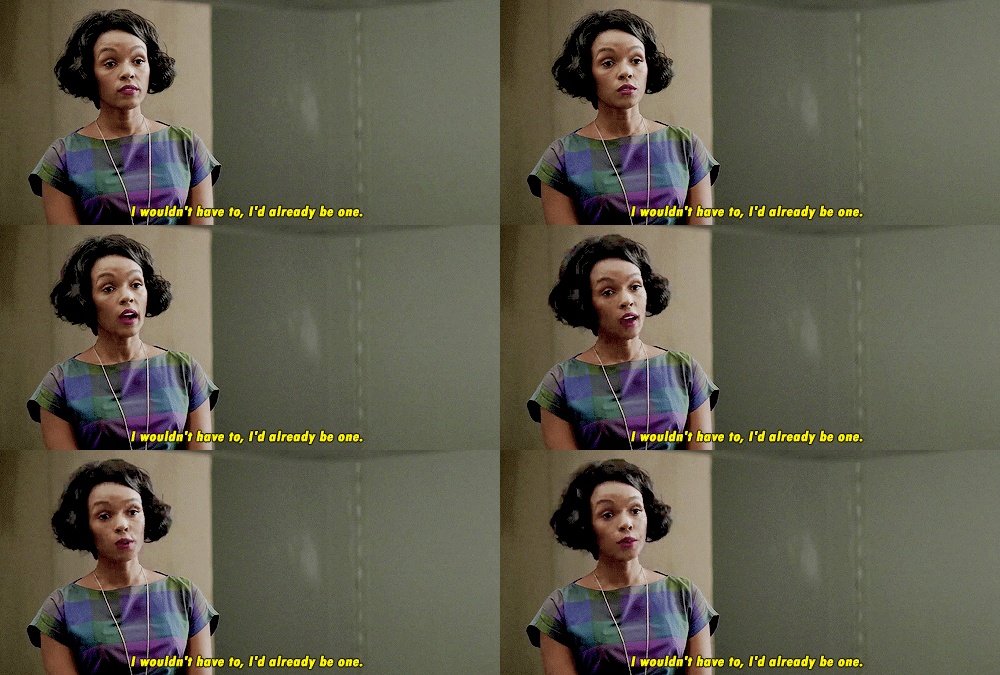
Mary Jackson wants to be an engineer. In one of the movie’s examples of a white ally, Karl Zielinski (Olek Krupa) tells Mary that she should apply for the engineering training program opening that they have in his department. As a Polish Jew whose family was killed in a Nazi prison camp, he empathizes with Mary’s concerns about being dismissed before being given a fair shot at the position. In a beautiful quote, Karl asks Mary,
“Let me ask you, if you were a white male, would you wish to be an engineer?” Mary responds with, “I wouldn’t have to. I’d already be one.”
When Mary talks to her husband, Levi (Aldis Hodge), about applying for the engineer position, he is skeptical, harsh, and I think in all honesty afraid. Afraid of what his wife making waves could do for them. His quote of “Civil rights ain’t always civil” Is proven true throughout history. Even though Dr. Martin Luther King Jr. organized peaceful protests, the people who participated in them were met with violence. They were beaten, arrested, and killed trying to create a world where people are judged by the content of their character and not their outward appearance; be that appearance color, disability, or sex. Mary applies for the position, and Vivian tells her that NASA doesn’t commission female engineers. Mary protests, insisting that her Bachelors degrees in Mathematics and Physical Sciences is the same as most of the Engineering department. In a handbook addendum—I would love to know when that addendum was written—it says that they now require additional classes, further making Mary unqualified. The college is too far away, but the local high school offers extension courses. The bigger problem? Both locations only allow white people to attend. Mary applies to the court for an exception. Having to be an engineer as well as her own lawyer Mary researches the judge who is to hear her case. She finds out that he has been a leader in several fields for his family and for his profession.
“Your Honor, out of all the cases that you’re gonna hear today, which one is gonna matter a hundred years from now? Which one is gonna make you the first?”
Mary Jackson (Janelle Monáe)
The first night she is to attend her night classes, her husband gifts her some mechanical pencils. He reassures her that he knows the great work she will accomplish.
“And nobody dare stand in the way of Mary Jackson’s dreams. Myself included.”
This goes a long way to redeeming this character for me. After his hesitation, be it justifiable of not, I wondered if Mary had married a person who didn’t understand who she was. This scene repairs that.
Katherine is one of those once-in-a-lifetime mathematicians. She understands numbers in a way few people do. When she first enters the Space Task Group, she is mistaken for a custodian. Her abilities are questioned. Even though she is the only person who has been able to keep up with the math, it takes weeks before Al Harrison (Kevin Costner) realizes she doesn’t have easy access to a bathroom (the nearest one is half a mile away and she must wear heels to adhere to the dress code. I would have blisters!), costing them valuable time. This lack of knowledge and awareness speaks to the white privilege that Al has been able to enjoy. He has a bathroom in the same building he works in. His white secretary Ruth (Kimberly Quinn) has a bathroom in the same building. Katherine’s first day in the office, she asks where she can use the restroom, and Ruth tells her she doesn’t know where a restroom for her would be. Clearly Ruth didn’t pass that on to Mr. Harrison! Further, Al learns that his team of supposed geniuses are putting wedges in their team structure by continuing segregation in their work space even though he (Al Harrison) has made it clear Katherine is part of the team. This is most clearly seen in how they get her a separate coffee pot with separate coffee grounds after her first day. I have never heard a more thorough dressing down than when Al Harrison moves to the coffee station and removes the colored label from that heinous coffee pot they’ve been making Katherine use in total silence. He then fixes the whole team with a look and goes to his office. I have no doubt in my mind that every man in that room knew they had done wrong that day. Even this, though, shows privilege. He had been getting his own coffee right next to that separate coffee pot for Katherine for who knows how long. Definitely weeks at this point, possibly months. He himself had never noticed the difference in the coffee station, since it didn’t affect him directly until his best mathematician was affected.
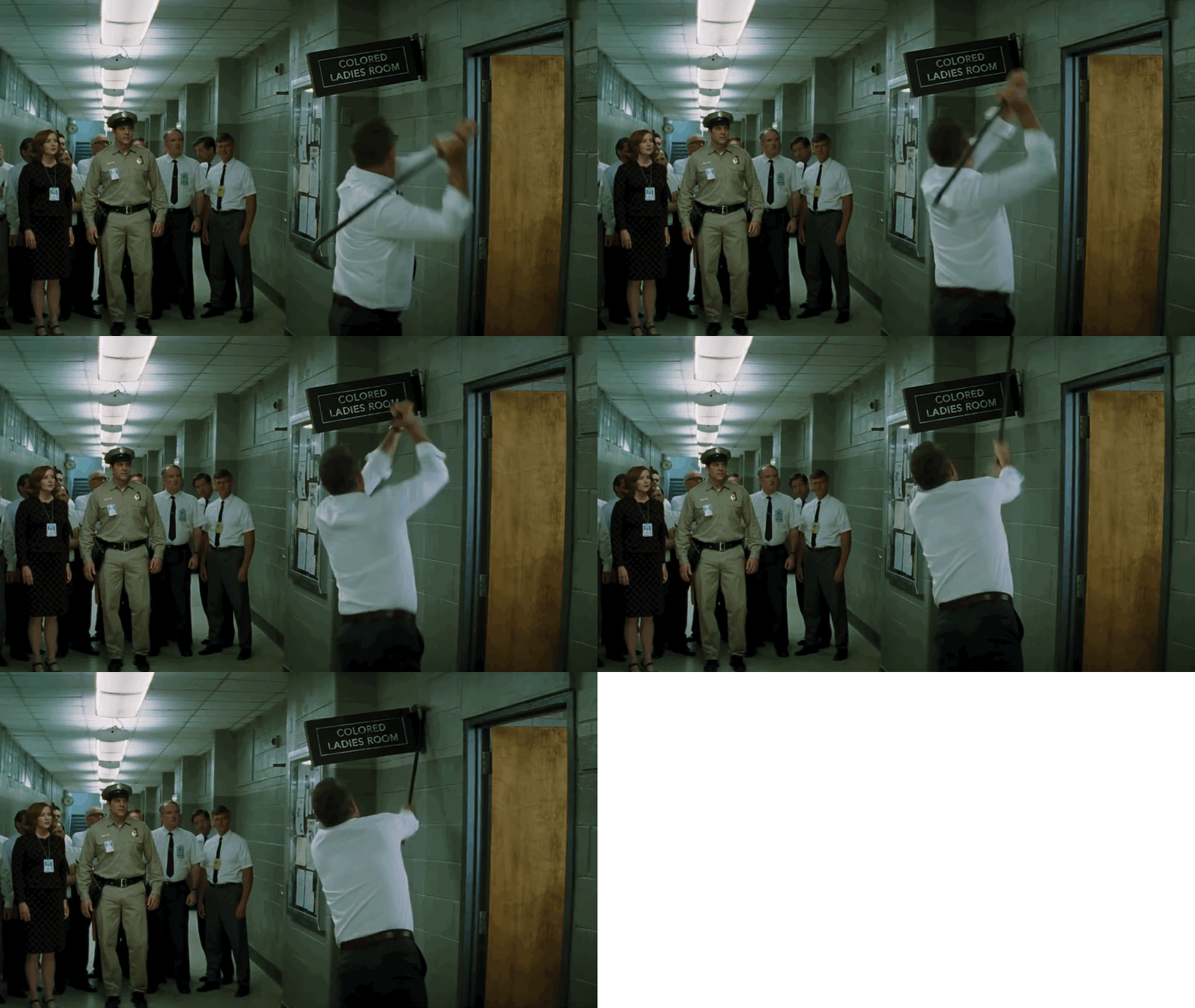
I don’t think I have ever been so happy to hear bathroom talk as when Al Harrison removes the sign for the colored ladies room, encouraging everyone to use a bathroom closest to their work station and says,
“Here at NASA, we all pee the same color.”
Al Harrison (Kevin Costner)
One of the beautiful things in this movie is the way Al Harrison paves the way. He doesn’t dismiss Katherine because she is a female; most of the workers in the computing groups are females! He doesn’t dismiss her because she is black. He leads by example, showing everyone that she is to be treated the same way everyone else on the team is treated. He gently guides (when he should probably outright order) Paul Stafford (Jim Parsons) to behave the same way, fighting back against his misogynoir tendencies with this speech:
“You know what your job is, Paul? To find the genius among those geniuses. To pull us all up. We all get to the peak together or we don’t get there at all.”
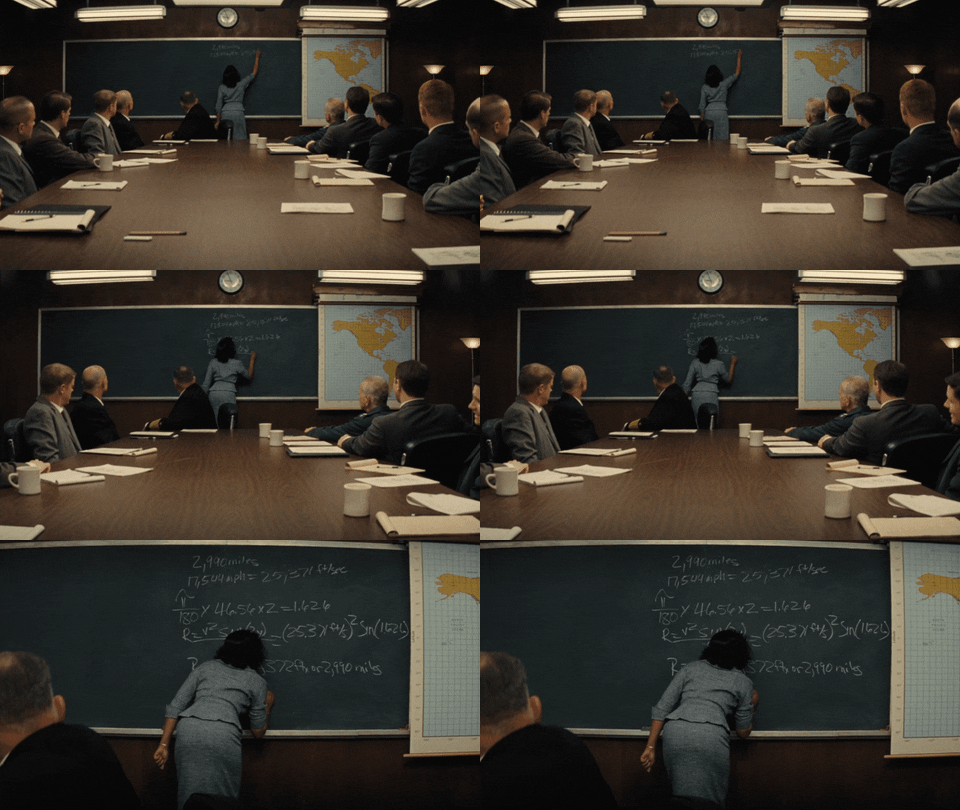
While his way makes for a slower resolution to the animosity between Paul Stafford and Katherine, it may be the better way. There is less resentment by the end of the film that Katherine is there to make sure that everyone in the Space Task Group looks good. And that Friendship 7 comes home safe. Another ally shown is John Glenn[1]. Throughout the movie, John Glenn is shown to be more concerned about making it to space and back to Earth safely than about who was doing the math. This is seen when he shakes hands with everyone present at Langley. It is seen when he watches Katherine do the math in real time in a behind-closed-doors Pentagon meeting that Al Harrison gets her into. Al Harrison immediately sees a way to help Paul and everyone in that room see how valuable Katherine is when they ask for numbers.
After Katherine does that math in front of everyone, John Glenn says, “I like her numbers.”
Once the IBM was up and working properly, NASA decided that Katherine, the only remaining worker of the now abandoned West Computing Group, needed to be let go. Out of an entire room of mathematicians and physical scientists, the only person we see let go is Katherine. Al Harrison does express regret at the actions being taken. In the common it’s not me it’s the institution he says, “It’s out of my hands, if you can believe that.” As a parting gift, they give her a wedding present of a string of pearls.
As Friendship 7 was experiencing difficulty with the go-no-go numbers prior to launch, John Glenn did ask for Katherine specifically[2]. “I mean, she says they’re good, I’m ready to go.” Al Harrison tracks her down and has her run the numbers. I don’t know what he did behind the scenes to have a clearance badge ready for her, but after Sam runs into the room, leaving Katherine on the wrong side, she waits. She waits longer than I likely would’ve, but Al Harrison opens that door and hands her a badge, bringing her back into the Space Task Group! Katherine continued her work with NASA, working on Apollo II as well as other missions.
These women did so much for NASA. Katherine Gobel Johnson was even given the Presidential Medal of Freedom. In the words of President Barack Obama[3],
“In her 33 years at NASA, Katherine was a pioneer who broke the barriers of race and gender, showing generations of young people that everyone can excel in math and science, and reach for the stars.”
President Barack Obama
In America today, we are on a precipice. We need to decide if we value Liberty and Freedom for all, or if we value only the freedoms that money can buy you. We are once again at a point in our history where we need to decide between doing what is safe and what is right. I hope that America continues to reach for the stars and rights our course before we lose all that we have become.
I’m not such a huge fan of this movie, but I thought the performances were great, especially Janelle Monae who wasn’t previously an actress.