When I think of Jules Feiffer, I always think of Tock the Watchdog.
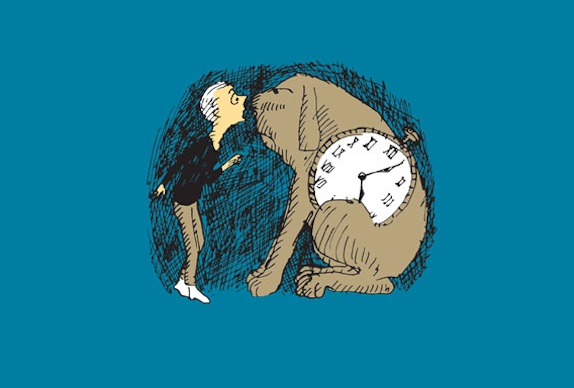
Like many kids of my generation, my first introduction to Feiffer was The Phantom Tollbooth, a children’s novel written by Feiffer’s then-roommate Norton Juster (an architect who was avoiding the book he’d actually received a contract to write). Lots of books get new illustrations over the years, but Feiffer’s sketchy drawings are as essential to the work as all the book’s puns and wordplay.
Feiffer made himself essential for most of his career. As a sixteen-year-old (maybe a seventeen-year-old, I’ve seen both), he begged legendary cartoonist Will Eisner for work, and while Eisner wasn’t particularly impressed with his drawing talent, he found enough odd jobs to keep the kid around. Fieffer got better at drawing (or Eisner got used to him) and Eisner discovered Feiffer’s gift for “writing characters that lived and breathed.” They collaborated on The Spirit for ten years, until Feiffer’s desire to comment on the world around him won out, and he started cartooning for the Village Voice. The Voice originally paid in exposure, but Feiffer parlayed his column into more success, including freelance sales to other outlets and national syndication in 1959. Feiffer would keep his column for the Voice for 41 years. When they dropped him, he created a monthly op-ed cartoon for The New York Times, which ran from 1997-2000. By then he was 71.
He published collections of his comics, graphic novels, children’s books, adult novels, and an autobiography in 2010. (He claimed he would have done more children’s books if he hadn’t encountered Maurice Sendak’s incredible talent.) He taught at several colleges. He wrote musicals, screenplays (including Robert Altman’s Popeye), plays, plays that got adapted into movies, and won an Oscar in 1961 for his animated short Munro, about a four-year-old boy who is drafted into the Army.
And the damn thing is, he was good at it all; in addition to that Oscar, he won two Obies and a Pulitzer. Maybe he wasn’t Maurice Sendak good at children’s illustrations, or Will Eisner good at superheroes, but still damn good, and no one made a political point like he did.
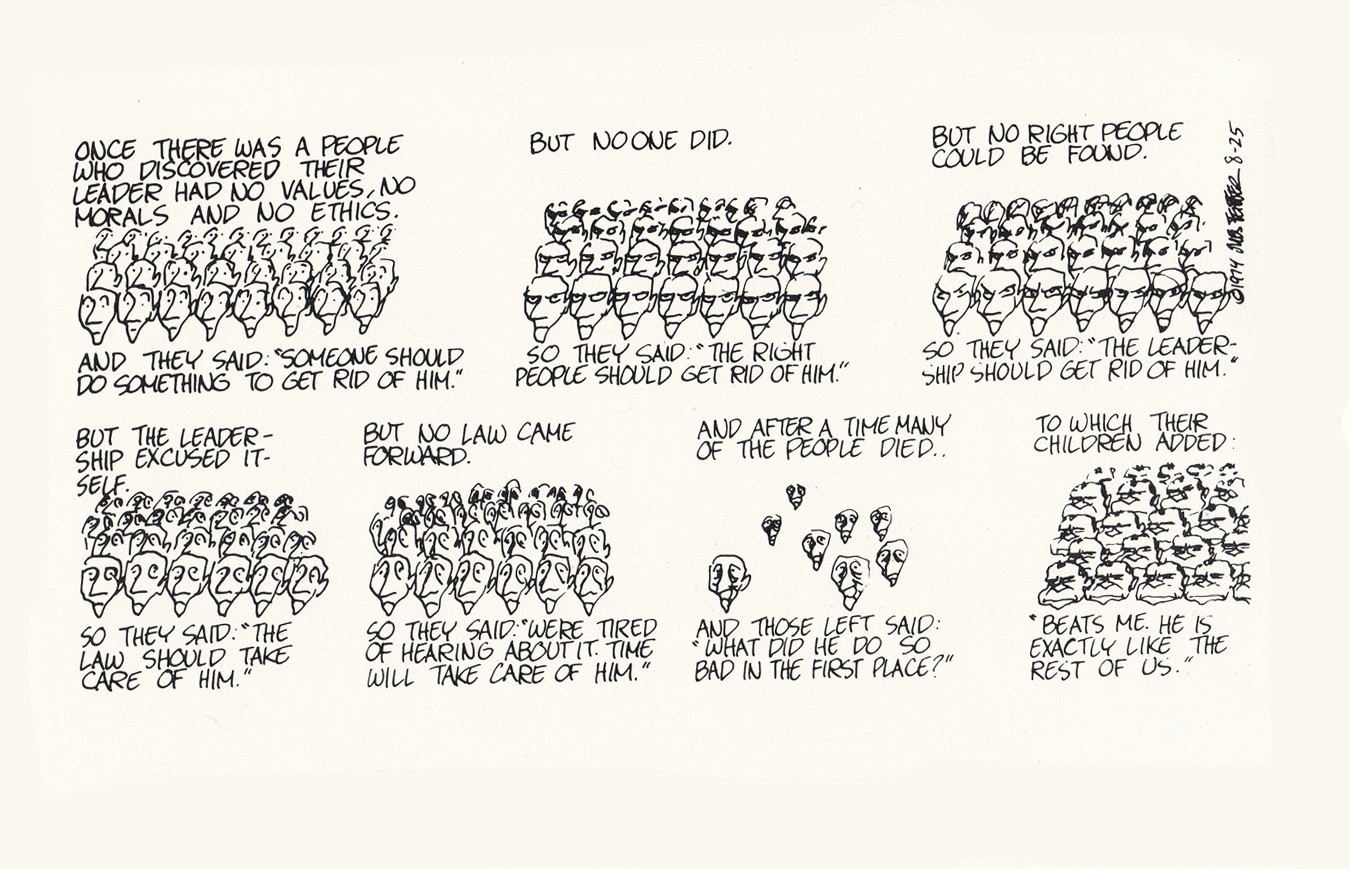
He said in interviews that one of the reasons he started making political cartoons was that he was angry and frustrated at, in his words, “the height of a form of domestic suppression” where conservative voices dominated. He lived to see the Civil Rights Act, the Voting Rights Act, gay marriage and the election of the country’s first Black President, as well as watching a man who promised to roll all that back get elected, twice. I don’t know what that means, other than that nothing ever really ends.
Fortunately, neither will the work of Jules Feiffer.
I couldn’t begin to span the man’s whole career, so let me recommend:
A lovely interview for the publication of his graphic novel Kill My Mother ten years ago.
The Paris Review on The Phantom Tollbooth at fifty.
A very long interview at The Comics Journal.
And from just this December, a graphic tribute at The Nation.
One of the legends for sure. We have sitting on our coffee table a copy of the first of a series of volumes from Fantagraphics collecting his Voice strip. Alas, it’s also the last in the series as there was a dispute of some sort with Feiffer’s representatives, but this book is full of wit, charm, anger, and of course grace.
He also wrote The Great Comic Book Heroes in the 60s, the first work to take those heroes seriously. A footnote but an important one for comics fans.
I really could have written something four times as long and have still missed so much. (The drama around comics publishing, I swear.)
The Comics Journal interview i linked is long but well worth it!
See below! Kill Bill uses his whole argument about Superman verbatim.
Wow, I had no idea he’d died. I read so many of his books, including The Man In The Glass Ceiling, and somehow I got a copy of The Great Comic Book Heroes and went through that one over and over. (Very useful book for getting into early superhero comics, and this is how I learned the first Wonder Woman comics were pervy and wonderfully weird – but same with the first Superman.) Brilliant guy.