Steamboat Bill Jr is a treasure trove of a bygone era. There is the relationship between a father and son. A relationship between a father and daughter. A new romance. Buster Keaton didn’t only star in this film he also created all the stunts, co-directed, and helped write the screenplay! Buster Keaton was able to take his vaudeville upbringing and bring it to the camera in a unique way. All stunts were stunts like they would be done in vaudeville with no camera trickery involved. In fact during one scene in a theatre Buster Keaton shows how a magic trick is done using a cleverly placed mirror.
Willie Canfield Jr (Buster Keaton) is the son of William “Steamboat Bill” Canfield (Ernest Torrence). He has been raised by his mother while his father ran a paddle steamer, the Stonewall Jackson. Upon his graduation from college, he looked his father up, likely for a job. William has fallen on hard times as his Stonewall Jackson isn’t as pretty as the brand-new steamer that J.J. King (Tom McGuire) has brought to town. J.J.’s daughter Kitty (Marion Byron) is returning from college at the same time. There is a bit of homophobia as William reacts to meeting his son for the first time. The way he acts isn’t how William thinks he should act, the way he dresses isn’t in line with a worker (more in line with a preppy college student), and he has the nerve to play the ukulele. It quickly becomes known that Willie and Kitty know each other from college and would like to start a romance that both fathers disapprove of. Let the hilarity ensue.
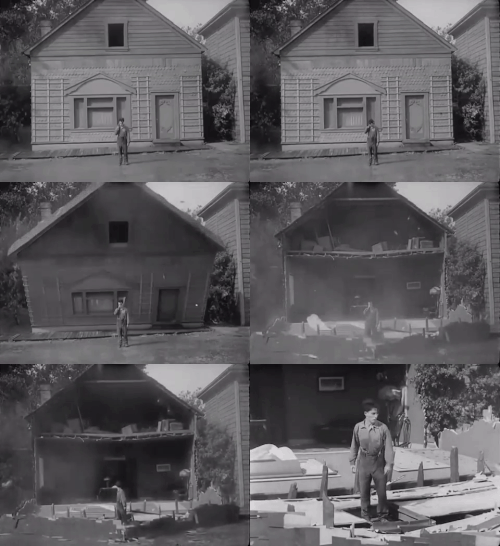
While the love story in this movie is simple, some of the troubles that Willie must overcome are far from it. His father gets arrested after a dust up with J.J. King and Willie tries to break him out. Instead he ends up in the hospital, and must face a hurricane while also saving everyone important to him and to Kitty. A stunt that was added is easily Buster Keaton’s most recognizable stunt, where the front of a house falls down during that hurricane scene and Buster Keaton is standing right where a window is saving his life. It is said that this stunt was added after his brother-in-law called to inform him that Buster Keaton Studios would be no more. That he would be going to work for Metro-Goldwyn-Mayer and that he would have no more creative autonomy. This theory seems to be supported by Buster Keaton himself who said, “I was mad at the time, or I would never have done the thing.” The point which Keaton was supposed to be standing was marked with a nail and Keaton said they had given themselves 2 inches of wiggle room in every direction. This being done with a two-ton building façade that easily could’ve killed him if he had missed his mark. The hurricane scene had 6 jet plane engines going to create the strong wind and the sets were falling apart around Keaton. He could’ve just as easily been hit by flying debris and been injured.
One of the things I enjoyed about this love story was the way that they portrayed Kitty pursuing Willie and Willie not noticing. She is seen following behind him at one point and you can see the debate going on within her. Do I approach him and try to understand what is going on, do I obey my father and leave him alone. The way Keaton filmed this in one shot allowed for these feeling to be conveyed.
A great tragedy of this film is that the role of Sheriff is uncredited. I had a large amount of joy in the entire jailhouse interaction and watched it through several times! I found the sheriff able to portray a lot with the silent film and the way he and Buster Keaton played off each other was fabulous. I sincerely hope that you take the time to look up this movie and watch it for yourselves.
I think this was the largest version of the house-facade stunt he did right? And like some people refused to be on set because they thought he was going to die?
I’ve looked into it before and not been able to find any thing about Keaton’s politics. It’s interesting how much “Lost Cause” romanticism was infused into early hollywood (at this point, most of the western U.S. is only a generation removed from the so-called “wild west” era). If I were a film historian, or just someone who lived in LA and could afford to spend a year digging through archives, I’d write a book examining this. If such book exists I’d read it.
Something I read about The General – one of a very few essays that takes it to task for its Lost Cause-ism – noted that the book the film is based on is about a Northern engineer facing South interference! But the assumption in the film industry at that time was that audiences would either believe that anyone from the Union was competent or heroic. So yes, incredibly pervasive.
Just incredibly pervasive, even though a significant majority of the country lived in states that fought for the Union.
I wonder how much of it was the success of birth of a nation versus the ex-confederate past of many wild west icons versus an intentionally political project.
I intuitively get the intrinsic romance of the losing side of a war, but I don’t necessarily get why a bunch of hollywood actors in a union state, many of whom are from north cities or are more recent emigres from Europe, would all identify with it. Would northerners not care if a movie had a confederate protagonist but southerners would?
I’ve read Dana Stevens’ book on Keaton and I think her conclusion is he didn’t have particularly strong political leanings, he was a showman first and foremost and otherwise a product of his times (he didn’t do a lot of blackface or other racial humor, but he wasn’t against doing it, most egregiously in College). In interviews he explains making the protagonist of The General a Southern soldier is because he wanted him to be the underdog, which I think is indicative of his sanitized view of the whole thing.
Several books are available as well as an amazing essay. Here is the link to the essay. https://www.nybooks.com/articles/2022/10/20/keep-your-eye-on-the-kid-buster-keaton/
This is an interview done with the author of the essay. https://youtu.be/q3cacN4U-54?si=g6OPS_HhRAL0LrZW
After watching a Buster Keaton movie, as I did frequently with my kids over the last couple years, they would demand to rewind to their favorite part, and it’s instructive that they didn’t choose the windstorm (which is what I chose, just to marvel at the effects) but the breakout scene in the jail. They howled loudest at his extended nonchalant pantomime of the breakout plan, which is what makes him an all-time master, able to pull off these small bits and then some of wildest stunts you’ve ever seen. Great write-up!